In these fascinating times, where conversations about permanent moon bases, colonizing Mars, and the rapid adoption of artificial intelligence are becoming everyday topics, it’s hard not to get a bit more philosophical. With the global race between companies and nations to develop artificial general intelligence and accelerating breakthroughs in quantum computing, it feels like we are living on the edge of something transformative.
Lately, all of this has reminded me of watching The Twilight Zone with my mom growing up. It’s funny how those episodes stick with you in a way most other TV shows don’t. One episode came to mind: the classic “To Serve Man.” Like many Twilight Zone titles, it carries a clever double meaning.
The episode centers on a seemingly benevolent alien race, the Kanamits, who arrive on Earth offering guidance and advanced technology. They quickly help humanity eliminate war, hunger, and poverty, ushering into an era of peace and prosperity. Naturally, people begin to trust them. During this time, a government cryptographer is tasked with translating a mysterious book left behind by the aliens. Though initially suspicious, he gradually lowers his guard as the aliens appear to deliver everything they promise.
Eventually, he deciphers the title of the book, To Serve Man, which seems to confirm the aliens’ goodwill. But as he prepares to travel to the Kanamits’ home planet, an opportunity many begin to see as a privilege, his assistant continues working on the full translation. In one of the most memorable twists in television history, she discovers the truth and desperately tries to stop him, shouting that the book is not a guide to helping humanity, it is a cookbook. By then, it is too late, he has already boarded the ship. The episode sticks with you because it highlights how easily optimism and technological promises can dull skepticism, something that feels especially relevant today.
From that reflection came an urge to revisit a classic piece of science fiction. I picked up Childhood’s End by Arthur C. Clarke, one of the great minds in the genre and the same author behind 2001: A Space Odyssey. Something about the premise felt aligned with the Twilight Zone episode I had been thinking about, that same tension between progress, trust, and the unknown.
A friend had recommended the book to me a long time ago, and for whatever reason it stuck in the back of my mind. Truthfully, I have not read much fiction in years, so picking it up felt like a bit of a departure from my usual routine. But it turned out to be a welcome one. There is something refreshing about stepping outside of facts, markets, and day-to-day responsibilities and immersing yourself in a story that asks deeper questions about humanity’s future.
Clarke’s writing immediately struck me as both imaginative and grounded. What surprised me most was how relevant it feels even today. The ideas he explores, written decades ago, do not feel outdated or distant. If anything, they feel increasingly plausible. That is always the fascinating thing about older science fiction. The best of it does not just imagine technology, it anticipates the moral, social, and philosophical dilemmas that come with it. In some ways, it feels less like fiction and more like an early interpretation of a future we are slowly moving toward.
Even the experience of finding the book felt a bit symbolic. It was tucked away on a shelf in the bookstore, and as it turned out, it was the only copy they had. There was something oddly fitting about that, almost like it was waiting to be rediscovered at the right time. In a world where everything is instant and algorithmically served to us, stumbling across something like that feels rare and a little more meaningful.
As I started reading, I could not shake the parallels forming between Clarke’s vision and the themes from To Serve Man. Both explore the idea of a more advanced intelligence arriving with promises of progress and improvement, and both force you to wrestle with a fundamental question: when something appears to solve all of humanity’s problems, how quickly should we trust it, and at what cost?
Getting into the book, my goal here is to highlight a few key ideas without spoiling the experience. Clarke doesn’t anchor the story to a single character. Instead, he moves across different people and time periods as the Overlords reshape Earth. That choice works. It gives the novel a sweeping, almost generational feel, like you’re watching history unfold rather than following a single storyline.
Early on, we’re introduced to Stormgren, the one man permitted to deal directly with the Overlords. He communicates with Karellen, the “Supervisor of Earth,” but always through a barrier, never face to face. Even when he’s brought aboard their ship, Karellen remains hidden. There’s authority there, but also distance, and Clarke leans into that tension.
By this point, the Overlords have been on Earth long enough to establish order. Life is improving in measurable ways, but not everyone is at ease. A religious movement, the Freedom League, begins pushing back, pressing Stormgren to force the Overlords into the open. Their concern cuts to the core: if something holds that much power and refuses to be seen, what exactly are we trusting?
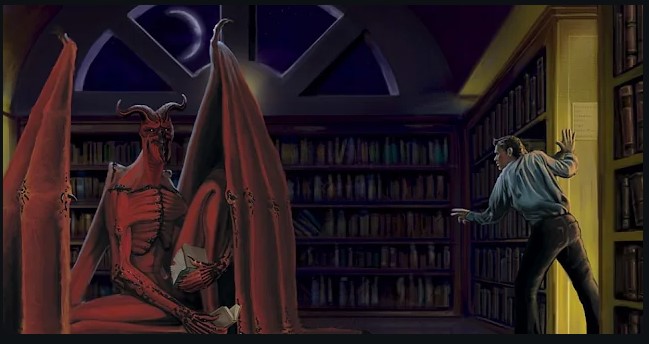
When Clarke finally reveals the Overlords, the shock isn’t that they’re monstrous, it’s that they’re familiar. They resemble the classic image of medieval devils. Tall, dark, with leathery wings, horns, and barbed tails, the kind of figure pulled straight out of old religious art and mythology. It’s not subtle. The physical form humanity has long associated with demons is, in this case, real.
That reveal lands on multiple levels. On the surface, it explains the secrecy. Karellen’s decision to remain hidden early on suddenly makes sense. Humanity wasn’t ready to take guidance, let alone authority, from something that looks like its oldest and most deeply rooted fear.
But Clarke pushes it further. The resemblance isn’t coincidence, at least not in the way you’d expect. It raises a much bigger question: why would humanity’s myths so closely mirror a real, physical species it had never encountered? It flips the usual perspective. Instead of imagining the devil based on fear of the unknown, it suggests that perhaps that image was never entirely imagined at all. That somewhere, buried deep in human consciousness, there was always a shadow of something real.
And that realization ties directly into one of the book’s central ideas. The Overlords may look like something out of humanity’s darkest stories, but they aren’t villains in the traditional sense. If anything, they’re intermediaries, part of a much larger process that humanity doesn’t yet understand. It’s one of Clarke’s strongest moves. He takes an image loaded with centuries of religious meaning and turns it into something both unsettling and strangely logical.
From there, the story subtly shifts. One of the more memorable sequences comes at a party hosted by Rupert Boyce, a collector fascinated with the paranormal. On the surface, it feels almost ordinary, but Clarke uses it to introduce a new cast of characters and quietly expand the scope of the story.
We meet George and Jean Greggson, a young couple representing a kind of stability in this new world, along with Jan Rodricks, who immediately stands apart. Jan is restless, curious, and not entirely content with the answers humanity has been given. While others seem willing to accept the Overlords’ order, he’s still looking beyond it.
The real tension builds in the library. Boyce has assembled a collection tied to psychic phenomena, and as the group debates their meaning, the dynamic shifts with the presence of an Overlord, Rashaverak, quietly observing. Up to this point, the Overlords have largely operated from a distance, so placing one of them in this intimate setting changes the tone. They’re not just governing from above, they’re studying, listening, engaging.
Then Clarke slips in a moment that feels almost incidental but ends up carrying real weight. During a game involving star maps and celestial coordinates, Jean begins to respond in a way that doesn’t feel entirely her own. Janet, watching it unfold, becomes overwhelmed and faints. In the confusion, a specific star system is identified, almost casually, but with just enough precision to stand out. That detail sticks with Jan.
It’s not presented as some dramatic revelation, just a fragment that doesn’t quite fit. But for someone already inclined to question, it’s enough. That single moment plants the seed that sends him down a very different path, one that shifts the story outward, away from Earth and toward the question that’s been lingering beneath everything: not just what the Overlords are doing, but where they come from.
It’s a quiet turning point. Even in a world that has been stabilized, almost perfected on the surface, curiosity hasn’t disappeared. If anything, it’s intensified. And through Jan, you start to feel that the real story is no longer just about humanity under the Overlords, but what lies beyond them. Jan’s path ultimately leads him further than anyone else in the story, beyond speculation and into experience.
What begins as curiosity, sparked in small moments like the party, turns into something much more deliberate. He pieces together enough to take a risk, secretly positioning himself to travel with the Overlords as they return to their home world. It’s a bold move, and in a book full of passive acceptance, it stands out. Jan isn’t content to live under their order. He wants to understand it.
His journey doesn’t deliver the kind of payoff you might expect. Clarke doesn’t present the Overlord world as some grand, fully revealed civilization. Instead, it feels distant, almost inaccessible, even when you’re there. Jan is physically closer than any human has ever been but still separated in a fundamental way. That distance matters. It reinforces the idea that even at our closest point of contact, there are limits to what humanity can grasp. The Overlords are not equals, and they’re not meant to be fully understood.
What Jan does gain isn’t complete knowledge, but perspective. He comes to see that the Overlords themselves are part of something larger, something they serve but don’t control. It shifts the entire frame of the story. The question is no longer just who the Overlords are, but what stands above them. It’s a quiet, almost isolating experience, but it pays off thematically. Jan sets out looking for answers and instead finds scale.
As the story moves toward its conclusion, Clarke shifts the setting to New Athens, a place that represents humanity’s last attempt to preserve its identity. It’s intentionally removed, almost frozen in time, focused on art, culture, and the idea of what it means to still be human in a world that’s rapidly moving beyond it.
George and Jean Greggson are at the center of this phase, and through them, Clarke brings the story down from the abstract to something deeply personal. Their children, particularly Jeffrey and Jennifer Anne, are no longer fully part of the world their parents understand. What began earlier as subtle, almost unexplainable moments has now become undeniable. The children are changing in ways that feel less like growth and more like transformation.
That’s where the tension really settles in. The Overlords didn’t come to rule humanity in the way people initially feared. They came to guide it to an endpoint. And in New Athens, you see the cost of that more clearly than anywhere else. The adults cling to culture, individuality, and meaning as they’ve always known it, while their children move toward something entirely different, something collective and unknowable.
George’s perspective grounds it. He isn’t reacting as a philosopher or politician, but as a father watching his children slip out of reach. That’s what gives the ending its weight. It’s not just about evolution or transcendence in some abstract sense. It’s about loss. Clarke leaves you with a difficult question. If humanity’s next step means leaving behind everything that defines it, was the journey upward, or simply away?
Stepping back from the book, it’s hard not to connect Clarke’s vision to the moment we’re living in now. When we talk about artificial intelligence, quantum computing, or even becoming a multi-planet species, the conversation almost always centers on progress. Faster, smarter, more efficient. We rarely stop to ask the harder question underneath it all: progress toward what?
That’s what stuck with me after finishing Childhood’s End. Clarke doesn’t argue against advancement. In many ways, the world he presents is objectively better, more stable, more unified, free from many of the problems we still wrestle with today. But he also forces you to confront the possibility that solving humanity’s problems might not preserve humanity itself.
That tension is what makes the story linger. It’s not fear in the traditional sense. It’s something quieter and more unsettling. The idea that growth, taken to its furthest extent, may carry a cost we don’t fully understand when we begin the journey.
Reading it over the span of just a few days, I found myself coming back to the same thought again and again: how quickly would we accept a better world if it meant surrendering control, or even identity, in ways we couldn’t fully comprehend? Clarke doesn’t hand you answers. He just widens the lens.
And maybe that’s the real value of a book like this, especially right now. In a time where innovation is accelerating and the future feels closer than ever, it’s a reminder to not just be impressed by what’s possible, but to stay curious, and even a little cautious, about where it leads. Because the question isn’t just how far we can go. It’s whether we’ll still recognize ourselves when we get there.
Like the appearance of the Overlords, buried deep within human consciousness, not something drawn from the past, but a shadow cast forward from the future, it makes you pause. For centuries, humanity painted the same image. Horns. Wings. Something powerful, watchful, and not entirely aligned with us. Clarke flips that idea on its head. What if those images weren’t rooted solely in fear or imagination, but in something glimpsed just beyond our understanding? Not a memory, but a premonition.
It’s hard not to draw a parallel to the way we’ve portrayed artificial intelligence. For decades, long before the technology had any real footing, we imagined thinking machines that would surpass us, guide us, replace us, or judge us. We told those stories over and over again, across books and films, as if we were trying to work something out in advance. Now we’re living in the early stages of that reality.
So it raises a question that feels a little uncomfortable the longer you sit with it. Are those portrayals just fiction shaped by our fears and creativity, or are they, in some strange way, echoes of a direction we’re already headed? A kind of subconscious anticipation of what comes next?
That’s where the line starts to blur. Clarke’s vision suggests that humanity doesn’t always understand its role in the larger trajectory of intelligence. That what we build, or what we become, may not be an extension of who we are, but a transition beyond it. And maybe that’s the unsettling part.
Because if our stories have been quietly circling the same idea all along, if we’ve been imagining versions of the future that consistently point to something greater, and less human, then the question isn’t just whether those futures are possible. It’s whether we’ve been preparing ourselves for them without even realizing it. Or, like something out of The Twilight Zone, whether we’ve been trying to warn ourselves the whole time?
Written by Michael McPhail
Childhood’s End: A Novel (Del Rey Impact): Arthur C. Clarke: 9780345444059: Amazon.com: Books

