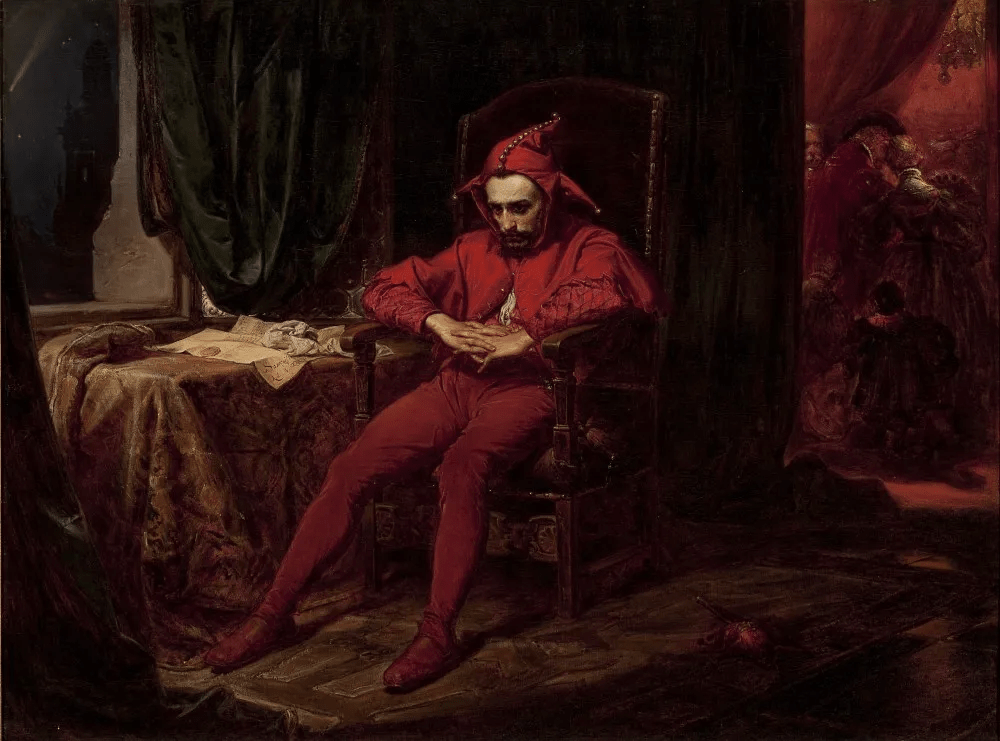
For our 100th post on Brains and Brawn, I want to highlight an individual I once idolized– the Underground Man. I was first introduced to this man in the 1864 novella by Fyodor Dostoevsky – Notes from the Underground, or Letters from the Underworld. I have since encountered him in various portrayals of the misunderstood anti-hero that is so endemic in media today. Notes from the Underground names its anonymous narrator the Underground Man [whom we will subsequently refer to as UM], a retired civil servant living in St. Petersburg, Russia. For years, I had framed the UM in my mind as a heroic rebel in pursuit of authenticity against a deterministic world. A reading in my third decade has given me a decidedly different perspective.
Notes from the Underground is divided into two parts: Underground and Apropos of the Wet Snow. Part I, Underground, is largely full of the UM’s philosophical reflections and theorizing. He sees the trajectory that Russia is on toward utopian socialism and rational materialism and offers his unsolicited critiques. Principally, he objects to the undisputed notion that the removal of pain and suffering will usher in a true age of human utopia.
For the UM, both pain and suffering are necessary prerequisites for human happiness as they offer the contrast that make their opposite states possible. He famously opens the work by saying, “I am a sick man… I am a wicked man. An unattractive man”. In these lines he attempts to peremptorily excuse himself for all the intellectual condescension and simultaneous self-loathing that is to come. The UM feels trapped in a hyper-rational society in which there is a presumption that everyone will act in their own best self-interest. While this seems self-evident to us, it was a repulsive imposition upon the UM, and he laments “to be overly conscious is a sickness.”
The UM would go so far as to suggest that the only way to express and validate an individual existence in a hyper-rational society is to do something highly irrational and antagonistic toward themselves. He provides a personal example of this in Part II in flamboyant fashion. Meanwhile, he bemoans that his own intelligent self-awareness is for him a crippling disability that does not allow him to experience societally approved means of success. He looks at businessmen, entrepreneurs, and civil servants who have bought in to the dream of a rational, profitable, and comfortable life and cynically becrys that he cannot do the same himself. “It is impossible for an intelligent man to become anything, only fools become something.”
Part II, Apropos of the Wet Snow, is a narration in which the UM puts his personal philosophy into practice. The first section relates a story of a police officer who insulted him in a pub. The UM passes by the officer frequently, though the officer does not recognize him or much less acknowledge his existence. The UM dwells on a plan for revenge. Comically, the UM borrows money and buys an expensive coat and then bumps into the officer to assert his equality. The officer does not even notice that anything happened.
In a later story, the UM recounts a group of old school friends and in particular Zverkov who is soon to leave the city. The UM begrudged this group of friends when he was younger, but he decides to attend the going away part of Zverkov nonetheless. The friends did not tell him that the time of the party had been changed, and he feels foolish for arriving so unfashionably early. He drinks to pass the time, and when they arrive, he lets them know exactly how he feels about this snub. Like the police officer in the earlier story, they seem to not care or even acknowledge the slight, and he decides to continue drinking heavily and pace in the same room as them while verbalizing his disdain. This behavior is cringe-worthy and almost infantile – but the UM persists and comments, “the pleasure lay precisely in the vivid consciousness of one’s own humiliation”. So long as he was able to maintain his own free will against the societal behavioral norms that were built against him, he felt empowered to continue his erratic behavior.
After a while, the group departs for a brothel and leaves him. Naturally, he pursues them in search of vindication. He does not find Zverkov or the others at the brothel, but he does encounter a prostitute named Liza whose saga comprises the rest of the story. The UM takes it upon himself to lecture Liza on the ultimate futility of prostitution and her inescapable disposal by society when she outlives her youth. He challenges her to rise above the predetermined facts of her life into a world in which she is the arbiter of her own existence. This address from the UM ignites Liza, and she finds herself enthralled and even indebted to him for this epiphany. He gives her his apartment address prior to departing the brothel.
The UM then abhors what he has done in giving her his address, primarily out of fear that she will come to his shabby apartment and see him as an unsuccessful fraud. Only minutes before her arrival, he is arguing with his landlord over his delinquent rent payment. When she arrives, he reneges on his prior apparent affection for her. He now states that rather than trying to help her he was just ridiculing her and wanted to point out how miserable and inevitable her position in life is.
As horrible a thing as this is to do to someone, he then swings in his affectation and begins crying. The UM reveals that he was only trying to dominate and humiliate her. He heaps an abundant amount of self-loathing and criticism onto himself and excuses his behavior by claiming he was simply embarrassed for her to see that reality of his own poverty and think less of him for it. Liza, in gracious and compassionate fashion, embraces him as he sobs.
Any rational story would end here in triumph, but remember that this story is anti-rational. The UM allows himself to be consoled for a time and then cries out in protest. He heaps unimaginable insults onto Liza and then demands that she leave his apartment. As a punctuation mark, he places a five ruble note into her hand, which is an insinuation that after all their breaking down of emotional boundaries he still views her as a base prostitute. Liza storms out.
The emotional swings do not stop there. The UM soon regrets his rash actions and rushes outside after her, to no avail. To his devastation, he never hears from her again. He offers himself a delusional comfort that she will be better off for the insult and that it will cleanse and elevate her in future relationships. He admits a true sadness at the self-sabotage that cost him the propect of a stable life with the potential for a loving relationship. He is unhappy, but he has maintained his sincerity, and this gives him supposed superiority over those phony individuals who assimilate into the actions that are expected of them. In his own words, “I have merely carried to an extreme in my life what you have not dared to carry even halfway.”
I stood dumbfounded at the end of this exchange with Liza and at how idiotic and self-destructive the whole enterprise truly was. In the end, the UM prioritized his own freedom to choose above all else. “Man needs only independent wanting, whatever the cost and whatever it may lead.” True freedom is breaking away from all restrictions and proscriptions even when [perhaps especially when] it is not beneficial or even harmful for one to do so. The ultimate outcome of the decision is not important so long as it was able to be made with total and transparent individual freedom.
What is the cost of such prerogative independence? For the UM, it was humiliation, isolation, loneliness, and utter lack of bourgeois comforts. He wore these as a badge of honor and the price to pay for the authentic. To the policeman, to Zverkov, and to Liza he states defiantly: “I am not going to bow and scrape before you. I have the underground.” He can escape vulnerability indefinitely and live a bitter, solitary, and reclusive life in which he is bound to no one.
Ultimately, the underground man is incapable of love – and it is for this that I pity him. There is a certain romanticism that I prescribed to him in an earlier decade. He was the untouchable intellectual who truly perceives the world while the mob drowns itself in the pursuit of trinkets. The UM sadly admits – “For me, love was a struggle that started from hatred and ended with moral subjugation.” Liza loves the UM, and yet, the UM is incapable of love and feels humiliated by his incapability which leads to his need to dominate and humiliate her in turn. While the UM fancies himself a romantic, he is afraid of its power. He crawls back to his books and his true life is revealed as inauthentic.
Notes from the Underground is such a beautiful and formative novella because it demonstrates how both rational egoism and romanticism are both deleterious to free will. The balance lies somewhere in between, in an elusive union between traversing the expected and well-trodden road and asserting one’s unique preferences in the absence of external validation.
Contributing largely philosophical entries to a book blog has often gravitated me towards romanticism, and yet the pursuit of knowledge must never propel me into an introverted regression toward the underground. Rather than “bow and scrape”, I must strive to “serve, humble, and love”. There is an immense, guilty pleasure in thinking that come what may, “I always have the underground”. While maintaining the sacredness of the underground as a place to recharge and rejuvenate the mind and the soul, we cannot stay there. I have come to understand that love is found in vulnerability. For his incapability to do so, the UM is someone who warrants pity rather than admiration.
Written by Cal Wilkerson
 Brains and Brawn