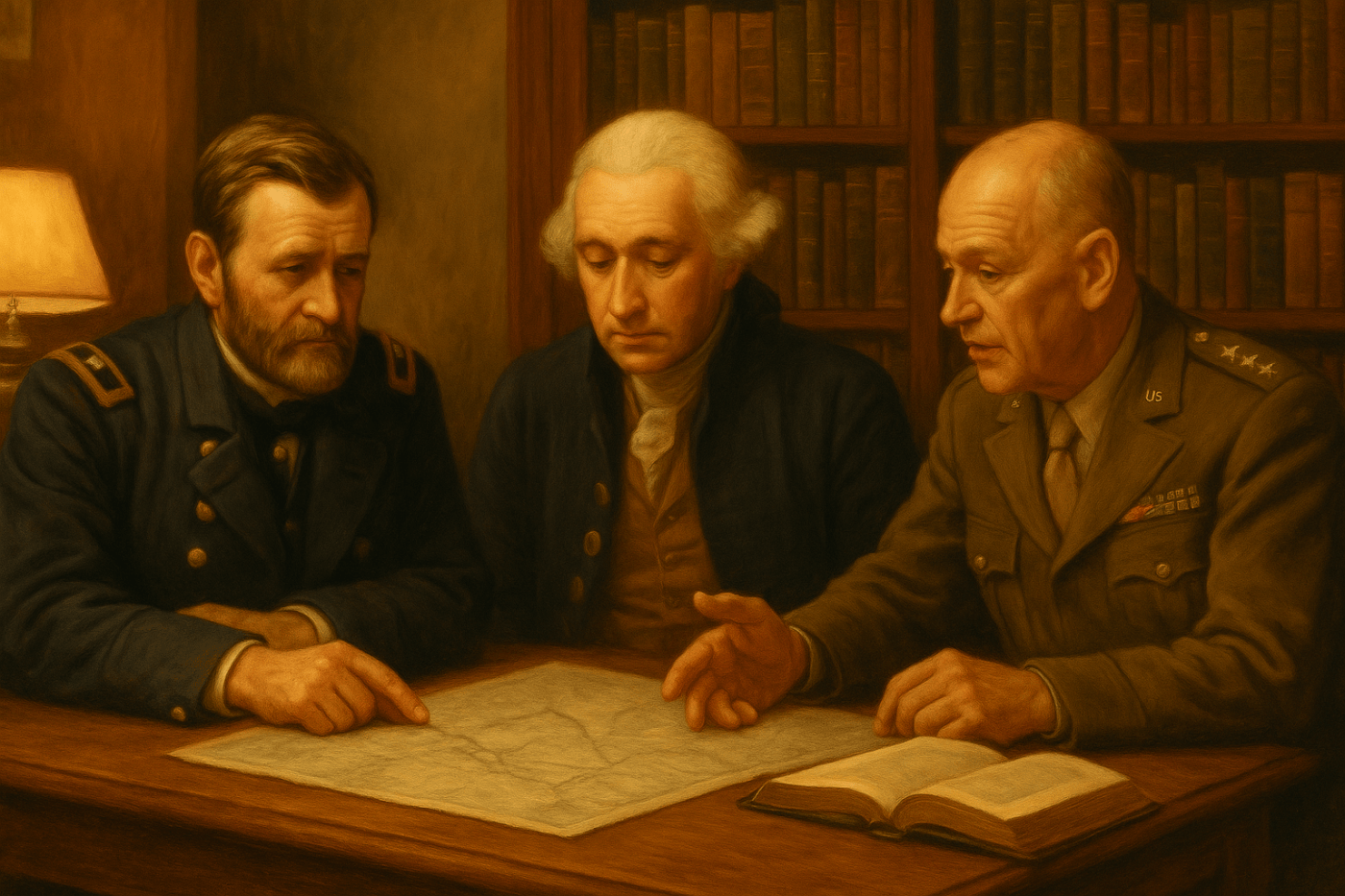
Not sure where to start? We’ve created a set of curated reading plans to help guide your journey. Each plan is built around a central theme — from war and leadership to philosophy, fiction, and spiritual reflection — based on the books we’ve covered and those that have shaped us behind the scenes.
Some of these titles are featured in posts, others are part of our personal shelves. All have been read by our contributors and selected for one reason: they push you to think deeper, live better, and become the kind of man who doesn’t settle for surface-level living.
Whether you’re new to serious reading or looking to build a deeper library, these plans are designed to give you structure without rigidity — a trail, not a syllabus.
American Revolution History:
- Common Sense by Thomas Paine
- Start here to understand the radical ideological spark that made revolution inevitable.
- The pamphlet that electrified colonial America and framed independence in simple, moral terms.
- Start here to understand the radical ideological spark that made revolution inevitable.
- The Crisis by Thomas Paine
- Written during the darkest days of the war, these essays offered clarity and courage.
- “These are the times that try men’s souls…” remains one of the most iconic opening lines in American writing.
- Written during the darkest days of the war, these essays offered clarity and courage.
- The Autobiography of Benjamin Franklin
- Read early to understand the values, mindset, and habits that shaped early American identity.
- A personal and witty window into the life and philosophy of a foundational American figure.
- Read early to understand the values, mindset, and habits that shaped early American identity.
- Benjamin Franklin: An American Life by Walter Isaacson
- Best read after Franklin’s own autobiography for a fuller, more balanced picture.
- Isaacson captures Franklin’s genius, contradictions, diplomacy, and relentless curiosity.
- Best read after Franklin’s own autobiography for a fuller, more balanced picture.
- 1776 by David McCullough
- An ideal narrative introduction to the early campaigns of the war.
- A vivid, humanizing account of George Washington and the desperate first year of the Revolution.
- An ideal narrative introduction to the early campaigns of the war.
- Washington by Ron Chernow
- Read after 1776 to track Washington’s growth from general to unifying president.
- A powerful and detailed biography of America’s most indispensable man.
- Read after 1776 to track Washington’s growth from general to unifying president.
- The British Are Coming by Rick Atkinson
- Start this after you’ve grounded yourself in Washington’s story.
- A brilliant narrative of the early war years, weaving battlefield drama with personal detail.
- Start this after you’ve grounded yourself in Washington’s story.
- Bunker Hill: A City, a Siege, a Revolution by Nathaniel Philbrick
- A focused, ground-level look at Boston on the brink of war.
- Philbrick brings emotional tension and rich characters to the events that lit the fuse.
- A focused, ground-level look at Boston on the brink of war.
- Washington’s Immortals by Patrick K. O’Donnell
- A gritty, infantry-level view of Revolutionary courage.
- Follows a Maryland regiment from desperate skirmishes to defining moments in the war.
- A gritty, infantry-level view of Revolutionary courage.
- Valiant Ambition by Nathaniel Philbrick
- Focuses on the unraveling relationship between George Washington and Benedict Arnold.
- A compelling moral study in loyalty, ego, and ambition at the war’s turning point.
- Focuses on the unraveling relationship between George Washington and Benedict Arnold.
- In the Hurricane’s Eye by Nathaniel Philbrick
- Closes out Philbrick’s trilogy with the underappreciated naval campaigns.
- Captures the critical role of the French navy and Washington’s strategic genius.
- Closes out Philbrick’s trilogy with the underappreciated naval campaigns.
- Washington’s Spies by Alexander Rose
- Read this after the major campaigns to understand the war’s secret side.
- A true account of the Culper Ring, espionage, and the quiet war that helped win the larger one.
- Read this after the major campaigns to understand the war’s secret side.
- The Glorious Cause by Robert Middlekauff
- Best read once you’ve built narrative and biographical context — this ties it all together.
- A scholarly but readable synthesis of the Revolution from start to finish.
- Best read once you’ve built narrative and biographical context — this ties it all together.
- John Adams by David McCullough
- A deeply human, balanced portrait of a brilliant and difficult man.
- Shows the Revolution from the political, diplomatic, and personal side of one of its fiercest patriots.
- A deeply human, balanced portrait of a brilliant and difficult man.
- Alexander Hamilton by Ron Chernow
- Pairs well late in the plan as a look at how revolutionary ideals evolved into national policy.
- Hamilton’s story, from orphan to founding architect, brims with relevance.
- Pairs well late in the plan as a look at how revolutionary ideals evolved into national policy.
- Thomas Jefferson: The Art of Power by Jon Meacham
- Finishing here allows you to wrestle with the philosophical promise and moral paradox of the Revolution.
- A nuanced look at America’s most eloquent and contradictory founder.
- Finishing here allows you to wrestle with the philosophical promise and moral paradox of the Revolution.
- This Fierce People by Alan Pell Crawford
- Challenges and completes the narrative with intellectual honesty.
- A sobering epilogue on how self-interest, power, and idealism coexisted among the founders.
- Challenges and completes the narrative with intellectual honesty.
American Civil War History:
- Battle Cry of Freedom: The Civil War Era by James McPherson
- Start here for context, chronology, and foundational understanding.
- A single-volume masterpiece that provides a sweeping, balanced overview of the causes, politics, and military action of the war.
- Start here for context, chronology, and foundational understanding.
- The American Heritage Picture History of the Civil War by Bruce Catton
- A great companion read alongside McPherson for orientation and inspiration.
- A richly illustrated narrative that makes the Civil War come alive visually and emotionally.
- A great companion read alongside McPherson for orientation and inspiration.
- The Civil War: A Narrative by Shelby Foote (3 Volumes)
- Spanning over a million words, this is the core of your longform Civil War journey.
- A deeply literary, panoramic epic of the entire war from a Southern leaning but even-handed storyteller.
- Spanning over a million words, this is the core of your longform Civil War journey.
- Gods and Generals by Jeff Shaara
- A fictionalized but historically grounded prequel to Gettysburg, focusing on the moral and strategic complexities of Lee, Jackson, Chamberlain, and Hancock.
- The Killer Angels by Michael Shaara
- Essential for understanding the human toll and decisions of Gettysburg.
- The Pulitzer Prize-winning novel of the Battle of Gettysburg — an emotionally intense, humanizing look at command, courage, and fate.
- Essential for understanding the human toll and decisions of Gettysburg.
- The Last Full Measure by Jeff Shaara
- The concluding volume of the Shaara trilogy, capturing the last brutal years of the war and the psychological wear on its commanders.
- Memoirs of U.S. Grant
- Start your primary source study here — Grant’s honesty and clarity reveal the soul of the Union war effort.
- Lucid, unsentimental, and one of the finest memoirs ever written by an American.
- Start your primary source study here — Grant’s honesty and clarity reveal the soul of the Union war effort.
- Memoirs of W.T. Sherman
- Paired with Grant’s memoirs, this gives you a full picture of the Western Theater mindset.
- Bold, strategic, and unapologetic, Sherman recounts his role in reshaping modern warfare.
- Paired with Grant’s memoirs, this gives you a full picture of the Western Theater mindset.
- Vicksburg: Grant’s Campaign That Broke the Confederacy by Donald L. Miller
- Best read after Grant and Sherman’s memoirs for added perspective.
- A vivid military history of the pivotal Vicksburg campaign, emphasizing leadership, logistics, and turning points.
- Best read after Grant and Sherman’s memoirs for added perspective.
- Lee’s Lieutenants: A Study in Command by Douglas S. Freeman
- Perfect for those ready to deep dive into strategy, personalities, and organizational complexity.
- A dense but rewarding multi-volume analysis of Confederate high command.
- Perfect for those ready to deep dive into strategy, personalities, and organizational complexity.
- Rebel Yell: The Violence, Passion, and Redemption of Stonewall Jackson by S.C. Gwynne
- Gwynne makes Stonewall’s life philosophically and tactically compelling, even to skeptics.
- A gripping, nuanced portrait of one of the most enigmatic figures of the war.
- Gwynne makes Stonewall’s life philosophically and tactically compelling, even to skeptics.
- Grant by Ron Chernow
- Recommended after his memoirs for deeper personal and political understanding.
- A sweeping, sympathetic biography that places Grant’s wartime genius in context with his flawed, fascinating humanity.
- Recommended after his memoirs for deeper personal and political understanding.
- Team of Rivals: The Political Genius of Abraham Lincoln by Doris Kearns Goodwin
- Pivotal for understanding the Union cause at the highest level.
- An essential biography of Lincoln through the lens of leadership, collaboration, and moral clarity.
- Pivotal for understanding the Union cause at the highest level.
- War on the Waters: The Union and Confederate Navies, 1861–1865 by James McPherson
- An underrated but essential angle on the Civil War — naval strategy, innovation, and its critical role in Union victory.
- Black Flag: Guerrilla Warfare on the Western Border by Thomas Goodrich
- Best for advanced readers interested in the war’s ugliest truths.
- Brutal, dark, and raw — a haunting look at irregular warfare and the moral gray zones of the war’s fringes.
- Best for advanced readers interested in the war’s ugliest truths.
- On Great Fields: The Life and Unlikely Heroism of Joshua Lawrence Chamberlain by Ronald C. White
- A fitting capstone to the plan — reminding us what true leadership and integrity look like.
- An inspiring, well-researched account of the professor-turned-soldier who embodied courage, humility, and resilience.
- A fitting capstone to the plan — reminding us what true leadership and integrity look like.
World War II History:
- An Army at Dawn by Rick Atkinson
- Start here to enter the war through the North African campaign — where American soldiers first faced real combat.
- A fresh, vivid look at inexperienced troops becoming hardened veterans.
- Start here to enter the war through the North African campaign — where American soldiers first faced real combat.
- The Day of Battle by Rick Atkinson
- The Allied slog through Sicily and Italy, marked by brutal terrain and shifting leadership.
- Highlights the complexity and chaos of the Mediterranean front.
- The Allied slog through Sicily and Italy, marked by brutal terrain and shifting leadership.
- Guns at Last Light by Rick Atkinson
- The Normandy invasion and the final push into Germany.
- Epic in scope, rich in detail, and deeply moving.
- The Normandy invasion and the final push into Germany.
- D-Day: The Battle for Normandy by Antony Beevor
- A focused account of the June 6 landings and the fight across France.
- Puts you on the beaches, in the hedgerows, and inside command tents.
- A focused account of the June 6 landings and the fight across France.
- The Battle of Arnhem by Antony Beevor
- Covers Operation Market Garden — a high-risk Allied gamble that went tragically wrong.
- A study in bold strategy, miscalculation, and courage.
- Covers Operation Market Garden — a high-risk Allied gamble that went tragically wrong.
- Ardennes 1944: The Battle of the Bulge by Antony Beevor
- Hitler’s last major offensive in the West.
- A gripping and tragic winter campaign filled with desperation and valor.
- Hitler’s last major offensive in the West.
- The Fall of Berlin 1945 by Antony Beevor
- The Soviet assault on Germany’s capital and the war’s harrowing end.
- Brutal, haunting, and essential for understanding total war’s final chapter.
- The Soviet assault on Germany’s capital and the war’s harrowing end.
- Pacific Crucible by Ian Toll
- Begin the Pacific Theater with Pearl Harbor through Midway.
- Political narrative, naval strategy, and personal intensity.
- Begin the Pacific Theater with Pearl Harbor through Midway.
- The Conquering Tide by Ian Toll
- Covers the U.S. advance across the Central Pacific, 1942–1944.
- Explores how strategy, culture, and brutality shaped the island-hopping campaign.
- Covers the U.S. advance across the Central Pacific, 1942–1944.
- Twilight of the Gods by Ian Toll
- The final chapter: Philippines, Iwo Jima, Okinawa, and the atomic bomb.
- Sweeping and sobering, it brings closure to the Pacific War arc.
- The final chapter: Philippines, Iwo Jima, Okinawa, and the atomic bomb.
- With the Old Breed by Eugene B. Sledge
- A Marine’s unforgettable first-person account of Peleliu and Okinawa.
- Brutal, reflective, and deeply human.
- A Marine’s unforgettable first-person account of Peleliu and Okinawa.
- Helmet for My Pillow by Robert Leckie
- Another front-line Marine perspective, source for HBO’s The Pacific.
- Fast-paced, raw, and vividly detailed.
- Another front-line Marine perspective, source for HBO’s The Pacific.
- Stalingrad: The Fateful Siege, 1942–1943 by Antony Beevor
- Read now for a deep understanding of the Eastern Front’s psychological and strategic toll.
- A definitive account of one of the war’s bloodiest battles.
- Read now for a deep understanding of the Eastern Front’s psychological and strategic toll.
- Crusade in Europe by Dwight D. Eisenhower
- Eisenhower’s own account of planning and leading Allied forces across Europe.
- Clear, reflective, and deeply strategic.
- Eisenhower’s own account of planning and leading Allied forces across Europe.
- The War as I Knew It by George S. Patton
- Collected wartime writings of the bold, controversial general.
- Blunt, tactical, and revealing of a warrior’s mindset.
- Collected wartime writings of the bold, controversial general.
- George Marshall: Defender of the Republic by David L. Roll
- A full biography of the quiet architect behind Allied victory.
- Explores Marshall’s influence over FDR, Churchill, and the overall war effort.
- A full biography of the quiet architect behind Allied victory.
Fiction with Depth
- Lord of the Flies by William Golding
- Start here to explore human nature stripped of civilization.
- A haunting, allegorical novel about innocence, savagery, and the fragile line between the two.
- Start here to explore human nature stripped of civilization.
- The Stranger by Albert Camus
- A foundational work in existential fiction.
- Cold, concise, and deeply philosophical — what does it mean to live without meaning?
- A foundational work in existential fiction.
- The Brothers Karamazov by Fyodor Dostoyevsky
- One of the greatest novels ever written, exploring faith, reason, suffering, and family.
- Dense but rewarding — best read after initial exposure to existential and moral questions.
- One of the greatest novels ever written, exploring faith, reason, suffering, and family.
- As I Lay Dying by William Faulkner
- A Southern Gothic meditation on death, identity, and broken family.
- Fragmented, intense, and strangely poetic.
- A Southern Gothic meditation on death, identity, and broken family.
- East of Eden by John Steinbeck
- A sprawling story of two families wrestling with sin, freedom, and legacy.
- A modern retelling of the Cain and Abel story — rich in wisdom and human fallibility.
- A sprawling story of two families wrestling with sin, freedom, and legacy.
- The Road by Cormac McCarthy
- Stark, quiet, and devastating — a father and son navigating a post-apocalyptic world.
- A powerful study in love, endurance, and moral clarity amid ruin.
- Stark, quiet, and devastating — a father and son navigating a post-apocalyptic world.
- The Sirens of Titan by Kurt Vonnegut
- Absurd, sharp, and strangely moving — Vonnegut’s take on free will, fate, and cosmic irony.
- A good breather after heavier reads, while still philosophically engaging.
- Absurd, sharp, and strangely moving — Vonnegut’s take on free will, fate, and cosmic irony.
- The Secret History by Donna Tartt
- A slow-burning academic thriller about beauty, guilt, and corrupted idealism.
- Set in a New England college, it’s elegant, eerie, and psychologically rich.
- A slow-burning academic thriller about beauty, guilt, and corrupted idealism.
- The Passenger by Cormac McCarthy
- McCarthy’s late novel — metaphysical, dark, and intellectually challenging.
- Ideal for readers ready to dive into fragmented memory, guilt, and the weight of knowledge.
- McCarthy’s late novel — metaphysical, dark, and intellectually challenging.
- A River Runs Through It by Norman Maclean
- A lyrical, quiet masterpiece about family, nature, and grace.
- The perfect closer — simple on the surface, profound underneath.
- A lyrical, quiet masterpiece about family, nature, and grace.
Self-Improvement and Search for Wisdom
The Book of Job
- Begin here with the oldest and deepest confrontation with suffering.
- A poetic dialogue on undeserved pain, divine justice, and the limits of human understanding — the foundation of all earnest self-inquiry.
Letters from a Stoic by Seneca
- Read next to gain a practical, Roman response to inward suffering and outward chaos.
- These personal letters offer wisdom on grief, moderation, time, and the dignity of reasoned life.
Nicomachean Ethics by Aristotle
- Ground your understanding of virtue, friendship, and happiness in rational structure.
- Aristotle’s guide to the “good life” remains unmatched in its clarity and moral sobriety.
Enchiridion by Epictetus
- A distillation of Stoic essentials in sharp, piercing lines.
- Ideal for daily contemplation: internal freedom through self-discipline and correct judgment.
Ecclesiasticus and Ecclesiastes
- Two wisdom texts from the Jewish tradition — one practical, one poetic.
- Ecclesiasticus teaches measured conduct; Ecclesiastes mourns vanity and time, but points to faith as anchor.
On Duty by Cicero
- A bridge from Greek thought to Roman public virtue.
- Cicero instructs the citizen-gentleman on integrity, responsibility, and moral clarity amid decline.
The Analects by Confucius
- Move East to encounter a parallel tradition of ethical selfhood.
- Confucius blends reverence, moderation, and familial duty into a vision of social harmony rooted in personal virtue.
The Republic by Plato
- Best read once you’ve built familiarity with moral philosophy.
- A majestic dialogue on justice, the soul, education, and the ideal city — the philosophical template of the West.
Confessions by Saint Augustine
- The soul’s intimate pilgrimage from restlessness to grace.
- A timeless, searching narrative of pride, sin, memory, and the radical call of God.
City of God by Saint Augustine
- A necessary sequel to Confessions, broadening the view from personal to cosmic.
- Written after Rome’s fall, Augustine contrasts the City of Man with the City of God — a Christian epic of history and hope.
The Book of Proverbs and Pirke Aboth
- Read together as complementary collections of maxims.
- Proverbs offers biblical guidance on speech, conduct, and humility; the Pirke Aboth gives rabbinic wisdom on learning, leadership, and justice.
Plato by A.E. Taylor
- A lucid and reverent portrait of Plato’s development.
- Taylor illuminates the harmony between Plato’s logic and his longing for the eternal, offering a perfect companion to The Republic.
The Orator’s Education by Quintilian
- Read before historical biography to understand the formation of civic and moral speech.
- Quintilian teaches that a good orator must first be a good man — uniting eloquence with ethical clarity.
Plutarch’s Lives
- Enter here to see virtue and vice embodied in the lives of great men.
- Plutarch’s paired biographies form a mirror for moral reflection — rich in anecdote, political insight, and moral character.
Abraham Lincoln: The Prairie Years by Carl Sandburg
- Enter the American tradition through its most Christ-haunted figure.
- A poetic, admiring, yet earthy biography of Lincoln’s youth, hardship, and rising moral purpose.
The Story of Philosophy by Will Durant
- A sweeping narrative of the lives and ideas of the great thinkers.
- Durant writes as both teacher and student — never dry, always clear, filled with moral admiration.
The Pleasure of Philosophy by Will Durant
- Follow up with Durant’s personal meditation on love, suffering, beauty, and justice.
- A more intimate work, probing not just what to think, but how to live wisely and joyfully.
The Story of Civilization by Will Durant
- End with a wide, historical lens on the human attempt at order and meaning.
- Read especially the volumes on Greece, Rome, and the Renaissance to see virtue, decline, and rebirth in rhythm across the centuries.
 Brains and Brawn