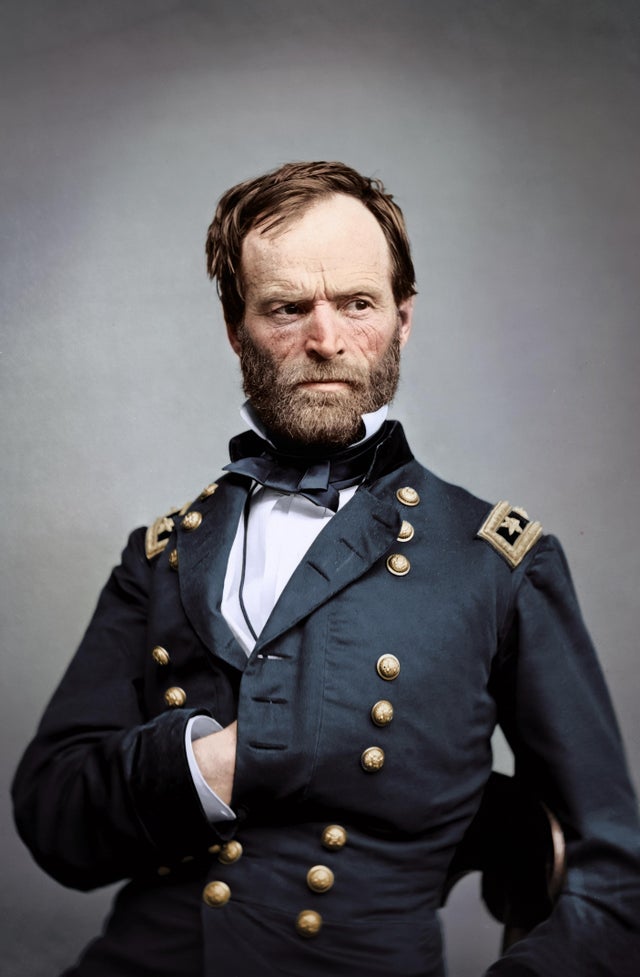
William Tecumseh Sherman remains one of the most controversial, reviled, and fascinating figures of the Civil War and American history. He served at Bull Run, Shiloh, Vicksburg, Jackson, Chattanooga, and ultimately from Atlanta through the Carolinas, where his concept of total war fully took shape. Aside from Nathan Bedford Forrest, Sherman’s portrait to me is one of the most striking and ominous of that era his dark, restless eyes, unkempt hair, and tense posture suggest a man who could barely sit still. Growing up in the South, I rarely heard his name mentioned, and when I did, it was never favorable. But after purchasing a beautiful Easton Press edition of his memoirs, reading B.H. Liddell Hart’s Sherman: Soldier, Realist, American, and finding a vintage copy of Lloyd Lewis’s Sherman: Fighting Prophet, the intimidating figure in that portrait began to take on depth and color in my mind. I came away with a genuine appreciation for his complexity. In the end, my takeaway is that he was instrumental in preserving the Union, his methods debated still, but undeniably effective.
Sherman was born in New Lancaster, Ohio, in 1820. According to Lloyd Lewis, he was originally named Tecumseh after the famed Native American leader, though his baptismal priest insisted on adding a Christian name hence William. This detail, however, is debated among historians. Sherman was one of eleven children born to Charles Robert Sherman, a lawyer and justice on the Ohio Supreme Court. After his father died suddenly of typhoid fever in 1829, nine‑year‑old Sherman was taken in by Thomas Ewing, a dominant figure in the Whig Party who later served as a U.S. senator from Ohio and as the first Secretary of the Interior. An additional note of interest: Sherman was a fifth cousin of Founding Father Roger Sherman. At sixteen, with the help of Thomas Ewing, Sherman secured an appointment to West Point and left Ohio for New York. There he roomed with George H. Thomas later known as “The Rock of Chickamauga” who became one of his closest lifelong friends. As a cadet from 1836 to 1840, Sherman lived and trained alongside a remarkable collection of young men who would later shape the Civil War. His time at the Academy overlapped with several future Union and Confederate commanders, including upperclassmen John Sedgwick, P.G.T. Beauregard, William Hardee, and Irvin McDowell, all members of the Class of 1838. His own Class of 1840 included future generals Richard S. Ewell, George W. Getty, and of course Thomas. In the years just behind him were younger cadets like William S. Rosecrans and James Longstreet, who entered in 1838, and Ulysses S. Grant, who entered in 1839, all of whom would become major figures in the war that followed. William Tecumseh Sherman spent the Mexican‑American War far from the front lines that brought national recognition to men like Robert E. Lee, Ulysses S. Grant, James Longstreet, George Pickett, and George Meade. While his peers distinguished themselves in battle, Sherman found himself stationed in California, a post he later admitted felt detached from the glory of war. Yet this assignment placed him at the epicenter of a different kind of upheaval: the dawn of the Gold Rush.
During his California service, Sherman witnessed firsthand the moment gold entered American consciousness. In his memoirs, he recalled being shown a small sample of placer gold brought from John Sutter’s mill. Governor Richard Barnes Mason asked him, “What is that?” Sherman described testing it himself: “I took the largest piece and beat it out flat, and beyond doubt it was metal, and a pure metal.” This seemingly mundane moment foreshadowed the economic convulsions that would soon transform California. After the war, Sherman remained in the region and entered the chaotic world of frontier banking. The Gold Rush economy was volatile, flush with speculation, and largely unregulated conditions that ruined many of his contemporaries. Sherman’s tenure as manager of the San Francisco branch of Lucas, Turner & Co. (1853–1857) is often portrayed as a failure, but the record suggests a more balanced assessment. Sherman’s correspondence from the period reveals a banker who was conservative, analytical, and clear‑sighted about risks. As modern historians note, his letters were “brisk, practical…warm and humane,” and he managed to keep the bank solvent during repeated financial shocks that toppled others. He anticipated looming instability ahead of the Panic of 1855 and acted accordingly. Ultimately, he chose to liquidate the bank not because it collapsed, but because he believed the economic climate made sustainable profits impossible. In fact, the California Historical Society notes that he “liquidated the firm at no loss to the partners,” a rare achievement in boom-and-bust San Francisco. Far from being a “failed banker,” Sherman was a cautious and competent one. He navigated one of the wildest financial environments in American history with prudence that many others lacked. His realism, what one biographer called his “hard‑headed practical sense” proved to be an asset, not a flaw. Though he missed the battlefield glory of the Mexican‑American War, Sherman’s California years were far from wasted. They offered him a front row seat to the Gold Rush, seasoned his understanding of finance and human behavior, and sharpened the administrative skills he would later use to profound effect during the Civil War.
Following the collapse of the San Francisco branch of Lucas, Turner & Co. in 1857, Sherman sought stability in the East. His later correspondence from New York reveals a man still deeply connected to his former colleagues in St. Louis. In an 1889 letter from West 71st Street in New York, he wrote approvingly of the work of the St. Louis Grant Committee and lamented that despite his intentions, “he is unable to visit St. Louis often.” His ongoing engagement with civic affairs, even decades later, demonstrated how closely he still identified with the region and the people he had worked alongside during his banking years. Though New York offered Sherman proximity to the political and economic centers of postwar America, it never became the emotional home that St. Louis had been. His writings from this period show a man increasingly reflective, wary of politics, and more inclined toward personal correspondence and veteran affairs than public ambition.
Sherman’s relationship with St. Louis began much earlier than his later letters suggest. He first arrived in the city in 1843 after a furlough, documenting his impressions of the bustling river city in his travel diary. He returned in 1850 with Company C of the 3rd Artillery Regiment, living first alone and then with his wife Ellen and their infant daughter. He found St. Louis “beyond doubt” a livelier and more vibrant city than the Ohio towns of his youth a place that offered opportunity, social prominence, and the possibility of reinvention. By the secession crisis of 1860–61, Sherman had returned to St. Louis, observing the spiraling tensions. During the Camp Jackson Affair of May 1861, he and his young son Willie found themselves taking cover as shots passed overhead a moment that vividly impressed upon him the gravity of the nation’s division. Though Sherman and Ulysses S. Grant had first known one another at West Point, it was St. Louis that brought their lives back into alignment. Grant, too, had deep roots in the city, having begun his military career at Jefferson Barracks in 1843 and later farming at White Haven with his wife Julia Dent Grant. Both men struggled in civilian life Grant as a farmer and wood hauler, Sherman as a banker and educator and both eventually gravitated back to military service as the nation moved toward war. By May 1861, both were in St. Louis when violence erupted at Camp Jackson. Their renewed connection deepened as the war progressed. While stationed in central Missouri in 1862, Sherman began working directly with Grant. Their relationship strengthened rapidly, marked by Sherman’s notable decision to waive his seniority to serve under Grant an early sign of loyalty that Grant would never forget.
Sherman later recalled Grant’s steady influence during moments when he himself doubted his abilities, especially in the early Western campaigns. Their partnership tested at Shiloh, validated at Vicksburg, and ultimately forged into one of the most consequential military alliances in American history was rooted in the years when both men were struggling civilians in St. Louis, trying to find their way. William Tecumseh Sherman entered the Civil War with all the emotional volatility of a man carrying a lifetime of professional disappointments, private anxieties, and unrealized potential. In late 1861, while commanding in Kentucky, he suffered what newspapers sensationally branded a mental breakdown. The New York Times later recounted that “the wire services proclaimed to the nation: GENERAL WILLIAM T. SHERMAN INSANE” after he requested relief from command during a deep depressive spell. Sherman’s own family felt the strain: he wrote home in fits of self‑reproach, unable to quiet his feeling that he was failing the Union when it most needed steadiness. B. H. Liddell Hart argues that this moment this public humiliation and private despair became the furnace in which his resilience was forged, noting Sherman’s astonishing recovery and calling him “the most original genius of the American Civil War” and “the first modern general.” Sherman’s redemption arrived at Shiloh (April 6–7, 1862), where his tenacity under surprise assault stunned even his critics. Despite being wounded in the hand and having multiple horses shot out from under him, he held his fractured lines long enough for Grant’s reinforcements to turn the tide the next day a moment Lloyd Lewis regards as the rebirth of Sherman’s military identity. Liddell Hart devotes an entire chapter to Shiloh, arguing that Sherman’s energy and refusal to collapse psychologically saved the Army of the Tennessee from disaster. Sherman later summarized Shiloh in his Memoirs as “the severest battle fought west of the Alleghenies,” a test not only of tactical skill but of internal fortitude.
If Shiloh gave Sherman confidence, Chickasaw Bayou (December 1862) gave him humility. His attempt to strike Vicksburg from the Yazoo swamps ended in bloody frustration. Sherman wrote candidly that the terrain was “exceedingly difficult,” and the failure convinced him to abandon brute frontal assaults in favor of movement, maneuver, and psychological pressure. Liddell Hart calls Chickasaw Bayou a “harsh but invaluable tutorial,” arguing that this defeat directly shaped Sherman’s turn toward wide‑ranging strategic envelopment the hallmark of his later campaigns. The Vicksburg campaign of 1863 provides the clearest picture of the mature Sherman: disciplined, methodical, and increasingly independent. Working under Grant, he executed diversions, canal works, inland marches, and river crossings that dismantled the Confederate grip on the Mississippi. The Library of Congress biography emphasizes how these operations hardened the operational partnership between Grant and Sherman, forming the war’s most effective command tandem. Liddell Hart’s chapters “The Maneuvers Against Vicksburg” and “The Fall of Vicksburg” highlight Sherman’s growing appreciation for speed, deception, and combined campaigning. At Chattanooga later that year, Sherman’s troops played a key role in prying Confederates off Missionary Ridge, reopening the gateway to the Deep South. Again, his actions reflected increasing operational sophistication rail cutting, turning movements, and aggressive pressure.
During these triumphs came the greatest heartbreak of Sherman’s life: the death of his nine‑year‑old son, Willie, on October 3, 1863, from typhoid fever in Memphis. According to contemporary accounts, Willie had been Sherman’s favorite child so much so that Ellen Sherman “reproved him repeatedly for making his preference…uncomfortably obvious.” After the boy’s death, Sherman wrote to Grant calling Willie “the one I most prized on earth.” What devastated Sherman most was the belief that he had caused Willie’s death by inviting his family into a military encampment he had proudly described as “comfortable…safe…beautiful.” The tragedy haunted him for the rest of his life. Ellen, deeply devout and steady, became his emotional anchor. Lloyd Lewis emphasizes how her religious faith counterbalanced her husband’s restless temperament, forming a union of psychological opposites.
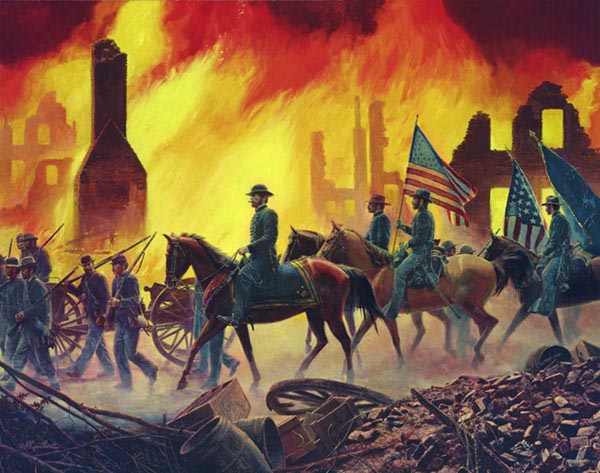
By 1864, Sherman now commanding the Military Division of the Mississippi began the Atlanta Campaign, a systematic push through northern Georgia that reflected the culmination of all he had learned. Step by step he forced Joseph E. Johnston back through Resaca, Kennesaw, the Chattahoochee until Atlanta fell on September 1. The destruction that followed has often overshadowed Sherman’s strategic logic, but his own words remain clear: “War is cruelty. There is no use trying to reform it.” Liddell Hart interprets this not as bloodlust, but as a modern recognition that breaking the enemy’s morale and logistical base is often more decisive than winning great battles. With Atlanta secured, Sherman embarked on the March to the Sea (November–December 1864) and then the Carolinas Campaign (early 1865), moving 60,000 men without supply lines, living off the countryside, and systematically dismantling the infrastructure that kept the Confederacy alive. The Library of Congress summarizes it as a nearly 300‑mile demonstration of logistical genius and moral warfare an effort to “cut the roots” rather than hack endlessly at the branches. Sherman defended this approach as the quickest route to ending the conflict and saving lives: “We can make war so terrible…that generations pass away before they again appeal to it.” Liddell Hart saw in these campaigns the embryonic form of twentieth‑century operational warfare mobility, independence from depots, and an emphasis on breaking national morale rather than annihilating armies in the field.
Sherman’s postwar life opened with a scene of national celebration: the Grand Review of the Armies in Washington, D.C., held on May 23–24, 1865. On the second day of the festivities, Sherman marched at the head of his battle‑hardened Western armies the Army of the Tennessee and the Army of Georgia down Pennsylvania Avenue before cheering crowds, dignitaries, and the nation’s political leadership. The capital was still shrouded in grief following Lincoln’s assassination, but President Andrew Johnson intended the spectacle to lift the mood of the city. Sherman, ever mindful of appearances, worried that his Western troops lacked the polish of the eastern forces and insisted that they drill, clean their uniforms, and shine every button and bayonet so they would present themselves in a manner he felt worthy of the Union’s victory. One Ohio newspaper described the scene as “a perfect ovation to our returning heroes…such as the old Romans gave their victorious legions,” capturing the grandeur of the moment.
In his Memoirs, Sherman recalled the Review with the straightforward, unadorned tone that defined much of his writing. He described leaving Washington only days after the procession, traveling with his family to Chicago for a fair organized to help the families of impoverished soldiers. He wrote simply that having described the events of the war, it now remained for him to reflect on “matters of general interest subsequent to the civil war,” signaling the transition from wartime commander to peacetime administrator. His postwar assignments began almost immediately. General Orders No. 118 placed him in command of the Military Division of the Mississippi (soon renamed the Division of the Missouri), stretching across a vast expanse from the Ohio River to the Rocky Mountains. The job thrust him into the complex work of managing demobilization, overseeing frontier posts, and dealing with early conflicts in the West all far removed from the grand set pieces of wartime campaigning.
Lloyd Lewis’s biography, Sherman: Fighting Prophet, provides a vivid and psychologically rich portrait of Sherman in these years. Lewis underscores the contradictions that made Sherman such a compelling figure: a man capable of great tenderness and devotion within his family circle, yet equally capable of what Lewis calls the “rarified heights of ruthlessness and cruelty” that had made his wartime reputation so fearsome. Sherman saw himself, Lewis writes, as a kind of punitive force “the avenging angel of the Lord” yet he was also forgiving, affectionate, and wholly devoted to those he loved. This complexity never left him, and in peacetime it became even more visible. Sherman balked at politics, distrusted radical reformers, and disliked journalists intensely. But he remained unfailingly loyal to his wartime comrades, especially Grant, and retained a sentimental attachment to the common soldiers whose endurance he admired.
These mixed elements of his personality appear in Sherman’s own postwar reflections. In the preface to his Memoirs, he rejects the role of historian, describing himself instead as “a witness on the stand before the great tribunal of history,” wishing to aid future scholars rather than shape the narrative himself. His writing displays flashes of pride, a sense of duty fulfilled, and moments of introspection. He understood the symbolic weight of the Grand Review and the campaigns that preceded it, but he also viewed his own achievements with pragmatic detachment, seeing them as part of a larger national struggle rather than his personal glory. Throughout these years, Sherman remained a man defined by the tensions within him restless without the purpose of war, impatient with the political winds of Reconstruction, affectionate toward family yet emotionally guarded before the public. Lewis observes that Sherman’s entire life was “a mass of contradictions,” and these contradictions became even sharper once the battlefields were behind him. What stands out is that Sherman survived not only the war, but also the myth it created around him. The conqueror who marched through Georgia and the Carolinas achieved national fame, yet the man who emerged from the war was more complicated: disciplined but weary, admired yet uneasy with admiration, a strategist who understood the human cost of his own tactics, and a public figure who never quite grew comfortable in the role the nation thrust upon him.
Written by Michael McPhail
Sherman: Soldier, Realist, American: Hart, B. H. Liddell: 9798307968598: Amazon.com: Books
Sherman, Fighting Prophet: Lewis, Lloyd, Simpson, Brooks D.: 9780803279452: Amazon.com: Books
 Brains and Brawn