James McPherson’s Battle Cry of Freedom: The Civil War Era is a masterful work that delves deeply into one of the most tumultuous periods in American history. McPherson, a distinguished historian and Pulitzer Prize-winning author, offers a comprehensive and engaging narrative that not only covers the Civil War itself but also meticulously examines the complex events and societal shifts leading up to the conflict. His ability to weave together political, social, and military history provides readers with a nuanced understanding of the era. In this post, we will focus on early America, the abolition movement, the economy, and politics, as we have already covered many of the battles in detail in our previous discussions of Shelby Foote’s Civil War trilogy. I particularly enjoyed how McPherson breaks down the intricate causes and consequences of the war, making the years leading up to it as compelling as the war itself.
In the early 1800s, America was a nation on the rise, marked by significant social and economic transformations. Literacy rates were impressively high, with four out of five Americans able to read and write, and a remarkable 90% literacy rate among the free population. This widespread literacy contributed to a vibrant public discourse and an informed citizenry. Economically, the average man could expect to increase his wealth fivefold from youth to maturity, reflecting the opportunities available in a rapidly expanding economy. The temperance movement also played a crucial role in societal change, successfully reducing the average American’s alcohol consumption from seven gallons of 200-proof alcohol per year to just two gallons.
The demographic landscape was shifting as well, with seven-eighths of immigrants choosing to settle in the North, contributing to its burgeoning industrial economy. In contrast, the South had a higher percentage of its population engaged in the military profession, with twice as many southerners compared to northerners pursuing military careers. This difference highlighted the distinct cultural and economic paths the two regions were taking. The growth of rail networks was another transformative factor; by 1850, the United States led the world with 9,000 miles of railroads, and by 1860, an additional 21,000 miles had been laid, further integrating the northern economy and facilitating westward expansion.
By 1860, the population of America had swelled to 32 million, including 4 million enslaved individuals. This stark reality underscored the growing divide in the political and economic direction of the country. The North and South were increasingly at odds, not just over the issue of slavery but also in their broader economic and political visions. The Charleston Mercury poignantly captured this sentiment, stating, “On the subject of slavery the North and South are not only two peoples but they are rival, hostile peoples.” This growing animosity set the stage for an impending crisis, as the nation grappled with irreconcilable differences that would soon erupt into civil war. The political and economic tensions of this era were a prelude to the conflict that would ultimately determine the future of the United States.
The Wilmot Proviso was a significant legislative proposal introduced in 1846 by Congressman David Wilmot. It aimed to prohibit the expansion of slavery into any territory acquired from Mexico following the Mexican-American War. Although the proviso passed the House of Representatives, it failed in the Senate, where the South had greater representation. This proposal intensified sectional tensions and highlighted the growing divide between the North and South over the issue of slavery.
During the late 1840s and 1850s, notable figures like Henry Clay, Daniel Webster, and John C. Calhoun made several attempts to find a compromise to avoid disunion. Henry Clay, known as the “Great Compromiser,” played a pivotal role in crafting the Compromise of 1850. This series of measures aimed to balance the interests of free and slave states, including admitting California as a free state, enacting a stricter Fugitive Slave Law, and allowing the territories of New Mexico and Utah to decide on slavery through popular sovereignty. Daniel Webster supported Clay’s efforts, advocating for national unity and compromise in his famous “Seventh of March” speech. In contrast, John C. Calhoun, a staunch defender of Southern interests, argued that the North’s growing power threatened the South’s way of life and insisted on the protection of slavery as a constitutional right.
The Supreme Court case Prigg v. Pennsylvania in 1842 further complicated the fugitive slave issue. The Court ruled that federal law superseded state law regarding the capture and return of fugitive slaves, weakening state efforts to protect escaped slaves and reinforcing the Fugitive Slave Act of 1793. This decision set the stage for the more stringent Fugitive Slave Act of 1850, which mandated that all escaped slaves be returned to their owners and imposed penalties on anyone aiding their escape.
The enforcement of the Fugitive Slave Act led to significant violence, particularly in Northern cities like Boston. One notable incident was the 1854 Boston Slave Riot, where abolitionists attempted to rescue Anthony Burns, an escaped slave, from federal custody. The failed rescue attempt resulted in a violent confrontation and heightened anti-slavery sentiment in the North.
Harriet Beecher Stowe’s Uncle Tom’s Cabin, published in 1852, played a crucial role in shaping public opinion against slavery. The novel vividly depicted the harsh realities of slavery and became immensely popular, selling over 300,000 copies in its first year. It galvanized the abolitionist movement and intensified sectional tensions, with many in the South denouncing it as propaganda. The book’s emotional impact and widespread readership helped lay the groundwork for the Civil War by highlighting the moral and humanitarian arguments against slavery.
These legislative efforts, court rulings, and cultural influences underscored the deepening divide in the United States, as political and economic tensions continued to escalate.The average southern white man was twice as wealthy as his northern counterpart, but this wealth was predominantly tied up in slaves and land. This concentration of wealth in human property and agricultural assets created a rigid social hierarchy and an economy heavily dependent on slavery. In contrast, the North was rapidly industrializing, with wealth more evenly distributed and tied to commerce, manufacturing, and a burgeoning middle class.
Horace Greeley, a prominent Northern journalist, captured the moral and economic arguments against slavery when he wrote, “Enslave a man, and you destroy his ambition, his enterprise, his capacity. In the constitution of human nature, the desire of bettering one’s condition is the mainspring of effort.” Greeley’s words highlighted the belief that slavery stifled human potential and economic progress. On the other hand, Southern leaders like James Hammond staunchly defended the institution of slavery, famously declaring, “Cotton, rice, tobacco, and naval stores command the world… no power on earth dares… to make war on cotton. Cotton is king.” This statement underscored the South’s reliance on cash crops and the global economic power they believed it conferred.
Political ambitions also reflected the South’s expansionist desires. In 1848, Jefferson Davis, who would later become the President of the Confederate States, asserted, “Cuba must be ours,” indicating the South’s interest in expanding slavery into new territories. This expansionist mindset was a significant factor in the political tensions of the era, as the North and South clashed over the future of slavery in new states and territories.
Efforts to find a political compromise were numerous but ultimately unsuccessful. One notable attempt was the proposal by John Crittenden, known as the Crittenden Compromise, which sought to extend the Missouri Compromise line of 36°30’ to the Pacific Ocean. This compromise aimed to allow slavery in all territories south of this line while prohibiting it in territories to the north. However, this proposal, like many others, failed to bridge the growing chasm between the North and South.
These economic, social, and political differences set the stage for an inevitable conflict. The North’s industrial economy and belief in free labor clashed with the South’s agrarian economy and dependence on slavery. As tensions escalated, the nation found itself on the brink of war, with each side entrenched in its vision for America’s future.
The Kansas-Missouri conflict, often referred to as “Bleeding Kansas,” was a series of violent confrontations between pro-slavery and anti-slavery factions in the Kansas Territory and neighboring Missouri from 1854 to 1859. This conflict was ignited by the Kansas-Nebraska Act, which allowed the settlers of Kansas to decide whether it would be a free or slave state through popular sovereignty. Senator David Atchison of Missouri, a fervent pro-slavery advocate, famously declared, “We intend to mormonize the abolitionists,” signaling his intent to overwhelm anti-slavery settlers with pro-slavery forces.
In the fall of 1854, Andrew Reeder, a Pennsylvania Democrat, arrived in Kansas as its first territorial governor. His tenure was marked by the invasion of “border ruffians” led by Atchison, who crossed into Kansas from Missouri to influence elections and intimidate free-soilers. The divide between the people of Kansas and Missouri was stark. Northern-born Kansas settlers derided Missourians as “pukes,” while Missourians referred to them as “long-faced sanctimonious Yankees.” This animosity was evident during the 1855 territorial election, where Atchison urged his followers to “mark every scoundrel among you that is the least tainted with free-soilism or abolitionism and exterminate him.” Consequently, 4,908 illegal ballots were cast, resulting in a territorial legislature dominated by thirty-six pro-slavery men and only three free-soilers.
By January 1856, Kansas had two competing territorial governments: the official pro-slavery government at Lecompton and the unofficial free-soil government at Topeka, which represented the majority of actual residents. This dual governance further fueled the conflict. In November 1855, a significant clash occurred in Lawrence, Kansas, where 1,500 Missourians fought against 1,000 free-soilers. This battle was part of a broader campaign of violence and intimidation aimed at suppressing the anti-slavery movement in Kansas.
The Kansas issue was seen as pivotal by many Southern leaders. Preston Brooks, a pro-slavery congressman, stated, “The fate of the South is to be decided with the Kansas issue.” Brooks is also infamous for his violent attack on Senator Charles Sumner in 1856, beating him with a cane on the Senate floor after Sumner delivered a speech condemning slavery and its supporters. This incident exemplified the intense passions and deep divisions that characterized the era.
The Kansas-Missouri conflict highlighted the failure of legislative compromises to resolve the issue of slavery and underscored the growing sectional divide that would eventually lead to the Civil War. The violence and political turmoil in Kansas were a microcosm of the national struggle over slavery, illustrating the deep-seated animosities and irreconcilable differences between the North and South.
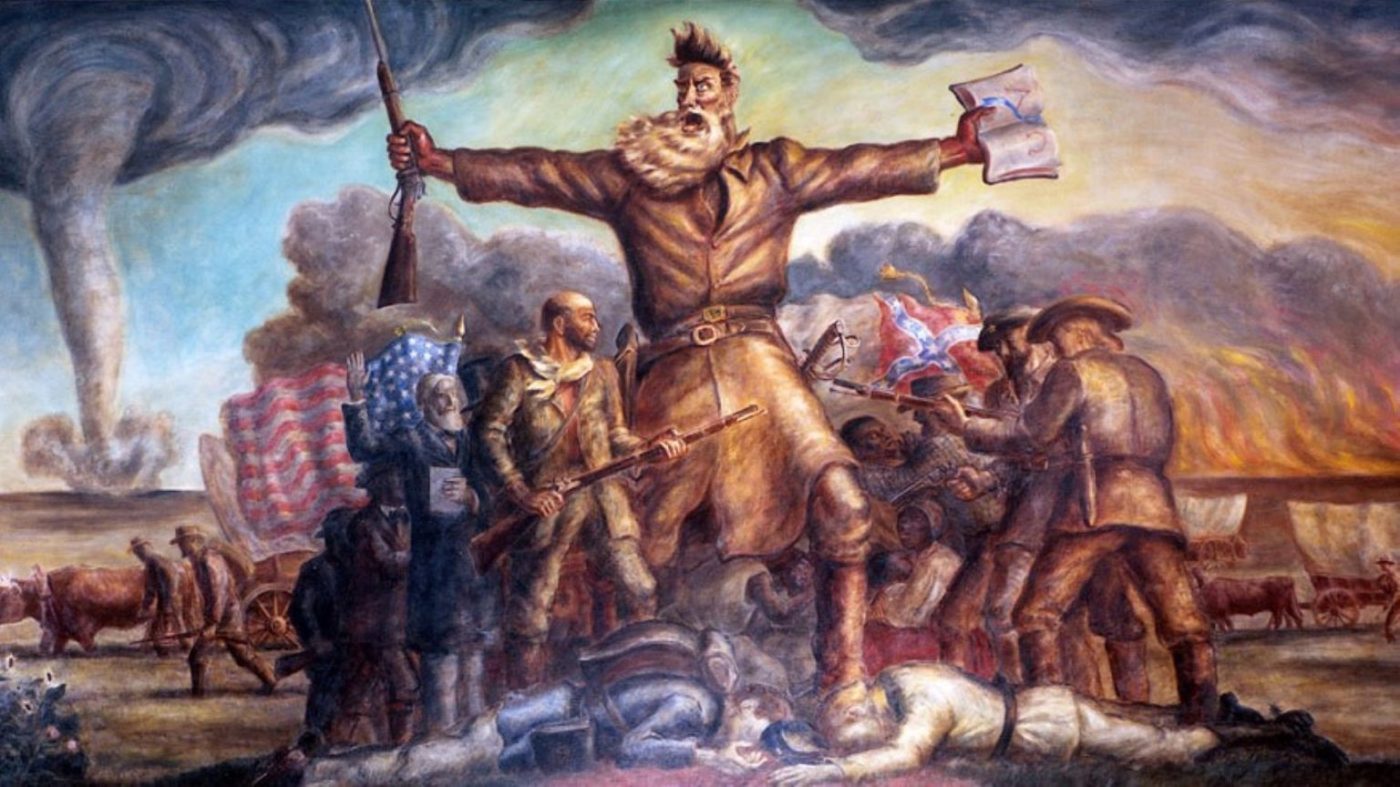
The violence in Kansas during the 1850s reached a fever pitch with the actions of John Brown, a fervent abolitionist who believed that drastic measures were necessary to combat the pro-slavery forces. In 1856, Brown enlisted a military company, including his sons, to “fight fire with fire.” He famously declared, “Something must be done to show these barbarians we have rights” and aimed to “strike terror in the hearts of proslavery people.” Brown conceived a radical retaliatory measure against what he called the “slave hounds.” On the night of May 24-25, he and his followers abducted five pro-slavery settlers from their cabins and brutally executed them by splitting their skulls with broadswords. This act of violence was Brown’s way of delivering an “eye for an eye” justice in the face of pro-slavery aggression.
The aftermath of Brown’s actions was immediate and severe. Two of his sons, who had not participated in the killings, were arrested, highlighting the chaotic and lawless environment in Kansas. The region descended into a bushwhacking war, characterized by guerrilla tactics and brutal skirmishes between pro-slavery and anti-slavery forces. The conflicts in Lawrence and Pottawatomie were particularly notable, with both sides committing acts of violence and retribution. The U.S. Army struggled to maintain order and keep Kansas tamed, often finding themselves outmatched by the sheer ferocity and determination of the combatants.
The violence of this period painted a grim picture of the deep-seated animosities that had taken root in Kansas. The Lawrence conflict saw pro-slavery forces attacking the town, sacking it, and destroying property, while the Pottawatomie massacre led by Brown was a stark example of the lengths to which abolitionists were willing to go. These events underscored the failure of legislative compromises and the growing realization that the conflict over slavery could not be resolved peacefully.
The 1850s in Kansas were marked by a brutal and bloody struggle that mirrored the larger national conflict. The violence and lawlessness of the time highlighted the deep divisions within the country and foreshadowed the coming Civil War. The actions of individuals like John Brown, who believed in taking extreme measures to fight for their cause, exemplified the desperation and determination that characterized this turbulent period in American history. As the nation edged closer to war, the events in Kansas served as a stark reminder of the high stakes and the profound moral and political conflicts that lay at the heart of the struggle over slavery.
In conclusion, as you can see the build up to the Civil War was tense and violent in and of itself. The eruption of hostilities at Harper’s Ferry, Fort Sumter, Manassas and Wilson’s Creek were just an incarnation of these decades of building rage over the direction of the United States and what citizens wanted this country to become ultimately. Often overlooked, the time period leading up to the outbreak of open hostilities is extremely important to understanding the conflict itself. The core of it and the people who tried to prevent it, the people who incited it and the issues they sparred over. We would all do well to note this in our own modern times in America. McPherson delivers an excellent volume, comprehensive, detailed and readable. I included a video on John Brown that I liked from Ken Burn’s documentary series which I have recommended it several times.
Written by Michael McPhail
 Brains and Brawn