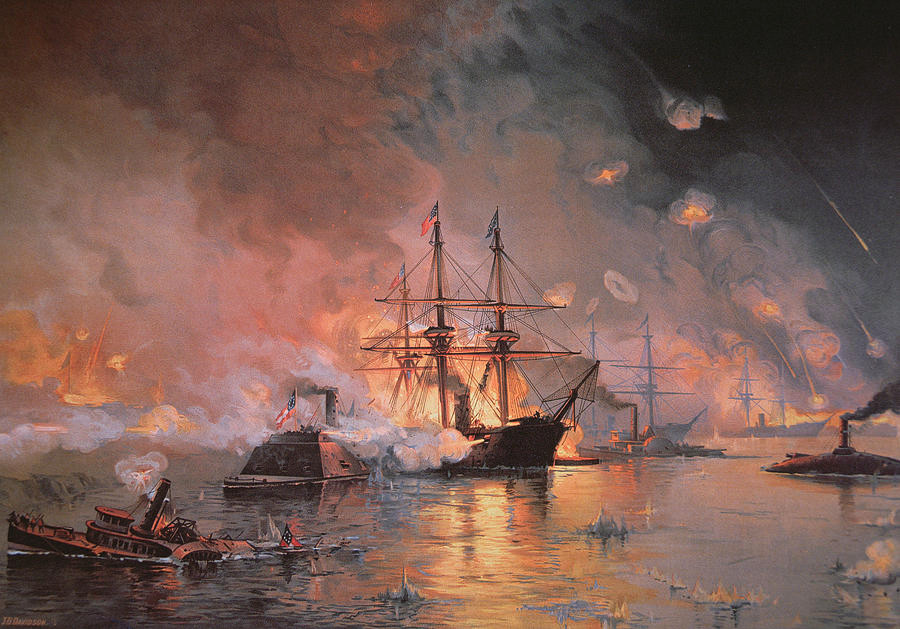
Many people have heard me say, “I am a navy man.” I even have two U.S. Navy flags proudly displayed in my front yard. Although I have never served, I would answer the call without hesitation and would choose the Navy. My fascination with naval history was recently reignited when I read James M. McPherson’s War on the Waters: The Union & Confederate Navies, 1861-1865. This book delves into the pivotal role that naval forces played during the Civil War, a topic that has captivated me since I first encountered images of the formidable ironclads. These monstrous vessels, with their varying sizes and armaments, represented a significant leap in naval technology. Just as advancements in weaponry transformed infantry battles, the evolution of naval vessels during the Civil War marked a revolutionary shift in maritime warfare. The ironclads, in particular, stood out with their imposing presence and innovative designs, forever changing the landscape of naval combat.
Key figures such as Union Rear Admiral David Farragut, known for his bold command during the Battle of Mobile Bay, and Confederate Secretary of the Navy Stephen Mallory, who was instrumental in the development of the Confederate ironclad fleet, played crucial roles in these advancements. Innovators like John Ericsson, the designer of the USS Monitor, and John M. Brooke, who contributed to the design of the CSS Virginia, were pivotal in pushing the boundaries of naval engineering. My interest in this subject goes beyond mere curiosity; it is a deep-seated passion that has grown. The stories of bravery, innovation, and strategic brilliance that emerged from the naval battles of the Civil War continue to inspire me. I hope to share this passion with others, shedding light on the often-overlooked naval aspects of the Civil War and honoring the legacy of those who served on the waters.
To begin, I wanted to lay out for the reader some of the leaders of the U.S. Navy during the Civil War. Often overlooked in their contributions, McPherson brings to life these heroes of American history. Many people know the household names like Grant, Lee, Sherman, Stonewall etc. but sadly names like Andrew Foote and Samuel DuPont are largely forgotten about. The Union Navy only represented approximately 5% of the fighting force during the Civil War but their contributions far exceed the investment of manpower. Below are some of their best Navy men from the war.
Rear Admiral David G. Farragut was the first rear admiral, vice admiral, and admiral in the U.S. Navy. He is famous for his command “Damn the torpedoes, full speed ahead!” during the Battle of Mobile Bay and played a crucial role in the capture of New Orleans and the Siege of Vicksburg. Farragut served in the West Gulf Blockading Squadron, covering the Gulf of Mexico, with his flagship being the USS Hartford. He coordinated with General Ulysses S. Grant during the Siege of Vicksburg. Flag Officer Andrew H. Foote led the Western Gunboat Flotilla, the predecessor of the Mississippi River Squadron. He was instrumental in the Union victories at Fort Henry and Fort Donelson and was known for his efforts in naval reforms and anti-slavery operations. Foote served in the Western Gunboat Flotilla, covering the Mississippi River and its tributaries, with his flagship being the USS Benton. He coordinated with General Ulysses S. Grant during the campaigns at Fort Henry and Fort Donelson. Rear Admiral John A. Dahlgren, known as the “Father of American naval ordnance” for his innovations in naval artillery, commanded the South Atlantic Blockading Squadron. He assisted General William Tecumseh Sherman in securing Savannah, Georgia. Dahlgren served in the South Atlantic Blockading Squadron, covering the southeastern coast of the United States, with his flagship being the USS Pawnee. He coordinated with General Sherman during the Savannah Campaign.
Captain Samuel F. DuPont played a major role in the Union blockade and the capture of Port Royal. He promoted engineering studies at the U.S. Naval Academy and was controversially blamed for the failed attack on Charleston, South Carolina. DuPont served in the South Atlantic Blockading Squadron, with his flagship being the USS Wabash. He coordinated with General Thomas W. Sherman during the Port Royal Expedition. Captain David D. Porter commanded the Mississippi River Squadron during the Vicksburg Campaign and played a significant role in the Red River Campaign. He became the second U.S. Navy officer to attain the rank of admiral. Porter served in the Mississippi River Squadron, with his flagship being the USS Black Hawk (one of my favorite ships). He coordinated with General Ulysses S. Grant during the Vicksburg Campaign and General Nathaniel P. Banks during the Red River Campaign.
If the Union Navy men only represented 5% of the fighting force, then the Confederate Navy was even less than that. Marked by quality of officers and southern innovation due to necessity, lack of resources and shipyards the Confederate Navy struck many blows against their stronger more organized adversary. Confederate raiding vessels stalked the oceans, the newly invented “torpedoes” (underwater mines) haunted the minds of Union captains and resurrected Union ironsides breathed new life to strike their former creators. Below are some of the fine Confederate Naval leaders from the Civil War.
Captain Franklin Buchanan was the only full admiral in the Confederate Navy. He commanded the ironclad CSS Virginia during the Battle of Hampton Roads, where he famously engaged the USS Monitor. Buchanan also oversaw the construction of the CSS Tennessee and commanded it during the Battle of Mobile Bay, where he was wounded and captured. He served primarily in the James River Squadron and the Mobile Bay area, with his flagship being the CSS Virginia. Buchanan coordinated with various Confederate army commanders, including General Robert E. Lee during the defense of Richmond3. Captain Raphael Semmes was renowned for his command of the CSS Alabama, the most successful commerce raider in maritime history, capturing 65 Union merchant ships. He also commanded the CSS Sumter before the Alabama. Semmes was promoted to rear admiral and briefly served as a brigadier general in the Confederate Army. He operated primarily in the Atlantic Ocean and the Gulf of Mexico, with his flagship being the CSS Alabama. Semmes coordinated with Confederate diplomats and military leaders to disrupt Union supply lines. Captain Isaac Newton Brown was instrumental in the construction and command of the ironclad CSS Arkansas. He led the Arkansas in a daring run through the Union blockade at Vicksburg, earning a promotion to commander. Brown later commanded the CSS Charleston, defending Charleston, South Carolina. His flagship was the CSS Arkansas. Brown coordinated with General John C. Pemberton during the Vicksburg Campaign.
Captain Samuel Barron served in both the U.S. Navy and the Confederate Navy. He commanded the coastal defenses of Virginia and North Carolina and was captured during the Battle of Hatteras Inlet. After his exchange, he commanded the James River Squadron and later served in Europe to secure naval support for the Confederacy. His flagship was the CSS Patrick Henry. Barron coordinated with various Confederate leaders, including General Robert E. Lee. Captain John N. Maffitt, known as the “Prince of Privateers,” was a successful blockade runner and commerce raider. He commanded the CSS Florida, capturing numerous Union merchant ships. Maffitt also served as a naval aide to General Robert E. Lee during the defense of Savannah. His flagship was the CSS Florida. Maffitt coordinated with Confederate army commanders to support coastal defenses and disrupt Union supply lines.
Both sides had excellent men in charge as Secretaries of the Navy, Gideon Welles, known as “Father Neptune,” served as the U.S. Secretary of the Navy under Presidents Abraham Lincoln and Andrew Johnson. Appointed in 1861, Welles faced the monumental task of expanding and modernizing the Navy at the onset of the Civil War. Under his leadership, the Navy grew from a modest fleet to a formidable force, crucial in implementing the Union’s Anaconda Plan, which aimed to blockade and divide the Confederacy. Welles was a keen strategist and administrator, overseeing the construction of ironclad warships like the USS Monitor, which revolutionized naval warfare with its innovative design and iron armor. His efforts in promoting merit-based promotions and minimizing corruption within the Navy were pivotal in maintaining an effective and disciplined naval force. Stephen Mallory, the Confederate States’ Secretary of the Navy, played an equally transformative role on the opposing side. Appointed by President Jefferson Davis, Mallory was tasked with building a navy from scratch. He implemented a four-point strategy that included deploying commerce raiders to disrupt Union trade, constructing ironclad vessels for coastal defense, and experimenting with new naval technologies. Mallory’s advocacy for armored vessels led to the creation of the CSS Virginia, which famously clashed with the USS Monitor in the Battle of Hampton Roads. His innovative approach also extended to the development of new weapons and tactics, making the Confederate Navy a formidable adversary despite its limited resources.
Concluding this post, three major naval battles that I consider important to the Civil War would be: Battle of Mobile Bay, Battle of New Orleans and Battle of Hampton Roads. The Battle of Mobile Bay was a pivotal naval engagement during the Civil War. On August 5, 1864, Rear Admiral David G. Farragut led a Union fleet into Mobile Bay, Alabama, a crucial Confederate port. The battle is famously remembered for Farragut’s bold command, “Damn the torpedoes, full speed ahead!” as his fleet navigated through a minefield (then called torpedoes) and heavy fire from Confederate forts and ironclads. The Union fleet successfully breached the defenses, leading to the surrender of the Confederate ironclad CSS Tennessee and the eventual closure of Mobile Bay to blockade runners. This victory was significant as it further tightened the Union blockade, cutting off vital supplies to the Confederacy. The Battle of New Orleans, another critical engagement, took place in April 1862. Rear Admiral David G. Farragut again played a central role, leading a daring night-time passage past the heavily fortified Forts Jackson and St. Philip on the Mississippi River. Despite facing fierce resistance and navigating through chains and obstructions placed by the Confederates, Farragut’s fleet managed to bypass the forts and reach New Orleans. The fall of New Orleans, the largest city in the Confederacy and a major port, was a severe blow to the Southern war effort. It disrupted Confederate trade and supply lines and provided the Union with a strategic foothold in the South.
The Battle of Hampton Roads, fought on March 8-9, 1862, is renowned for the historic clash between the ironclads USS Monitor and CSS Virginia (formerly the USS Merrimack). McPherson highlights this battle as a turning point in naval warfare, marking the end of the era of wooden warships. The CSS Virginia wreaked havoc on the first day, sinking the USS Cumberland and setting the USS Congress ablaze. However, the arrival of the USS Monitor the following day led to a dramatic duel between the two ironclads. Although the battle ended in a tactical draw, it demonstrated the superiority of ironclad ships and revolutionized naval engineering and combat strategies. This engagement underscored the importance of innovation and adaptability in warfare.
In conclusion, the navies of both the Union and the Confederacy played crucial roles in shaping the outcome of the Civil War. While the land battles often dominate historical narratives, the strategic importance of naval operations cannot be overstated. The Union’s effective blockade, spearheaded by innovative leaders and advanced ironclad ships, choked off Confederate supply lines and split the South, contributing significantly to the Union’s victory. On the other hand, the Confederacy’s use of commerce raiders and ironclads showcased remarkable ingenuity and resilience, managing to disrupt Union trade and challenge its naval supremacy despite limited resources.
Elements often overlooked include the sheer scale of logistical and technological advancements achieved during this period. The transition from wooden ships to ironclads marked a revolutionary shift in naval warfare, setting the stage for modern naval engineering. Additionally, the collaboration between naval and army forces, exemplified by figures like Farragut and Grant or Semmes and Confederate diplomats, highlights the integrated nature of military strategy during the war. The bravery, strategic brilliance, and technological advancements of the naval forces deserve recognition and appreciation, as they were pivotal in shaping the course of American history. I would highly recommend picking up this book.
Written by Michael McPhail
A video with many of the Ironclads:
 Brains and Brawn