The Plague, a novel published by Albert Camus in 1947, was my first introduction to a subset of existentialist thought popularized by Camus known as absurdism. While much of the content of absurdism was covered in the earlier post on The Stranger, I did want to begin this post by familiarizing the reader with a simple definition of absurdism. It is a belief that the universe in which we live is both meaningless and irrational, and that our attempt to find meaning brings us into direct conflict with the universe. Albert Camus uses a mysterious plague afflicting the French Algerian coastal town of Oran to serve as the vehicle for his absurdist framework in this novel.
The novel is told by a narrator who does not reveal his identity until late in the book, but whom most readers can identify as being Dr. Bernard Rieux, a humanist and atheist who works in Oran from the very beginning to the end of the plague. The plague starts with the arrival of dead rats in the city, a prelude of things to come. Dr. Rieux makes the connection early that the rats are a bad omen, and he urges mindfulness to sanitation and quarantine. A hotel concierge named M. Michel dies from a fever and becomes the first human victim, yet the plague does not relent after his death.
While Dr. Rieux attempts to get the city or Oran to adopt strict measures, it makes little difference in the outcome of the plague. This is perhaps the first nod towards Camus’ absurdist philosophy, as the individual is ultimately powerless to affect any sort of change in an indifferent world. Rieux’s wife is sent to a sanatorium in another city for an unrelated chronic illness, sparing her from the plague and her husband’s attempts to thwart it but heightening the sense of isolation for the protagonist. The authorities, including the prefect, are initially unsure whether the situation is serious or what actions they are expected to take. Eventually the city is sealed up and the citizens plunge into isolation.
“Thus each of us had to be content to live only for the day, alone under the vast indifference of the sky. This sense of being abandoned, which might in time have given characters a finer temper, began, however, by sapping them to the point of futility”.
Jean Tarrou, an enigmatic man who arrived in Oran on vacation shortly prior to the arrival of the plague, becomes a chronicler of the events. Through his observations, he shows that the citizenry was full of monotony prior to the arrival of the plague. They were not actually living their lives to the fullest or making the most of their finite existence. Rather, they were wasting their time in the pursuit of nothingness. In this sense, the plague can be understood as an allegory for indifference. Truly one could wonder whether the individual citizens of Oran were ever truly free before the arrival of the plague or were they simply slaves to monotony. The plague made them reconsider the things they had always taken for granted.
Dr. Rieux becomes the enforcer of quarantine in the city, and the beds in the emergency hospital are always full. It is always an emotional scene whenever he commits an individual to quarantine, separating them from their families. In a sense, he must divorce himself from reality and avoid pity. He must be in denial in response to other people’s suffering to deliver the most equitable care possible.
Toward the middle of the book, the mail services cease, bringing with it a deep sense of isolation. The citizens become very selfishly self-absorbed in their own suffering. One asthmatic who is a patient of Dr. Rieux spends his time counting peas to pass the time, a clear nod towards the absurdism that Camus is highlighting. This endeavor is quite understandably meaningless, yet the asthmatic chooses to engage in it, nonetheless.
An interesting character in the book is Joseph Grand, a clerk for the city government who passes his time by counting the number of plague deaths. This is clearly a comparison to the asthmatic pea counter, as both endeavors have a similar impact on the outcome of the plague. During his tenure as clerk, he worked so hard and diligently that he forgot to love his wife and she left him. He attempts to write a book, but he ends up rewriting the same sentence over and over. He also attempts to write a letter to his wife to make amends but is unable to complete more than the first sentence.
Of course, not everyone experiences the plague the same way. Cottard, a criminal on the run, is relieved during the plague. This is because he has committed a crime that during any other time would see him arrested. Prior to the plague he unsuccessfully attempted to commit suicide; however, during the plague he becomes somewhat liberated. Father Panneloux is another plague dissident. He uses it as an opportunity to deliver a sermon espousing that the plague is a god-sent punishment for the sins of the citizens of Oran. Many are converted by his sermon. He will later redact this sentiment, but more on this to come.
Raymond Rambert is a young paramour whose plan is to escape the city to join his wife in Paris. The city officials refuse his request to leave, and he spends much of the book trying to craft a clever escape plan. Rieux and Rambert are at odds with each other because Dr. Rieux will not provide him a letter of exception to leave the city during quarantine. Not realizing that Rieux is also separated from his wife, Rambert rebuts:
“No, you can’t understand. You’re using the language of reason, not of the heart; you live in a world of abstractions”.
I thought it humorous and relatable, but one reason that Rambert appeals to wanting to leave Oran during quarantine is his “advanced” age. “At thirty one’s beginning to age, and one’s got to squeeze all one can out of life”.
The only irrefutable aspect of The Plague is death. It is an absurd condition of intense desire to continue living while simultaneously being condemned to death. The only meaningful thing to do in response to this reality is to rebel against death. It is always a collective catastrophe, though it seems individualized, because it is the collective fate of humankind. Herein lies the heart of absurdism, that try as they might, individuals are ultimately powerless to affect their ultimate destinies.
Rieux is asked during the height of the plague whether he believes in God. His response is telling:
“No – but what does that really mean? I’m fumbling in the dark, struggling to make something out. But I’ve long ceased finding the original.” He then goes on to contrast his experiences to those of Father Paneloux, a man sure of his faith.
“Paneloux is a man of learning, a scholar. He hasn’t come in contact with death; that’s why he can speak with such assurance of the truth – with a capital T. But every country priest who visits his parishioners and has heard a man gasping for breath on his deathbed thinks as I do. He’d try to relieve human suffering before trying to point out its excellence.”
Paneloux spends his first sermon pointing out the excellence of human suffering, but he will change his tone drastically during his second sermon. Dr. Rieux suggests that belief in God is an impediment to the work of a doctor.
“if he believes in an all-powerful God he would cease curing the sick and leave that to Him. But no one in the world believed in a God of that sort; no, not even Paneloux, who believed that he believed in such a God. And this was proved by the fact that no one ever threw himself on Providence completely. Rieux believed himself to be on the right road – in fighting against creation as he found it.”
This next line came at an all-time low point of the plague, the plague representing a never-ending defeat.
“Since the order of the world is shaped by death, mightn’t it be better for God if we refuse to believe in Him and struggle with all our might against death, without raising our eyes toward the heaven where He sits in silence.”
One light-hearted and somewhat comical line in the book came during a conversation between Rambert, who ultimately decided to stay in Oran to help with the plague victims, and Tarrou.
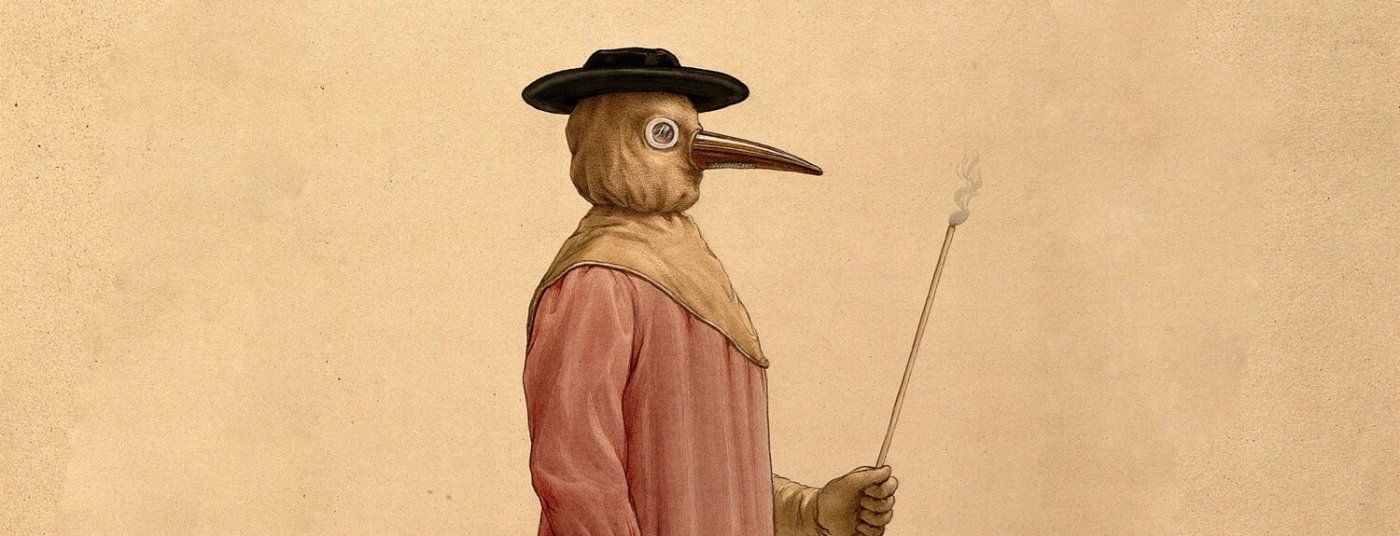
“Opening one of these [cupboards], he took from a sterilizer two masks of cotton-wool enclosed in muslin, handed one to Rambert, and told him to put it on. The journalist asked if it was really any use. Tarrou said no, but it inspired confidence in others.“
I could not help but think of the covid pandemic and all the virtue signaling that came along with wearing cloth masks that were largely ineffective at stopping its spread. They were worn almost exclusively to inspire confidence in others.
Another interesting character in the book is Dr. Castel, a counterpart of Dr. Rieux who works tirelessly to bring a serum for the plague into the city to turn the tide of this public crisis. The efficacy of the serum is dubious, and there are also concerns as to whether there will be enough for everyone if it does work. I could not help but be reminded of the early stages of the emergency use authorization for the covid vaccine when both questions were on the forefront of everyone’s minds.
The most iconic, albeit morose, section of the book comes when Dr. Castel’s new anti-plague serum is tried for the first time on the magistrate Othon’s young son. Dr. Rieux, Father Panneloux, and Tarrou are all at bedside and witness with horror as the serum fails and Othon’s son suffers greatly. Witnessing this catastrophe further entrenches Dr. Rieux in his prior atheistic beliefs:
“No, Father. I’ve a very different idea of love. And until my dying day I shall refuse to love a scheme of things in which children are put to torture.”
This scene sets the stage for the second of Father Panneloux’s sermons, in which he himself wrestles with the existence of God in the face of the death of this child. He begins to wonder whether an eternity in heaven is enough to make up for the horrors that he just witnessed.
“Thus he might easily have assured them that the child’s sufferings would be compensated for by an eternity of bliss awaiting him. But how could he give that assurance when, to tell the truth, he knew nothing about it? For who would dare to assert that eternal happiness can compensate for a single moment’s human suffering? He who asserted that would not be a true Christian, a follower of the Master who knew all the pangs of suffering in his body and his soul.”
Father Panneloux decides that to live in a world with an all-powerful God who wills children to suffer and die, it must also be the will of God’s followers that such things come to pass, paradox though this is.
“My brothers, a time of testing has come for us all. We must believe everything or deny everything. And who among you, I ask, would dare to deny everything? Thus today God had vouchsafed to His creatures an ordeal such that they must acquire and practice the greatest of all virtues: that of the All or Nothing.”
The choice for the believer is to believe everything, even in the sufferings of children, because the alternative is to deny everything.
“And his choice would be to believe everything, so as not to be forced into denying everything… the sufferings of children were our bread of affliction, but without this bread our souls would die of spiritual hunger.”
Encountering many of these sad situations in my pediatric residency thus far, with children missing various parts of vital organs and being born into terrible situations has certainly given me a backdrop for the internal turmoil that both Dr. Rieux and Father Paneloux went through with Othon’s son. Despite the dark overtones present through this book, with themes of the absurdity and the pointlessness of struggling against the inevitable, it is worth noting that the core characters in the book choose to stay in the city and fight the plague with as much human decency as they can muster. There is a beautiful line about exposing selfishness and self-centeredness during extenuating circumstances.
“In fact, it comes to this: nobody is capable of really thinking about anyone, even in the worst calamity. For really to think about someone means thinking about that person every minute of the day, without letting one’s thoughts be diverted by anything – by meals, by a fly that settles on one’s cheek, by household duties, or by a sudden itch somewhere. But there are always flies and itches. That’s why life is difficult to live. And these people know it only too well.”
Sadly, Tarrou will die from the plague and Dr. Rieux will spend some time contemplating his death and the brief friendship that they had together. He uses the death of Tarrou to reexamine his own relationship with his mother, whom he realizes he has never had more than a superficial connection to.
“He knew, too, that to love someone means relatively little; or, rather, that love is never strong enough to find the words befitting it. Thus he and his mother would always love each other silently. And one day she – or he – would die, without ever, all their lives long, having gone further than this by way of making their affection known. Thus, too, he had lived at Tarrou’s side, and Tarrou had died this evening without their friendship’s having had time to enter fully into the life of either.”
There are many beautiful moments and key lessons to take from The Plague, not least of which is the timeliness of reading this book while coming out of a global pandemic that read eerily like this work from 75 years prior. The book teaches the reader what it means to truly struggle in the face of circumstances that seem and feel meaningless, such as the death of Othon’s son and Tarrou. They challenge the reader to find a purpose to continue working towards something good, true, and real when all evidence points to this being a fruitless endeavor. I hope that readers will pick up this book and strive like Dr. Rieux for no other reason than the intrinsic good of the act. In time, the plague will pass regardless. What matters is the type of person the plague finds you to be.
Link to purchase The Plague by Albert Camus: https://amzn.to/45T3BG6
Written by Cal Wilkerson
 Brains and Brawn