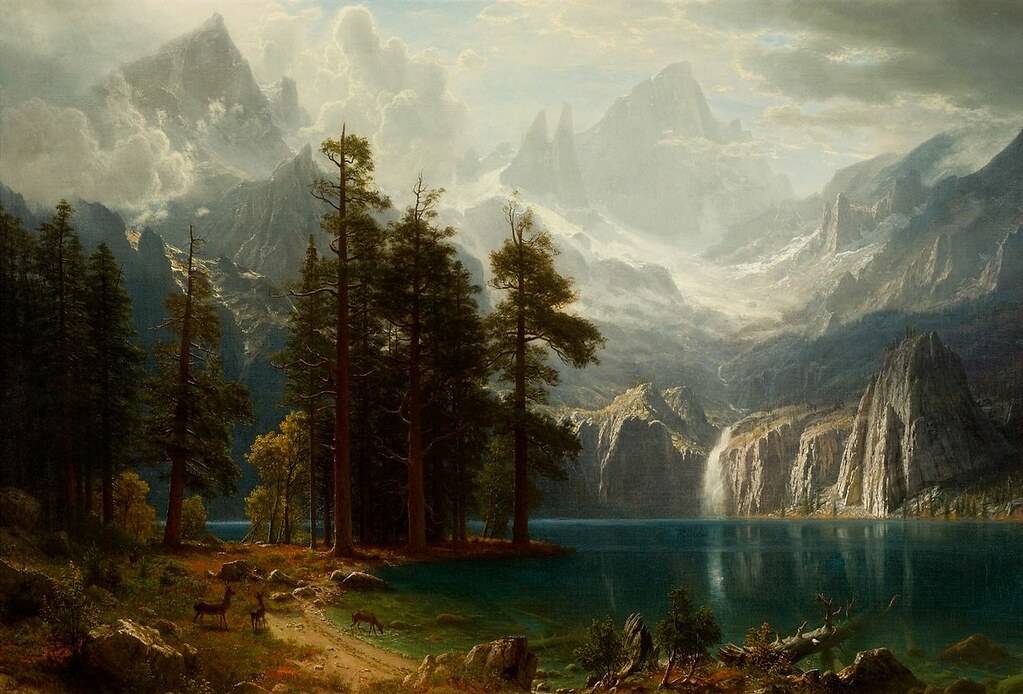
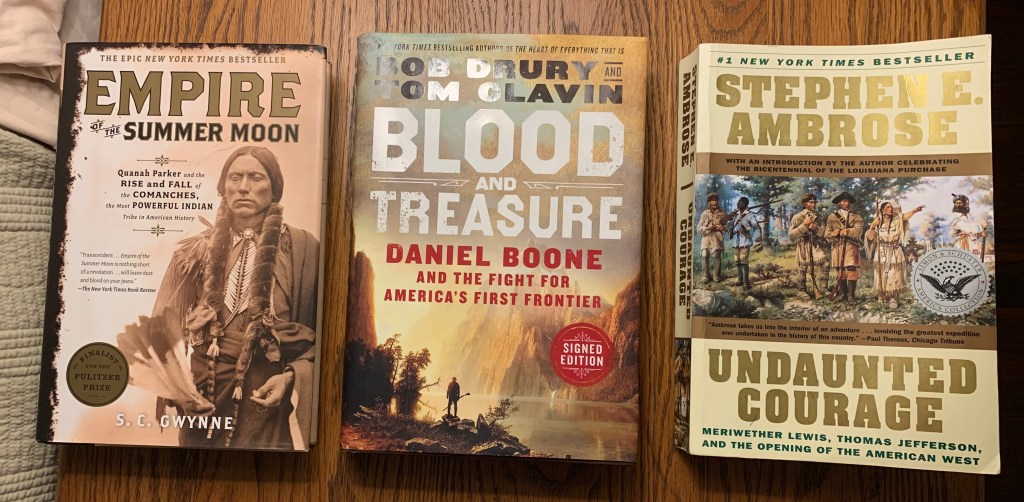
During the last half of 2022, I read three books all having to do with the westward expansion of the United States of America. Growing up in rural Mississippi people like Meriweather Lewis, William Clark, Daniel Boone and Davy Crockett were household names to me. Granted, as an adolescent I wasn’t deeply researching these men but I was aware of their lore in our collective consciousness as a country. Honestly, I think everyone has a particular image in their head of the above mentioned frontiersmen among others. This post will cover three books specifically like I have mentioned: Empire of the Summer Moon: Quanah Parker and the Rise and Fall of the Comanches, the Most Powerful Indian Tribe in American History by S.C. Gwynne, Blood and Fire: Daniel Boone and the Fight for America’s First Frontier by Bob Drury and Tom Clavin and Undaunted Courage by Stephen Ambrose. All correlate and even cross over.
Overall, these three books have given me a deep appreciation for the land we all enjoy here in the United States. The rivers, mountains, deserts, lakes, forests and a rich bounty of all sorts of wildlife. Also, a reverence for the Native American tribes that lived here for thousands of years or more. Powerful portraits of a warrior culture sadly pushed aside by European / Colonial settlers through robbery or veiled diplomacy. My references to the many tribes throughout this post are intended to be so. There is much respect in my heart for the pioneering men and women that set forth into the unknown essentially with just an idea of a better life, a hope of more opportunity and the desire to live a life unlike anyone before them.
Perhaps my favorite book of 2022 was Blood and Treasure: Daniel Boone and the Fight for America’s First Frontier. Daniel Boone is still a widely celebrated frontiersman but this was the first book I actually read about the real person. Growing up from Quaker roots in Pennsylvania to ultimately relocating with his parents as a teen to Yadkin Valley, North Carolina. Growing up in the years before the Revolutionary War, Boone interacting at a young age with Delaware, Shawnee and Iroquois tribes thus inspiring and influencing his outdoor acumen. As a twenty year old Daniel Boone fought in the French and Indian War alongside George Washington. Surviving a brutal defeat at the hands of the French and Ottawa, Shawnee, Delaware, Chippewa, Potawatomi, Seneca and Wyandot warriors led by the legendary chieftain, Pontiac at Fort Duquesne (present day Pittsburgh, PA). Post French and Indian War, Boone marries and is gets involved with another conflict referred to as the Cherokee Wars. Eventually moving through the Cumberland Gap and settling in the fabled land of modern day Kentucky.
Some of the key themes of this book in my analysis were:
The exploration and conquest of the American frontier. The book covers Boone’s travels and expeditions across the Appalachian Mountains and into the uncharted wilderness beyond, as well as his encounters with Native American tribes and the battles that ensued. The authors delve into the motivations behind Boone’s exploration, including his desire for adventure, his quest for wealth and land, and his duty to expand American territory.
Another major theme of “Blood and Treasure” is the complex relationships between European settlers and Native American tribes during the colonial era. Boone’s interactions with various tribes, including the Cherokee, Shawnee, and Delaware, are explored in detail, as are the cultural differences and clashes that arose between the two groups. The book also delves into the impact of disease, alcohol, and land disputes on these relationships.
The authors examine the development of American identity and the role that figures like Boone played in shaping it. The book portrays Boone as a symbol of the rugged individualism and self-reliance that were central to the American ethos, as well as a pioneer of westward expansion and the concept of Manifest Destiny.
The book is fully of exciting scenes from Daniel Boone’s actual life instead of Hollywood, in one of the book’s most thrilling scenes, Boone and a fellow captive manage to escape from the Shawnee tribe who have been holding them prisoner. The two men make a daring run for freedom, dodging arrows and pursuing warriors as they flee through the wilderness. Not to mention the Battle of Blue Licks where Boone leads a group of militia in a desperate defense against a superior force of British and Native American soldiers, with the outcome of the battle hanging in the balance until the very end. Also Boone faces off against a massive black bear. Armed only with a hunting knife, Boone manages to slay the beast after a tense struggle.
Daniel Boone was very much a pragmatist as well, he is portrayed as a political moderate who sought to navigate the turbulent political landscape of the colonial era. While Boone had a strong sense of loyalty to the American colonies, he was also wary of severing ties with Britain and saw himself as a mediator between the two sides. Boone was critical of British policies that he felt were unjust, such as the Proclamation of 1763 which limited westward expansion, but he also recognized the benefits of remaining part of the British Empire. When the American Revolution broke out, Boone initially tried to remain neutral but ultimately sided with the Americans and served as a militia officer. Overall, the book portrays Boone as a pragmatist who was guided by his own sense of right and wrong, rather than strict political ideology (my kind of guy).
In conclusion, Blood and Fire: Daniel Boone and the Fight for America’s First Frontier was an eye opening and honestly surprising read that sent me down a path of reading the following books about the frontiersmen of our country’s history. It offers a vivid and immersive account of one of America’s most iconic figures and the tumultuous era in which he lived. It is full of thrilling scenes of exploration, combat, and survival, as well as insights into the complex relationships between European settlers and Native Americans. I would highly recommend picking it up.
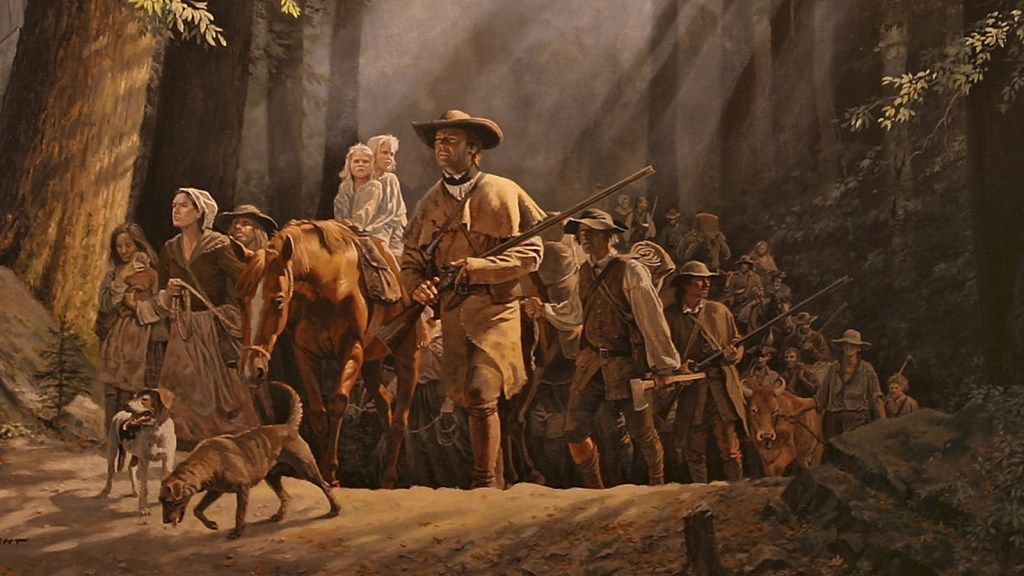
Daniel Boone leading settlers into Kentucky
Perhaps one of the more recognized books I dove into this past year was Empire of the Summer Moon: Quanah Parker and the Rise and Fall of the Comanches, the Most Powerful Indian Tribe in American History by S.C. Gwynne. Maybe due to Joe Rogan’s fascination with the book and Comanches it seems to have made a comeback even though the book was published in 2010. It was certainly eye opening to the settling of Texas. Empire of the Summer Moon has been widely praised for its depth of research, vivid storytelling, and balanced portrayal of both the Comanches and the white settlers who sought to conquer them. It is a compelling and powerful book that sheds new light on a pivotal moment in American history and the enduring legacy of the Comanche people.
The book begins by describing the Comanches’ traditional way of life as nomadic hunters and warriors on the vast plains of what is now Texas, Oklahoma, and Kansas. Gwynne chronicles their rise to power in the 18th and 19th centuries, as they became the dominant force on the Great Plains, mastering the horse and using their formidable skills as warriors to raid and plunder neighboring tribes and white settlements.
Other than the newly arrived white settlers of the 18th and 19th centuries, the Comanches had no shortage of rivals that contributed to their emphasis on warrior culture, nomadic lifestyle and raiding tendencies. One of the Comanches’ main rivals were the Apache, who were also a nomadic tribe and shared some cultural similarities with the Comanches. However, the two tribes were often in conflict over resources and territory, and the Comanches generally had the upper hand due to their larger numbers and superior military tactics.
Another significant rival of the Comanches were the Spanish, who established a foothold in the region in the 16th century and were among the first Europeans to encounter the Comanches. The Spanish attempted to establish settlements and missions in the Comanche territory, but were often met with resistance and violence from the Comanches. Despite these rivalries, the Comanches also had alliances and trading relationships with some neighboring tribes, including the Kiowa and the Cheyenne. These alliances were often fluid and changed depending on the circumstances.
Enter the Federal Government of the United States:
The US government’s policy towards Native American tribes during this period was one of assimilation and forced relocation. The government established reservations, where tribes were expected to live and farm according to European-American standards. However, many Comanches resisted this policy and continued to live their traditional way of life on the open plains. In response to this resistance, the US Army launched a series of brutal campaigns against the Comanches in the late 19th century. These campaigns were marked by atrocities on both sides, with the Comanches raiding settlements and the Army responding with massacres and forced relocations.
One of the most infamous events in this conflict was the Sand Creek Massacre of 1864, when a Colorado militia attacked a peaceful encampment of Cheyenne and Arapaho, killing around 150 men, women, and children. The US Army also targeted Comanche food sources, especially the buffalo herds on which they relied for survival. This tactic, along with the forced relocation of Comanches to reservations, ultimately led to the decline of the tribe and the loss of their traditional way of life.
In addition to the violence and displacement, the Comanches also suffered from disease and cultural suppression. The government attempted to eradicate their traditional religion and culture, and many children were sent to boarding schools where they were forced to adopt European-American customs.
Cynthia Ann Parker and Quanah Parker are certainly two of the more highlighted characters in this book and their lives serve as a representation of this complex time period in American history.
Quanah Parker was one of the most famous and controversial figures in Native American history. He was the son of Comanche Chief Peta Nocona and Cynthia Ann Parker, a white woman who had been captured by the Comanches as a child and raised in their tribe. Quanah was born in the mid-1800s, and he grew up in the Comanche way of life, learning the skills of hunting, warfare, and leadership from his father and other tribal elders.
As a young man, Quanah was known for his bravery and his strategic thinking. He became a leader of the Quahadi band of Comanches, which was one of the most powerful and independent groups on the plains. He was involved in many battles with the US Army and other Native American tribes, and he was known for his fierce resistance to efforts to subdue the Comanches and force them onto reservations.
Quanah’s mother, Cynthia Ann Parker, was also a figure of great interest and controversy. She had been captured by the Comanches in a raid on her family’s homestead when she was just nine years old, and she was raised in the tribe for over two decades. She became fully assimilated into the Comanche culture, marrying a warrior named Peta Nocona and having three children, including Quanah. In 1860, Cynthia Ann was captured by Texas Rangers during a raid on the Comanche camp, and she was forcibly taken back to her white family. She was unable to readjust to white society, and she spent the rest of her life longing to return to her Comanche family. She died in 1870, and her story became a symbol of the conflicts and complexities of the Native American-white relations in the West.
Quanah, on the other hand, lived on for many years after his mother’s death, becoming a respected leader and spokesperson for his people. He ultimately surrendered to the US government in 1875 and led his people onto the reservation, where he worked to negotiate for better treatment and more autonomy for the Comanches. He also became a successful rancher and businessman, and he worked to preserve his people’s culture and traditions. He died in 1911, leaving behind a complicated legacy as both a fierce warrior and a savvy negotiator who worked to protect his people’s interests in a rapidly changing world.
In conclusion, Empire of the Summer Moon: Quanah Parker and the Rise and Fall of the Comanches, the Most Powerful Indian Tribe in American History” by S.C. Gwynne is a book that should be read by today’s readers because it offers an insightful and compelling account of the history of the Comanche people and their interactions with European settlers and the US government.
The book sheds light on the complex and often violent history of the American West, including the conflicts and misunderstandings that arose between Native American tribes and European settlers. It also offers a nuanced portrayal of Quanah Parker, one of the most famous Native American leaders of the 19th century, and his efforts to protect his people’s interests and preserve their culture in the face of overwhelming challenges.
By reading this book, you can gain a better understanding of the experiences and perspectives of the Comanche people, as well as the broader historical and cultural context of the American West. The book also offers important insights into the ongoing challenges facing Native American communities today, including the struggle to protect their land, sovereignty, and cultural heritage.
Overall, “Empire of the Summer Moon” is a thought-provoking and informative book that offers a powerful reminder of the complex and often tragic history of the American West, and the ongoing importance of understanding and respecting the experiences and perspectives of Native American communities.
“The story of the Comanches is a reminder that history is never simple, and that the truth is often more complex and more painful than we would like it to be. It is a story of conflict, misunderstanding, and tragedy, but it is also a story of resilience, courage, and cultural richness.”
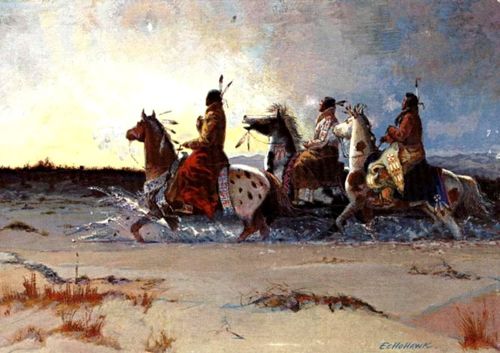
Comanche Painting by Brummett Echohawk
David and I both thoroughly enjoyed reading Undaunted Courage by Stephen Ambrose. Although we did a podcast on this book, I still felt like writing about it to include it in this “trilogy” of sorts. I found myself to be sad wrapping up the book before Ambrose’s writing style really made me feel like I was alongside the expedition. I have spent much time in that part of the country as well and have seen lots of the same sights they discovered.
Ambrose’s book is a detailed account of the expedition from its inception to its triumphant conclusion. He describes the challenges that Lewis and Clark and their crew faced, including harsh weather, treacherous terrain, and encounters with hostile Native American tribes. Ambrose also brings to life the personalities of the expedition’s members, including Sacagawea, the Shoshone woman who accompanied the group as an interpreter and guide.
In addition to chronicling the events of the expedition, Ambrose also provides historical context for the journey. He explores the political climate of the United States in the early 19th century, including the tension between the United States and Great Britain, and the conflict between the United States and Native American tribes. Ambrose also delves into the scientific discoveries made by Lewis and Clark, including their observations of the flora and fauna of the western wilderness.
Overall, Undaunted Courage is a compelling narrative of one of the greatest American adventures of all time. Ambrose’s vivid descriptions and meticulous research makes the story come alive, and I was left with a deep appreciation for the bravery and determination of the Lewis and Clark Expedition.
During their expedition, Lewis and Clark made a number of significant scientific discoveries that helped expand the knowledge of the western territories of the United States. Lewis and Clark were tasked with collecting samples of the plants, animals, and minerals they encountered on their journey. They collected and documented over 200 different species of plants, many of which were previously unknown to science. Some of the new species they discovered include Lewisia redviva, Lewis’s Mock Orange, and Clarkia pulchella.The expedition’s zoological findings were also significant. They documented dozens of new species of animals, including the pronghorn antelope, the grizzly bear, and the bighorn sheep. They also observed and recorded the behavior of various animals, including the salmon and the prairie dog.
Lewis and Clark created detailed maps and charts of the western territories they explored. They surveyed and documented the topography of the region, including the Rocky Mountains, the Missouri River, and the Columbia River. Their maps and charts were later used by other explorers, settlers, and scientists. The expedition’s interactions with Native American tribes provided valuable insights into the cultures and traditions of these communities. Lewis and Clark documented the languages, customs, and social structures of the tribes they encountered, and they also collected and recorded Native American artifacts and objects.
President Thomas Jefferson at the time chose two fascinating men to lead this expedition, I wanted to point out the differences in their backgrounds.
Family background: Meriwether Lewis was born in 1774 in Virginia, into a family of planters. His father died when he was young, and he was raised by his mother, who was a strong influence on his education and character. William Clark was born in 1770 in Virginia, into a family of farmers. He was the ninth of ten children and was close to his older brother, George Rogers Clark, who was a Revolutionary War hero.
Education: Lewis received a private education and was an avid reader, particularly of scientific and philosophical works. He was also trained in the military and served as an officer in the Army. Clark had little formal education but was well-versed in wilderness skills and had experience as a soldier and a frontiersman.
Personality: Lewis was known for his intelligence, curiosity, and drive. He was an excellent organizer and planner, and he had a deep interest in science and exploration. Clark was known for his practicality, resourcefulness, and leadership skills. He was a skilled outdoorsman and had experience dealing with Native American tribes.
Military experience: Lewis was an officer in the Army and had experience dealing with military logistics and organization. Clark also had military experience and had served in the Army during the Northwest Indian War.
Despite their different backgrounds and experiences, Lewis and Clark worked well together and complemented each other’s skills during the expedition. Their partnership was key to the success of the expedition.
After the conclusion of the expedition Lewis and Clark had differing paths though. Meriwether Lewis returned to Washington D.C. in 1807 and was appointed Governor of the Louisiana Territory by President Jefferson. He struggled in this role and faced criticism and legal troubles, including accusations of mismanagement and embezzlement. In 1809, Lewis died under mysterious circumstances while traveling to Washington D.C. to defend himself against these accusations. Some historians speculate that he may have committed suicide, while others suggest that he was murdered.
After the expedition, Clark returned to St. Louis, where he was appointed as the Superintendent of Indian Affairs for the Louisiana Territory. He served in this role for over 30 years, working to establish peaceful relationships with Native American tribes and negotiate treaties on behalf of the U.S. government. In 1822, he was appointed as the Governor of the Missouri Territory, a position he held until 1838. Clark remained an important figure in Missouri politics and society until his death in 1838.
Wrapping up, all good books lead you to another interest or topic in my opinion. It is like a web that ultimately you can trace from book to book. John Colter was a member of their expedition that even before reading the book, I knew his name due to my time in Montana / Wyoming visiting Yellowstone National Park and Grand Teton National Park. Many areas and landmarks bear his name. After the expedition concluded, Colter decided to stay out west.
Colter left the expedition in 1806 and embarked on his own journey, traveling through what is now Wyoming, Montana, and Idaho. He was the first white man to explore Yellowstone National Park area, and he witnessed and recorded its geothermal wonders, including geysers and hot springs.
Colter’s adventures were not without danger, and he narrowly escaped death multiple times while traveling alone in the wilderness. Perhaps his most famous escape occurred in 1808, when he was pursued by a group of Blackfeet Indians after he accidentally stumbled upon their camp. Colter managed to outrun his pursuers and escape into the wilderness, covering a distance of over 250 miles in just 11 days.
John Colter’s exploits were widely publicized and became the stuff of legend in American history. He was celebrated as a symbol of American courage, endurance, and adventure, and his legacy continues to be remembered and celebrated today. I certainly plan on reading a book about him in the near future. Also I wouldn’t mind reading more specifically about William Clark.
This is a must read, I firmly believe Lewis and Clark are in the Top 10 most important Americans and I stand by that. Overall, Undaunted Courage is a compelling narrative of one of the greatest American adventures of all time. Ambrose’s vivid descriptions and meticulous research make the story come alive, and you will be left with a deep appreciation for the bravery and determination of the Lewis and Clark Expedition.
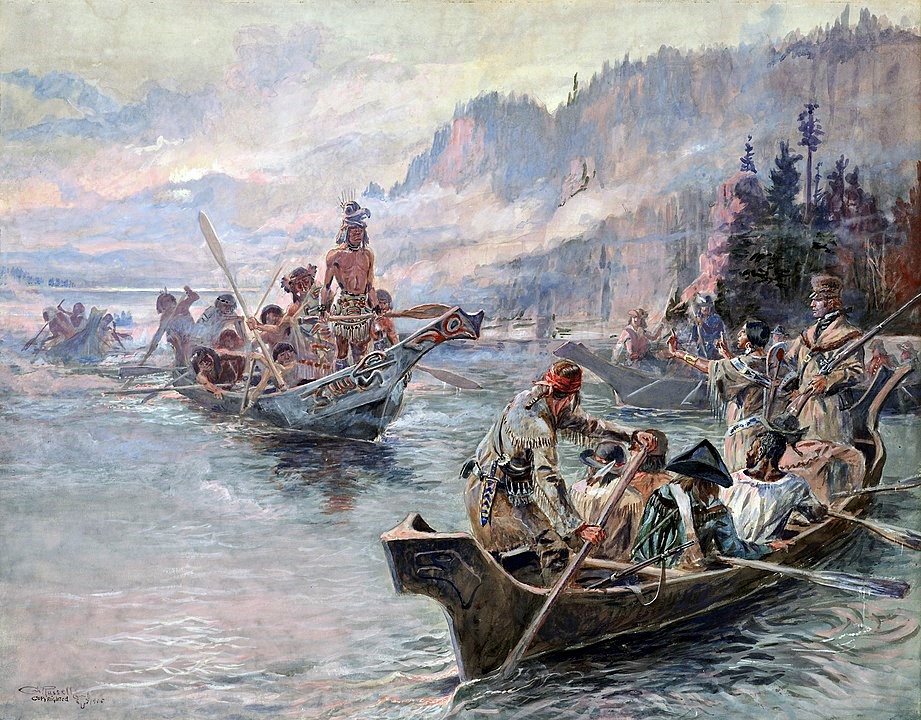
Lewis and Clark on Missouri River
Concluding this lengthy post covering three books, trying to digest it all in one sitting would be a challenge but thankfully I read these books over the course of several months. As my old history professor in college would say, “what do we make of all this?” Well, one major point I would make is if you want to have a strong opinion on the growth and settlement of this country one way or the other, you owe it to yourself to do the research. Study the characters, read about the interactions and attempt to have some understanding of the mindsets the Native Americans and Explorers had at the time. Another takeaway I had was, what a wild continent North America is! Although somewhat tamed and settled now, this land with its’ massive mountain ranges, giant grizzly bears and roaring rivers are nothing to be trifled with. I have seen some of the sights that these great men and women discovered or trekked across and it is very humbling.
We also have a tendency of having selective memory in history, we remember the great Daniel Boone blazing a trail into Kentucky, we remember Lewis & Clark making it to the Pacific and we idolize the Texas Rangers. We selectively forget things like Daniel Boone was at times rash putting his entire family in danger and being constantly in debt, Meriwether Lewis was an alcoholic (although probably struggled with depression and self medicated), William Clark sold his slave York (separating him from his family) that had been with him pretty much since birth and survived the entire expedition to the Northwest and honestly the Texas Rangers sounded like an ill-trained and ill-equipped bunch of drunks most of the time fighting poorly against the Comanches. Those criticisms sound harsh but they are a part of the whole picture, William Clark and Daniel Boone are quite frankly still two of my heroes. I would be fortunate to have an ounce of their courage and fortitude. Lastly, on a more positive note, a primary takeaway for me was the images of these brave people capture the American spirit, the determination to make a better life to etch their names into the history books and seek adventure. The powerful Comanche tribe on the plains, a warrior culture perhaps greater than even the Mongols one could argue. Lewis and Clark along with Sacagawea, York, Colter and company navigating their way through an unknown and unmapped land negotiating and trading with various tribes. The bravery, coordination and belief they had to keep going is truly inspiring. Daniel Boone, fighting and surviving three wars, discovering and settling a new land and living to his 80s, well that is just amazing.
I feel like this time period gets overlooked because it is after the Revolutionary War and before the Civil War era that we are still rightfully fascinated with but don’t forget Westward Expansion and these true legends that lie in the bookshelf between the heroes of the Revolutionary War and the wide array of characters, conflicts and debates of the Civil War .
Written by Michael McPhail
 Brains and Brawn