Very few people from history occupy the space that Gaius Julius Caesar does. A military leader, political leader and religious leader all wrapped up into one. I recently had the pleasure of reading one of the two surviving works from the polarizing emperor himself, The Conquest of Gaul also commonly referred to as the Gallic Wars. Essentially it is a collection of writings from Caesar recounting his campaigns when he was proconsul around 58 B.C. to 49 B.C. When Caesar refers to “Gaul” it is the geographical area of modern day France, Belgium, Netherlands, Luxembourg, Switzerland and Northern Italy. I wouldn’t include Britain or Germany in this category because Caesar seems to notate those areas with special emphasis. Gaul is also made up a wide variety of people groups such as the Aedui, Belgae, Suebi, Helvetii, Sequani and many more. It is his account of these campaigns and undoubtedly he and his Roman legions are the stars. Regardless, I haven’t had the opportunity to read much Roman history to this point and I found it to be quite compelling.
The Conquest of Gaul is divided into eight books addressing different campaigns some of the titles of these chapters include: The Conquest of Belgic Tribes, Invasions of Germany and Britain and the rebellion of Vercingetorix along with the rebellion of Ariovistus and the Suebi to name a few. Obviously Caesar had his hands full, the combat and factions in this book truly amaze me. I thought modern day geopolitical tensions were high. Caesar refers to his campaigns in “seasons” almost like a sport reference.
A notable encounter in this book is Caesar’s campaign against the German king Ariovistus. Who had been invited by the Gauls to assist them in their wars against other tribes. However, he later turned on them and established himself as a ruler in the region. Caesar writes, “The German king Ariovistus had settled in their (Sequani) territory and seized a third of their land- the best in all Gaul. Ariovistus had shown himself arrogant and cruel tyrant, demanding the children of every man of rank as hostages, and making an example of them by the infliction of all manner of tortures.” One thing to note is the exchange of hostages, throughout this book the exchange of hundreds of hostages from tribes to Caesar and / or other warlords in Gaul is extremely common as a form of currency almost. Seemed like just a way of life and I am sure Rome subsisted to some degree on a slave trade of sorts.
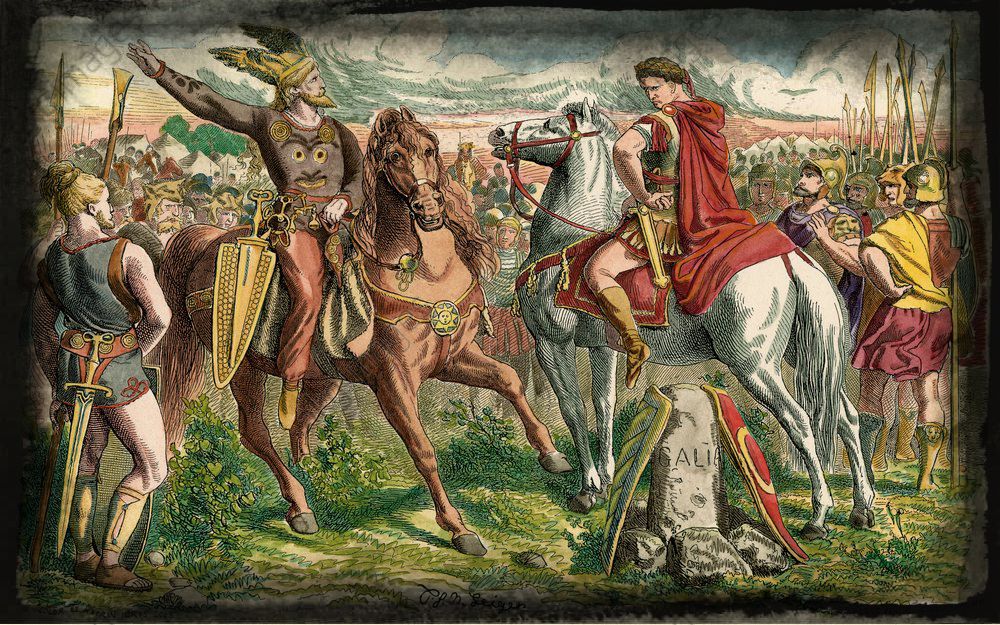
As Ariovistus expands his kingdom in Gaul, he says of Caesar (Caesar says Ariovistus says this so take it with a grain of salt), “No one has ever fought me without bringing destruction upon himself. Let him attack whenever he pleases. He will discover what German valor is capable of. We have never known defeat.” There is also a dramatic meeting between Caesar and Ariovistus in a field (pictured above), basically Ariovistus offers to be Caesar’s extension of sorts in Gaul if he is allowed to retain it, if he needs to wage a war on anyone he will do it for Caesar. They don’t reach an agreement.
A dramatic battle ensues and there is a portrayal of Caesar in the trenches, “Caesar snatched a shield from a soldier in the rear, made his way into the front line, addressed each centurion by name, and shouted encouragement to the rest of the troops, ordering them to push forward and open out their ranks, so that they could use their swords more easily.” The battle by Caesar’s account is back and forth between the armies eventually by the heroics of Roman leadership such as Publius Licinius Crassus, the Romans win the day and expel the fleeing Ariovistus from Gaul.
On a side note, I really found myself liking all the badass Roman soldier names scattered throughout the book: Lucius Aemlius (cavalry commander), Titus Balventius (a chief centurion), Quintus Fufius Calenus (general), Marcus Petronius (centurion of the 8th legion) to name a few. There are also Romans most of us would recognize that are referenced: Marcus Tullius Cicero (the famous orator, ended up fighting against Caesar in civil war but was pardoned), Decimus Junius Brutus (et tu, brute?) and Marcus Antonius (aka Mark Antony) all were involved in his conquest of Gaul.
Some very valuable historical information Caesar gives us is specifically about the culture of the “Gauls”. He writes of the Germans, “Their diet, daily exercise, and the freedom from restraint that they enjoy- for from childhood they do not know what compulsion or discipline is, and do nothing against their inclination- combine to make them strong and as tall as giants. They inure themselves, in spite of the very cold climate in which they live, to wear no clothing but skins- and these are so scanty that a large part of the body is uncovered. They absolutely forbid the importation of wine, because they think it makes men soft and incapable of enduring hard toil.” Hence why the Germans were a very tough opponent for the Romans.
He writes of the Britons, “All the Britons dye their bodies with woad, which produces a blue color, and shave the whole of their bodies except the head and the upper lip. Wives are shared between groups of ten or twelve men, especially between brothers and fathers and sons.”
He writes of the Celts, “The Druids officiate at the worship of the gods, regulate public and private sacrifices, and give rulings on all religious questions. A lesson which they take particular pains to inculcate is that the soul does not perish, but after death passes from one body to another.” Caesar goes on to reference the wicker man practice of the Gauls, “Some tribes have colossal images made of wickerwork, the limbs of which they fill with living men; they are then set on fire, and the victims burnt to death. They think that the gods prefer the execution of men taken in the act of theft or guilty of some offence; but when they run short of criminals, they do not hesitate to make up with innocent men.” Caesar references much more but it is a fascinating description of the early European tribes.
Wrapping up, the rebellion of Vercingetorix is a key highlight of this book as well. He was a chieftain of the Arveni tribe who had a vision of a somewhat unified Gaul. He managed to temporarily gain control of much of the territory. Vercingetorix’s strategy was to avoid direct confrontation with the Romans and instead use guerrilla tactics to wear them down. He adopted a “scorched earth” policy, burning crops and villages to deny the Romans resources and shelter.
However, Vercingetorix’s forces were ultimately defeated by Caesar’s more experienced and better-equipped army. Vercingetorix surrendered to Caesar in 52 BCE after the Battle of Alesia, in which Caesar’s forces successfully besieged his stronghold. Vercingetorix was taken to Rome as a prisoner and was held in captivity for six years before being publicly executed in 46 BCE during Caesar’s triumphal parade. The rebellion against Caesar was a significant event in the history of Gaul, and it demonstrated the power and organization of the Roman Empire.
In conclusion, Julius Caesar’s book Conquest of Gaul provides valuable insights into the military and political tactics used by the Romans during the conquest of Gaul. The book not only provides a detailed account of the events that took place during the conquest but also provides a glimpse into the mindset of the Roman army and their approach towards warfare.
Caesar’s ability to lead his troops and maintain discipline in the face of adversity is a testament to his military prowess. The book is a valuable source for historians, scholars, and military leaders who seek to understand the strategies and tactics used by the Romans during this time.
Despite its importance, the book has been criticized for its biased portrayal of the Gallic people and for its glorification of Caesar’s achievements. However, it remains an essential piece of literature that offers valuable insights into the Roman Empire’s expansion and the challenges it faced during its conquests.
I would also like to recommend Dan Carlin’s Celtic Holocaust (https://youtu.be/iT92zx790c4) and the Kings and General’s documentary Caesar in Gaul (https://youtu.be/LRV185XaMIM).
Written by Michael McPhail
Link to purchase The Conquest of Gaul by Julius Caesar: https://amzn.to/3YBjVXt
 Brains and Brawn