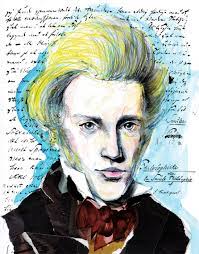
N.B. The first section of Kierkegaard’s 1843 publication, Either/Or, is covered in a prior post titled “A Fragment of Life”, dated 01/20/2023.
We move now to the second, and by far more uplifting, portion of Kierkegaard’s first great work. The scene is set to progress from the aesthetic to the ethical stage when our pseudonymous author, Victor Eremita, finds a collection of letters from a retired judge named Judge Vilhelm [yet another pseudonym]. In this correspondence, Judge Vilhelm attempts to convince A of the superiority of the ethical stage of life over the aesthetic stage of life, arguing that the aesthetic can be enjoyed within the framework of the ethical. However, the wanton pilgrimage of pleasure must be restrained to make way for values, responsibility, and virtue. Judge Vilhelm lays out his arguments in four sections, which I will discuss in order.
In his first section,” The Aesthetic Validity of Marriage”, Judge Vilhelm defends marriage as the ideal arrangement for life as opposed to the seductive lifestyle offered by Don Giovanni or Faust. There is a certain candor between Judge Vilhelm and A, and the reader is to assume that the two have a relationship of mutual respect, albeit frank disagreement over principle matters. Judge Vilhelm, partly in jest but with an overtone of severity, remarks to A:
“This much is certain: had I a daughter of an age where there could be any question of her being influenced by you, I would most assuredly warn her, the more so if she were also intellectually gifted.”
This should come as no surprise given the escapades recounted in “The Seducer’s Diary”. Still, Judge Vilhelm has a soft spot for A and admits that even he has the propensity to be deceived by his cool charisma.
“I am letting myself be carried away by your exuberance, by the apparently good-natured wit with which you mock everything, that I am letting myself be borne away into this aesthetic-intellectual intoxication in which you live.”
This segment is an apt description of the entire lifestyle espoused by A in “Either”: an aesthetic-intellectual intoxication. It should also be noted that this lifestyle, while wrapped in “apparently good-natured wit” is also at its core a mockery of life itself and all of the possible for good that exists therein. While the veneer is wholesome, the core is rotten. Since the primary mode exercised by A is in the seduction and deception of romantic partners with no intent for commitment, Judge Vilhelm directs his attention towards juxtaposing this false lifestyle with marriage as the ultimate interpersonal commitment.
Judge Vilhelm outs A as a coward; one running from vulnerability, as it will expose the character and substance of A as flimsy and unremarkable. To avoid this, A positions himself in a shroud of aesthetic-intellectual-secrecy that is only truly a diversion and a farce.
“It needs courage to reveal oneself as one truly is, it needs courage not to want to purchase one’s freedom from a little humiliation when one can do that through a certain secretiveness, not to want to purchase oneself a little addition to one’s stature when one can do that by being reticent. It needs courage to want to be healthy, to want the truth in all honesty and candor.”
The last line in the above quotation comes with an uncanny power and is in my opinion the conclusive statement of the entire work. “It needs courage to want to be healthy”. A lacks the courage to want to be healthy. He is lost so far in his fever dream that he cannot even recognize the state of unhealth that he is in. He has wrapped himself in a cocoon of furtiveness to avoid detection by the outside world. Judge Vilhelm, in an act of love, will not allow this behavior to go unchecked forever.
“Your activity is designed to keep yourself hidden, and in that you succeed, your own mask is the most enigmatic of all; for you are nothing and exist merely in relation to others, and you are what you are in this relation.”
The reader can assume [though never has the benefit of a response from A] that these words cut like a knife: “your own mask is the most enigmatic of all”. A wears a mask to portray and identify himself that not even he understands. He exists only in his relation to others and is defined by his relation to others, but ultimately he is nothing. His existence is nothing so long as he wears the mask. The substance of his enigmatic activity, in which he keeps himself hidden in his relation to others, does not allow for him to be defined in relation to others and therefore does not allow him to truly exist. In essence, Judge Wilhelm is implying that the aesthetic life does not permit A to exist at all. He continues:
“But he who cannot reveal himself cannot love, and he who cannot love is the unhappiest of all. And you do this wantonly, you train yourself in the art of being a riddle to everyone. My young friend! What if no one bothered to guess your riddle? What pleasure would you get out of it then?”
In a chilling rejoinder to A’s previous chapter “The Unhappiest One”, Judge Vilhelm condemns the man who cannot be vulnerable in relation to others to the fate of being the unhappiest one of all. To make matters worse, he points out that A has been doing this with reckless abandon and frivolity, deriving enjoyment out of making his life into a riddle for others to solve. A knows all the while that there is no answer to his riddle, and that he poses it simply for his own amusement. Judge Vilhelm puts a swift end to this by reminding A that there will come a time when no one bothers to guess his riddle, and no pleasurable ending will result from making his life into an unsolvable mystery. Humans are relational creatures, and it is no paradox to insist that others intimately engage in a state of non-vulnerability. There can only intimacy with vulnerability.
The second section, “Equilibrium Between the Aesthetic and the Ethical in the Development of Personality” demonstrates that A’s refusal to engage in the ethical has plunged him into a state of self-loathing and self-indulgence known as melancholy. As demonstrated in “Essays Read Before the Symparanekromenoi”, A wears his melancholy like a badge of honor. Judge Vilhelm refutes this vehemently:
“But melancholy is sin, really it is a sin as great as any, for it is the sin of not willing deeply and sincerely, and this is a mother to all sins.”
Melancholy disavows oneself of responsibility and existence. Using Emperor Nero [who followed a similar logical progression as A] in example, Judge Vilhelm shows that the inevitable endpoint of melancholy is suicide.
“Even a suicide does not really want to do away with his self; he, too, has a wish, he wishes he had another form of his self, and there could well be a suicide, therefore, who was convinced in the highest degree of the immortality of the soul but whose whole being was so confused that he thought to find in this way the absolute form of his spirit.”
This concept is quite fascinating to me, that even in the act of committing suicide, the act is not really the desire of the person who is committing suicide. The true wish is that the individual had another form of his self. Finding your way to this different form requires wading through the quagmire of confusion to find the absolute form. This requires an immense amount of courage, as Judge Vilhelm reminded A: “it needs courage to reveal oneself as one truly is”.
The final sections of this work, “The Last Word” and “The Edifying in the Thought That Against God We Are Always in the Wrong” encourage subservience to an absolute within the framework of existential individualism. In characteristic Kierkegaard style, Judge Vilhelm concludes the work with the following existential benediction:
“Ask yourself, and keep on asking until you find the answer, for one can recognize a thing many times and acknowledge it, one can want a thing many times and attempt it, yet only the deep inner movement, only the indescribable motions of the heart, only these convince you that what you have recognized ‘belongs unto you’, that no power can take it from you; for only the truth that edifies is truth for you.”
At the end of this great work, the only truth that edifies is truth for you. What will the reader choose as his truth? Two ways, that of the aesthete and that of the ethicist are presented as viable options. In his sequel novel, Stages on Life’s Way, Kierkegaard goes on to show even more modes of existence. For the purposes of Either/Or, he gives us the aesthetic option of immediacy, whether refined or unrefined, to choose from. The ethicist counterpoint is that of commitment. While Judge Vilhelm gets the last word, the brilliance in the writing is that A never gets a chance to respond to the Judge’s rebuttal. In fact, the words of A stand on their own. In the end, everyone is going to choose the mode that seems best and most edifying to them.
This brief post has not done justice to the depth of themes that exist within Kierkegaard’s first great work. I encourage all interested readers to dive into the pages of this Danish philosopher. In my biased opinion, he remains the greatest Western philosopher of modernity and I look forward to venturing out into the deep waters of existential angst with him in his many subsequent works.
Written by Cal Wilkerson
Link to purchase Either/Or: A Fragment of Life by Soren Kierkegaard https://amzn.to/3T0Qvke
 Brains and Brawn