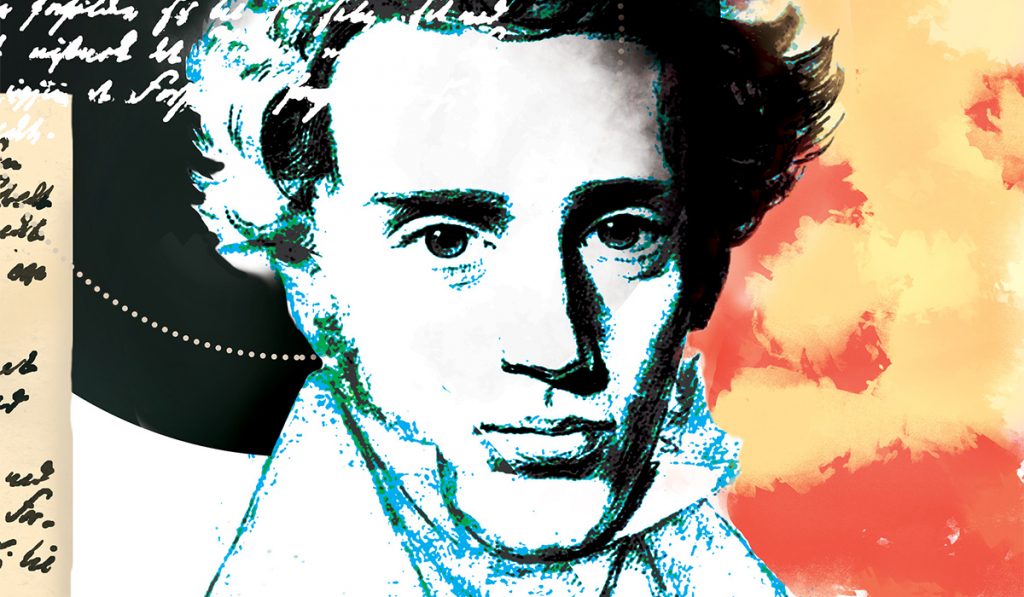
“I see it all perfectly; there are two possible situations – one can either do this or that. My honest opinion and my friendly advice is this: do it or do not do it – you will regret both.”
To say that Soren Kierkegaard is a philosophical method actor might not fully capture his capacity for disjointed monologue that he displays in his first published work, Either Or: A Fragment of Life. The subtitle of the work itself betrays the fragmentary hold that Kierkegaard has on his own relationship to existence and sets the stage for a momentous work in role play. This work was published in two volumes in 1843 under the pseudonym Victor Eremita (“Victorious Hermit”, in Latin). Its two-part narrative outlines two possible modes for human existence: the aesthetic mode and the ethical mode. Either, the first and lengthier section, argues for the aesthetic mode; and Or, the second and shorter section, argues for the ethical mode. This combined work was difficult to read and complicated to interpret, but it is worth reading for the interplay of two distinct modes of life both being pseudonymously exposited by a tortured philosopher, regarded by some as the father of existentialism.
Either begins with Victor Eremita finding a collection of papers written by “the Aesthete” (referred to in the shorthand as ‘A’). It is further subdivided into sections. In Diasplamata, A introduces us to the concept of despair. He uses several aphorisms to illustrate despair. As an example, he gives the reader the clown. “A fire broke out backstage in a theatre. The clown came out to warn the public; they thought it was a joke and applauded. He repeated it; the acclaim was even greater. I think that’s just how the world will come to an end: to general applause from wits who believe it’s a joke.”
He moves from despair in Diasplamata to a very lengthy extolling of Mozart as the greatest musical composer of all time, especially in his work Don Giovanni. This section is titled The Immediate Stages of the Erotic, or Musical Erotic. He argues that music expresses the spirit of sensuality greater than language, or prose, and that no one does this better than Mozart. It is here that he introduces the theme of the seducer, such as Don Juan, who is the ultimate aesthete operating under the auspices of deception. A counterpoint to this seduction is Faust, whose seduction falls under the category of the ethical rather than the aesthetic. In comparing the two, A points out that Don Juan seduced 1,003 women, but Faust seduces just one. Despite the numerical difference, it is implied that the seduction of Faust is the far more sinister, as it is an intellectual seduction and one that can change an individual to the very core of their beliefs:
In speaking of Faust, A writes – “the moment he wants to implicate others in his doubt, an impure passion can easily become mixed up in it. As soon as the doubt is made to implicate others, an envy is involved that takes pleasure in depriving them of what they take to be certainties… depriving her of her faith is no task for him; on the contrary, he feels it is only faith that makes her the great thing she is.”
The next section, Essays Read Before the Symparankekromenoi, is a bizarre collection of lectures from A to a club that titles itself the “fellowship of the dead” and writes posthumous papers. These three essays focus on historical figures who perfected the art of melancholy in one way or another. The first essay deals with tragedy, as captured most poignantly in the Greek story of Antigone. The second essay, “Shadowgraphs: A Psychological Pastime”, reflects on Mozart’s Elvira and Goethe’s Margaret, who were two victims of seduction for Don Juan and Faust respectively. In it he traces the evolution of desire to grief when love becomes duplicity. The third and most bizarre essay is titled “The Unhappiest One” and deserves special attention.
In this essay, A rightly acknowledges that if there exists an unhappy person in the world, there must also exist a comparative [unhappier] and a superlative [unhappiest]. He explores several historical figures to see if they fit the bill, ranging from Job, the father of the prodigal son, Abraham, or perhaps even Christ. He believes that he has found the tombstone of this unhappiest of all individuals, and reflects on the epigraph: “For there he stands, the emissary from the kingdom of sighs, the elected favorite of suffering, the apostle of sorrow, the silent friend of pain, the unhappy lover of memory, confounded in his memory by the light of hope, deceived in his hope by the shadows of memory”.
My particular copy left out an included section of Either titled “The First Love”, as it focused on a rather obscure Danish play that would require a higher level of knowledge and context to truly appreciate. Perhaps some day when I am better versed in the intricacies of Danish playwrights, I will return to read this section, but as it stands I was content with the omission on my first pass through this work.
The penultimate section of Either was by far my favorite and the one that intrigued me the most: Crop Rotation: An Attempt at a Theory of Social Prudence. In it, the aesthete postulates that it is boredom that is the root of all evil and must be avoided at all cost. He draws the analogy of the farmer who uses crop rotation to keep the soil fertile, and proposes that a man must do the same, constantly changing himself to remain interesting. He encourages all men to avoid any situation that would lock them into a sense of constancy and lead to boredom – namely friends, family, and marriage. As soon as one has an experience that beckons towards constancy, they must do everything in their power to forget it.
“To forget – all men want to do that… but forgetting is an art that must be practiced beforehand. Being able to forget depends always on how one remembers, but how one remembers depends always on how one experiences reality. The person who sticks fast in it with the momentum of hope will remember in a way that makes him unable to forget.”
The final, and by far best-known section in A’s portion of the book, is “Diary of a Seducer”. Building on “Crop Rotations”, this section espouses that what is interesting is of the most value and justifies the devastation that others might be subjected to along the way. The “Diary” is written by ‘Johannes the Seducer’, and follows the slow manipulation of a girl named Cordelia. A previously simple and rather boring girl, Johannes grooms her to be what he considers interesting and convinces her to fall in love with him. He becomes engaged to her, and then he plants the idea in her head of questioning the engagement. He then succeeds in having her break off the engagement herself, all part of his baleful plan to make her more interesting in his eyes.
“And this can explain why, when God created Eve, He let a deep sleep fall upon Adam; for woman is the man’s dream.”
This is a deeply twisted plot line that involves a very lengthy courtship full of guile and artifice. Johannes convinces his friend Edward to court Cordelia while they both pay visits to Cordelia’s Aunt Jette’s house and gains the confidence of all three while seeming disengaged and aloof. Once Edward is firmly in love with Cordelia and confides in Johannes that he intends to propose to her, Johannes proposes to Cordelia in the ultimate act of deceitfulness. Because Johannes had expended so much effort in winning the trust of Aunt Jette, Cordelia agrees to the engagement. Johannes then initiates the second part of his plan which is to make Cordelia fall madly in love with him to such a degree that she begins to view the actual engagement and future marriage as an unnecessary trapping of society. Cordelia, of her own volition though surreptitiously guided by Johannes, breaks off the engagement while still remaining madly in love with him. After a cumulative act of their love, Johannes reveals that it is the tormented love that is the most interesting, and that his entire ruse was to turn Cordelia into something more interesting, a tragic unification of the aesthetic and the ethical.
The great irony behind all of Either is that it mirrors the actual events of Kierkegaard’s own life. Kierkegaard began courting his future fiancé, Regine Olsen, while visiting the home of Mrs. Catrine Rotrdam. She was immediately impressed by his intellect and elocution. Their infatuation with each other grew deeper while Olsen was being tutored by Johan Frederik Schlegel [her future husband]. Kierkegaard pursued her over a very long period of time, from her age of 15 to 24. He eventually asked her father’s blessing to marry her, and the two became engaged. He almost immediately began to have doubts about his ability to be a husband and redirected his energies towards his seminary studies. Their relationship grew more and more distant.
He ended their engagement a mere 11 months after the proposal, ostensibly as a kindness to Regine. He believed that there was “something spectral about me, something no one can endure who has to see me every day and have a real relationship with me.” He also believed that he was being called by God to a life of celibacy and that his declining health portended a short remainder to his life at any rate. He wrote her a final letter and returned the engagement ring. Regine later said that Kierkegaard “sacrificed love… for the sake of writing.”
Kierkegaard would go on to become a prolific writer, and considered by many to be the father of modern existentialism. He plunged into a passionate and deep introspection, tinged with nearly equal measures of Christianity and perpetual melancholy. The continuing correspondence between the two and public scandal that ensued in Copenhagen is the subject for a much lengthier work but suffice it to say that Olsen was devastated, and that Kierkegaard later wrote to her: “above all, forget the one who writes this; forgive someone who, whatever else, could not make a girl happy.”
Perhaps Kierkegaard was mentally ill, or perhaps he was pure genius. Whatever the truth may be, he did leave one of the most profound bodies of existential philosophical writings still extant to this day. He is the ultimate philosophical method actor: one who becomes the characters in the story that he writes. Even a brief read through of the paragraphs above will show that he was writing Either from personal experience, and not from a theoretical vantage point. I do not condone what he did to Regine Olsen, but there was likely no other way for him to produce the philosophical works that he did. His melancholic philosophy was born out of tragedy, and he may rightly be considered “The Unhappiest One” of all.
He is the clown who cries out fire in the theater, to raucous applause. He is Faust, foregoing the seduction of 1,003 for the beguilement of the one. He is Job, the emissary from the kingdom of sighs. He is the farmer, rotating his crops and attempting to forget what cannot be forgotten. He is Johannes the Seducer, the tragic lover of Cordelia. Or he is not. And to exonerate himself he must first demonize himself, create a caricature of himself, and use the pen to liberate and show that Or is possible after making a choice that society cannot understand.
“If you marry, you will regret it; if you do not marry, you will also regret it; if you marry or do not marry, you will regret both.
Laugh at the world’s follies, you will regret it, weep over them, you will also regret that; laugh at the world’s follies or weep over them, you will regret both; whether you laugh at the world’s follies or weep over them, you will regret both.
Believe a woman, you will regret it, believe her not, you will also regret that; believe a woman or believe her not, you will regret both; whether you believe a woman or believe her not, you will regret both. Hang yourself, you will regret it; do not hang yourself, and you will also regret that; hang yourself or do not hang yourself, you will regret both; whether you hang yourself or do not hang yourself, you will regret both. This gentleman, is the sum and substance of all philosophy.”
This post has been among the most somber that I have ever written. Kierkegaard did say that one should either read the whole of the work of not read it at all. Therefore, Or will be continued in a subsequent post.
Written by Cal Wilkerson

Cal Wilkerson at the gravesite of Soren Kierkgaard, Assistens Cemetery of Copenhagen, Denmark (04/01/2022)
Link to purchase Either/Or: A Fragment of Life by Soren Kierkegaard https://amzn.to/3T0Qvke
 Brains and Brawn