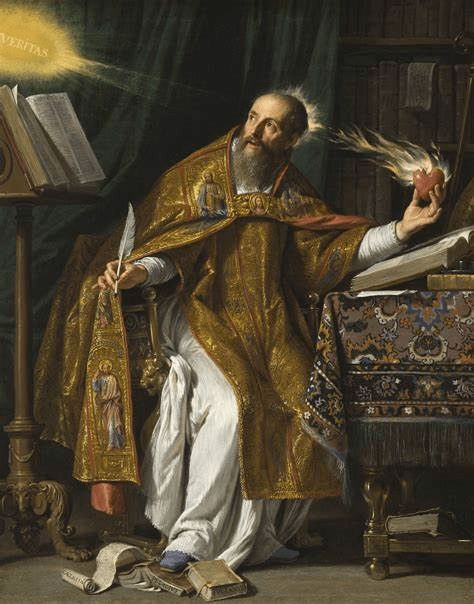
Recently, I have admittedly been reading a great deal of mindless high fantasy to the exclusion of more substantial works of literature. To find my way out of this slump, I decided to dust off the copy of St. Augustine of Hippo’s Confessions that has been occupying space on my bookshelf, unread, for years. I had a fragmentary understanding of the book’s framework from my Christian upbringing and from a class on Ancient Christianity that I took in college. What I did not realize was that Saint Augustine, besides being one of the most renowned Church Fathers, was also a philosopher in his own right.
The book is an autobiography of Saint Augustine’s life, written from infancy to his current age at time of writing [thought to be early 40s]. It is subdivided into 13 individual books, the first 9 being mainly autobiography and the last 4 being philosophical. It is interesting to note that this work is perhaps the first Western Christian autobiography, and one of the most complete accounts of any Western individual’s life in the 4th-5th century.
Briefly – Augustine was born in Thagaste [modern day Algeria] in 354 AD. His father, Patricius was a pagan and his mother, Monica, was a Berber Christian. He received a classical Latin education in Carthage, where his interests turned towards the study of rhetoric for a career in public speaking. He describes his early propensity towards a wild life of carnal indulgence, entering into an illicit relationship. While never revealing the name of his lover, he did have a son with her named Adeodatus [“gift of God”]. During this time, his father Patricius died, and Augustine became a “hearer” in the heretical sect of the Manicheans. They held that the world existed as a duality between darkness and light, and that one could detach from their immorality as it represented only one aspect of the dual nature of humanity.
Augustine then read Cicero’s Hortensius and dedicated himself to the study of philosophy, all the while maintaining his carnal indulgences and association with the Manicheans. In 384, Augustine finally rejected Manicheism and was converted to Catholicism after listening to the sermons of Bishop Ambrose on the story of St. Anthony. Famously, he heard a child tell him to “pick up and read”, prompting him to open a copy of St. Paul’s writings to Romans 13 where he read “not in riots and drunken parties, not in eroticism and indecencies, not in strife and rivalry, but put on the Lord Jesus Christ and make no provision for the flesh in its lusts.” Monica was overjoyed at the conversion of her son, but died a few months later, leaving Augustine in deep anguish.
His son Adeodatus died in 390, and Augustine left for Hippo where he became a Bishop in the Catholic Church. It was here that he wrote Confessions. I could not hope to, nor do I intend to, give an exhaustive account of this work. Far brighter minds than mine have already done that throughout the ages. Instead, I wish to highlight a few comical passages that show the relatability of Augustine, and a few weightier passages that show one of the greatest philosophical minds to every publish his thoughts.
As Augustine first began to truly grapple with the Christian faith, he famously asked of God, “’give me chastity and continence, but not yet.’ For I was afraid that you would answer my prayer at once and cure me too soon of the disease of lust, which I wanted satisfied, not quelled.” Such a line captures that honest humanity of Augustine, a flawed and licentious individual with an abundance of self-awareness that would not let him live the incongruent life he had embarked on.
I remember distinctly a period in my childhood when my pastor was preaching an extensive evening sermon series through the book of Isaiah. As I child I comprehended little of what was being exposited. Augustine, it seems, had a similar struggle with this major prophet. During his first introduction to Biblical readings he was told by his mentor “to read the prophet Isaiah.. but I did not understand the first chapters, and on the assumption that the rest of the book would be equally difficult, I laid it aside to be taken up again later, when I should be more used to the style in which God’s word is spoken.” To this day, Augustine and I are in a similar position with this great prophet’s work.
As for the weightier themes, Augustine touches brilliantly on the nature of knowledge, theodicy, memory, time, and creativity. Far ahead of his time, it is plausible that Augustine struggled with believing that he lived in a simulation. He writes on faith in sacred books, “I began to realize countless things which I had never seen or which had taken place when I was not there to see – so many events in the history of the world, so many facts about places and towns which I had never seen, and so much that I believed on the word of friends or doctors or various other people. Unless we took these things on trust, we should accomplish absolutely nothing in this life.”
His epistemology adopted a heuristic approach that belief on faith is practically integral to existence. “Most of all it came home to me how firm and unshakeable was the faith which told me who my parents were, because I could never have known this unless I believed what I was told.” Obviously, Augustine lived before the age of empiricism where many doubts can be dispelled by the scientific method and empirical demonstration of truth, but this is an amateur philosophy blog post, and any moderately competent philosopher could dismantle anything further I might add on the matter.
Like many Christian intellectuals, Augustine was no stranger to the ever-present problem of theodicy – the vindication of divine goodness and providence in view of the existence of evil. Apparently, he struggled immensely with these discouraging thoughts. “These were the thoughts which I turned over and over in my unhappy mind, and my anxiety was all the more galling for the fear that death might come before I had found the truth.” Modern psychology would posit that Augustine utilized the immature ego defense mechanism known as intellectualization: using facts and logic to emotionally distance oneself from a stressful situation. His race to solve the theodicy before his death likely drove him from his former passions into monastic robes.
It is essential to remember that Augustine was just outside of the grips of Manicheism when he wrote the following words.
“Can it be that there was something evil in the matter from which he made the universe? When he shaped this matter and fitted it to do his purpose, did he leave in it some part which he did not convert to good? But why should he have done this? Are we to believe that, although he is omnipotent, he had not the power to convert the whole of this matter to good and change it so that no evil remained in it? Why, indeed, did he will to make anything of it at all? Why did he not instead, by this same omnipotence, destroy it utterly and entirely? Could it have existed against his will? If it had existed from eternity, why did he allow it to exist in that state through the infinite ages of the past and then, after so long a time, decide to make something of it? If he suddenly determined to act, would it not be more likely that he would use his almighty power to abolish this evil matter, so that nothing should exist beside himself, the total, true, supreme, and infinite Good? Or, if it was not good that a God who was good should not also create and establish something good, could he not have removed and annihilated the evil matter and replaced it with good, of which he could create all things? For he would not be omnipotent if he could not create something good without the help of matter which he had not created himself.”
I have not read City of God or any of his subsequent works, but it may come as some comfort to Augustine that if he did not find a fully satisfactory answer to the question he was posing, theologians to this day are still in full pursuit of the answer.
Towards the end of the book, Augustine touches on memory, time, and creation in a totally unique way that brought a fresh perspective to my own view of the three topics. Working without any understanding of modern neuroscience he elucidated more about memory than I have ever gotten from my studies of axons, dendrites, neurons, neurotransmitters, and anatomical locations within the brain. He has a riveting account about the paradox of remembering what you forgot, and whether this is even possible or just semantics.
“When, therefore, the memory loses something – and this is what happens whenever we forget something and try to remember it – where are we to look for it except in the memory itself? And if the memory offers us something else instead, as may happen, we reject what it offers until the one thing which we want is presented. When it is presented to us we say ‘This is it’, but we could not say this unless we recognized it. True enough, we had forgotten it. Or could it be that it had not entirely escaped our memory, but part of it remained, giving a clue to the remainder, because the memory, realizing that something was missing and feeling crippled by the loss of something to which it had grown accustomed, kept demanding that the missing part should be restored? Something of this sort happens when we see or think of a person whom we know, but cannot remember his name and try to recall it. If any other name but his occurs to us, we do not apply it to him, because we do not normally associate that name with him. So we reject all names until we think of the one which corresponds accurately with our normal mental picture of the man. But how can we think of his name unless we bring it out from the memory? For even if we recognize it because someone else prompts us, it is still by our memory that we do so, because we do not accept it as a fresh piece of knowledge but agree that it is the right name, since we can now remember it. If the name were completely obliterated from our minds, we could not remember it even if we were prompted. For we do not entirely forget what we remember that we have forgotten. If we had completely forgotten it, we should not even be able to look for what we lost.”
The above bolded sections give me chills to read. It is like to plot of a sci-fi movie in one line [ala Dr. Strange’s last act for Peter Parker, anyone?]. One a heavier note, I try to remember this line with every patient that I encounter with dementia, whether it be from Alzheimer’s or some other insidious cause. These patients descend slowly into the abyss of being able to remember names of loved ones from active recall, to requiring prompting, to the point where they should not even be able to look for what they lost. All the while, the memory realizes that something is missing and feels crippled by the loss of something to which it had grown accustomed, demanding that this missing part should be restored. Augustine returns a bit of humanity for these patients with his lines, without knowing that this disease state even existed.
Another interesting bit about time that Augustine explores is that of God as the being before time, the creator of time. An interesting “belief stumper” question that often gets asked is – what was God doing before creation? Augustine responds: “But if there was no time before heaven and earth were created, how can anyone ask what you were doing ‘then’? If there was no time, there was no ‘then’. Furthermore, although you are before time, it is not in time that you precede it. If this were so, you would not be before all time. It is in eternity, which is supreme over time because it is a never-ending present, that you are at once before all past time and after all future time… your today is eternity.” This concept of the never-ending present gives me a mountain of anxiety, but it is the hope of all the faithful that they march towards it through this succession of events that we have labeled as time, the first creature of God.
Augustine gives this useful framework for viewing time: “The past increases in proportion as the future diminishes, until the future is entirely absorbed and the whole becomes past.” This statement is so beautiful, it is almost a verbose mathematical equation. You can just visualize a Cartesian plane inside the words of this ancient church father. The following is my favorite passage in the entire work:
“But how can the future be diminished or absorbed when it does not yet exist? And how can the past increase when it no longer exists? It can only be that the mind, which regulates this process, performs three functions, those of expectation, attention, and memory. The future, which it expects, passes through the present, to which it attends, into the past, which it remembers. No one would deny that the future does not yet exist or that the past no longer exists. Yet in the mind there is both expectation of the future and remembrance of the past. Again, no one would deny that the present has no duration, since it exists only for the instant of its passage. Yet the mind’s attention persists, and through it that which is to be passes towards the state in which it is to be no more. So it is not future time that is long, but a long future is a long expectation of the future; and past time is not long, because it does not exist, but a long past is a long remembrance of the past.
This is such a useful understanding of time, that of expectation, attention, and memory. In some ways, we are like God in the never-ending present, as attention is the only “real” state of being. The future is just the expectation of passing through the present, and the past is simply the remembrance of the attentive state through which we have passed. At the same time, the present has no duration as it is perpetually instantaneous. The only vehicle we have to experience time is the mind, so long as it stays attentive. We are otherwise in a never-ending present, with a long expectation of the future and a long remembrance of the past.
The final point I want to illustrate from Confessions is that of the purely creative. I remember as a child trying to imagine something that did not yet exist. I did not know what I was doing at the time, but essentially, I was attempting to be God before time, attempting to create ex nihilo. This is of course an impossible task for a human, as we cannot relate to that which we do not already know. The ancient Hebrews had a particular phrase for this concept in Genesis – tohu wabohu “without form and void”. Augustine comments thus:
“So I gave up trying to find a solution in my imagination, which produced a whole series of pictures of ready-made shapes, shuffling them and rearranging them at will. Instead I turned my attention to material things and looked more closely into the question of their mutability, that is, the means by which they cease to be what they have been and begin to be what they have not been. I suspected that this transition from one form to another might take place by means of an indeterminate stage in which they were deprived of all form but were not altogether deprived of existence.”
This is such an awe-inspiring representation of what an artist attempts to do when they create in imitation of God, the platonic form of creation. They attempt to transition from one form to another by means of an indeterminate stage deprived of all form but not altogether deprived of existence. This is precisely what makes us stand in wonder at truly novel and innovative forms of art; human beings take on the nigh impossible task of unique creation that belongs to God alone.
My post is growing wordy at this point so I will close with this – I hope that I have demonstrated with a few select passages that Augustine, known for being a preeminent theologian in the Christian tradition – should not be underestimated as a preeminent philosopher. His lessons on epistemology, theodicy, time, memory, and creation are but a few of the treasures within the chest of this great work of literature. Regardless of creed, this book is a must read for anyone who aspires to have their notions of reality broadened by one who did not have any of the tools of modern science and reason at his disposal. His ingenious thought experiments have stood the test of time and will continue to capture the imaginations of readers for years to come.
Written by Cal Wilkerson
 Brains and Brawn