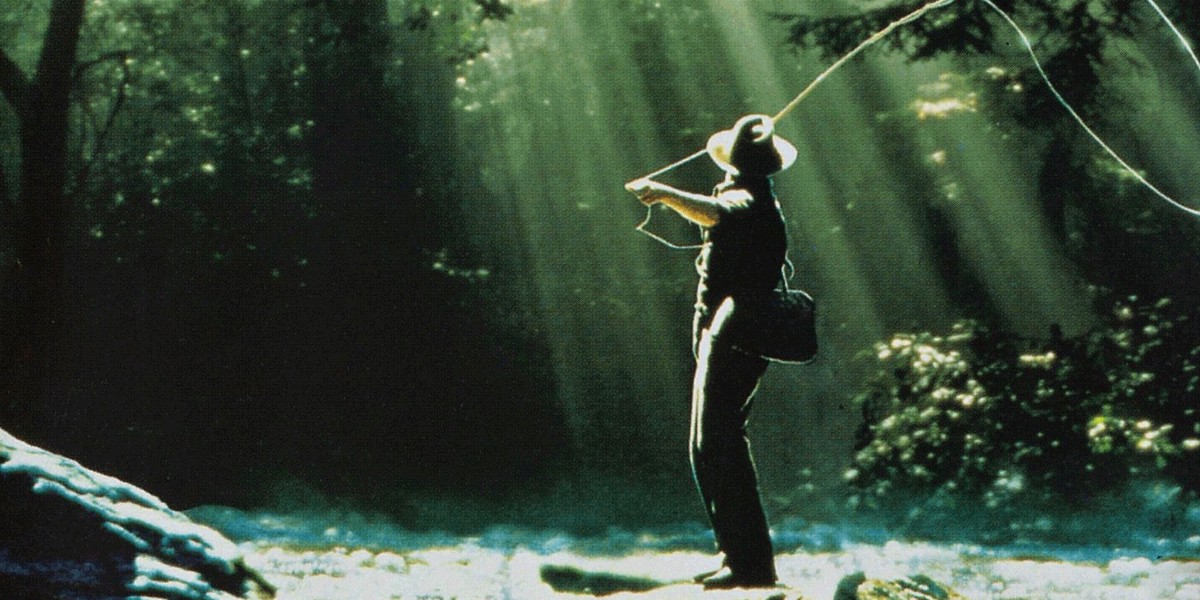
As a Presbyterian descendant of Scottish-Gaelic speakers who has spent time living on a river in Montana, it was my duty to eventually read Norman Maclean’s A River Runs Through It: And Other Stories. This short, pithy, work is remarkably beautiful considering its brevity and otherwise mundane subject content – fly fishing and family upbringing in Missoula, Montana. Published in 1976 by the University of Chicago Press as their first work of fiction, it popularized the sport of fly fishing and the Treasure State. The 1977 Pulitzer Prize committee for fiction recommended it to receive the Pulitzer Prize that year, but for unclear reasons the recommendation was ignored, and no award was given that year. In popular culture the book is probably best remembered for its 1992 film adaptation by the same name directed by Robert Redford and starring Brad Pitt.
Maclean opens his semi-autobiographical work by informing his readers that “in our family, there was no clear line between religion and fly fishing.” He gives an account of what life in the household of a Presbyterian minister father is like that can surely only be humorous to someone who was similarly raised. One day a week was “given over wholly to religion,” consisting of Sunday school, morning service and evening service. In between on Sunday afternoons, Norman and his younger brother Paul had to study The Westminster Shorter Catechism for an hour and then recite it before they could go on a Sunday walk with their father. According to Norman, they were never actually asked to recite past the first question in the catechism: “what is the chief end of man”, to which their recitation satisfied the demands of their zealous father. Norman notes that in a typical week of their childhood he and Paul “probably received as many hours of instruction in fly fishing as we did in all other spiritual matters.”
Their father, being both a Scot and a Presbyterian, believed that “man by nature was a mess and had fallen from an original state of grace.” He also believed that counting was important to God, and that only by attuning oneself to “God’s rhythms were we able to regain power and beauty.” In one of my favorite lines of the story, Paul recounts that his father, unlike many Presbyterians, often used the word “beautiful.” Because counting was important to God, casting a fly rod “is an art that is performed on a four-count rhythm between ten and two o’clock.” This is known as casting “Presbyterian-style, on a metronome.” There is no telling how many fly-fishing instructors throughout the United States have either since used this teaching method or have had to reply to their curious tutees about this famous line.
While many of the opening pages of this book are mainly full of inside references for Presbyterians (such as natural man and a state of grace in relation to the art of fly fishing), the rest of the book is haunting to all readers. Norman goes into incredibly personal detail about his extremely charismatic younger brother struggling with alcoholism, a gambling addiction, and falling in with the wrong crowd of loan sharks. He also casts his brother-in-law Neal Burns in an incredibly unflattering light while telling of his wife Jessie’s insistence that Paul and Norman take Neal fishing and the mischief that ensues. During this trip, Norman attempts to reach out to his brother Paul who refuses his help outright. It is a painful thing to read for anyone who has ever tried to intervene in the life of someone they love deeply. He would wake up early in the morning pondering ways that he could get through to his brother. “Sunrise is the time to feel that you will be able to find out how to help somebody close to you, who you think needs help even if he doesn’t think so. At sunrise, everything is luminous, but not clear.”
While Paul’s personal life was an absolute mess, his fly-fishing prowess was unparalleled. Norman could only dream of being half the fly-fisherman that his younger brother was. Watching him fish was, in a sense, like watching a transient piece of art in motion. While watching his brother catch a fish on the Blackfoot River on the last day the two would ever fish together, Norman stated “poets talk about ‘spots of time,’ it is really fishermen who experience eternity compressed into a moment.” Sadly, for anyone who has ever seen true beauty in real time, life does not actually imitate art. “And I knew just as surely, just as clearly, that life is not a work of art, and that the moment could not last.”
Shortly after this final fishing trip on the Blackfoot River, Paul was beaten to death with a gun butt in 1938. His gambling addiction and debts finally caught up with him, and Norman was not able to save him despite his best efforts. Norman laments, “so it is that we can seldom help anybody. Either we don’t know what part to give or maybe we don’t like to give any part of ourselves. Then, more often than not, the part that is needed is not wanted. And even more often, we do not have the part that is needed.” This tragic story with a brutal ending catches the reader with an emotional gut punch, reminding us that our deepest relationships can be swept away in an instant despite our best efforts to preserve them. With the passing of his brother, Norman vowed to never lose touch emotionally with his wife. “And we never have, although her death has come between us.”
One does not need to be a Presbyterian, have a sibling, or know anything about fly fishing or Montana to deeply appreciate this beautiful work. It is a brave and jarring piece in which an author exposes the most intimate parts of his life and personal failures with his audience, using beautiful writing on par with Thoreau or Hemingway. The iconic line that closes the book especially lingers in my mind – tying together the drama with Paul, their religious upbringing, and their shared love for the Montana waterways. “Eventually, all things merge into one, and a river runs through it. The river was cut by the world’s great flood and runs over rocks from the basement of time. On some of those rocks are timeless raindrops. Under the rocks are the words, and some of the words are theirs. I am haunted by waters.”
Written by Cal Wilkerson

Norman MacLean
 Brains and Brawn