I must admit that when Mike first bought this book for me, I vastly underestimated it and it collected dust on my bookshelf for nearly a year. I would get around to it eventually, but this book appeared to be yet another “man takes on extreme conditions and inner turmoil and conquers both” story that has been hashed out so many times. To my pleasant surprise, Stephen Bown’s The Last Viking: The Life of Roald Amundsen is a work of a completely different nature. It is the biography of the life of a man who at his time could have been the most famous individual in the Western world. A man whose expeditions and exploits caused world dictators to change their plans and empires to alter course. Most notably, a man whom I had never even heard of before Mike gave me this book. This man is the Norwegian Roald Amundsen.
Amundsen was born in Borje, Norway, in 1872. The youngest of 4 brothers, his mother desperately wanted him to become a doctor. Being a dutiful son, Amundsen enrolled in university to study medicine but was always truant, choosing instead to spend his time skiing and learning to survive in the bitter Norwegian cold. When his mother died, Amundsen (aged 21), dropped out of medical school and resolved to become a great explorer. While I have often fantasized about dropping out of medical school to become a great adventurer and explorer, I could never take the step that Amundsen did. And while he did realize his true dream, it was not without its consequences. Even to his dying day, Amundsen was penniless and in massive debt to others. Creditors hounded him from the moment he decided to not pursue the professional path and societal respectability. Then again, no one would remember his name and authors would not be writing books about him had he not.
His first true expedition was with the Belgian Antarctic Expedition led by Adrien de Gerlache on the Belgica. This ship became the first in history to overwinter in Antarctica. Possibly a bit of deceit on the part of Gerlache led to this “feat”, but the entire crew were ill-prepared and locked into the ice off the Antarctic peninsula for an entire winter. According to his accounts, he and American doctor Frederick Cook discovered that by hunting and eating seals and other marine life, the crew would be able to stave off scurvy. This served as an important lesson for future expeditions. Infighting between Amundsen and Gerlache led him to resolve to always be both captain and expedition leader in the future. He thought that the very safety of his men depended on this.
In 1903, Amundsen was both captain and leader of the first expedition to successfully navigate the Northwest Passage between the Atlantic and Pacific Oceans. He took his ship the Gjoa along with a crew of six men on this daunting journey. In what seems utterly impossible to modern sensibilities, the crew was iced in at King William Island and spent two entire winters there. This location later came to be known as Gjoa Haven (and still is today). Here Amundsen became friends with and learned valuable Arctic survival skills from the Netsilik Inuits that would serve him well on future adventures. By the time that Amundsen successfully navigated the passage and made it Nome, Alaska, to relay his message, his country had gained its independence from Sweden. He and his crew had been on their adventure in the bitter Arctic cold for three and a half years.
Certainly, his most famous exploit is his controversial “race to the South Pole” with Robert F Scott. Amundsen was funded by the Norwegian government to take the ship Fram on a scientific survey of the North Pole. However, when he learned that Frederick Cook and Robert Peary had both placed competing claims on being the first to reach the geographic North Pole, he realized that there was no glory in being the third there and turned the ship south. This was an amazing coup on his part. He did not own the ship and was in clear defiance of his orders from a sovereign government funded trip. Nevertheless, Amundsen did not take any form of wireless communication with him (intentionally) and would later learn that Norway had attempted to call him back. He landed on the Ross Ice Shelf in the Bay of Whales and set up a base known as Framheim.
Using skis and dog sleds, skills he had learned from the Netsilik, Amundsen was better situated to reach the South Pole before British explorer Robert F Scott, who was using ponies to pull his sleds and did not use skis. Ironically, the last British explorer to almost reach the South Pole, Ernest Shackleton, had listed not using skis in his recollections of why he was unsuccessful. Amundsen brought nearly a hundred dogs with him from Norway. This part of his legacy is the most controversial by far. While crossing the Transantarctic Mountain Range, Amundsen decided to kill some of his starving and overworked dogs. Seemingly an act of mercy, he and his crew then proceeded to eat these slaughtered dogs and feed them to the dogs that he left alive. In our modern world of dressing up dogs in Halloween costumes and spending tens of thousands of dollars on their lifetime upkeep, this seems an unspeakable horror. One must appreciate that Amundsen learned his care of dogs from the Netsilik, for whom dogs were not pets but rather animals of work and for whom the wolves were a fearsome enemy. Reading about these dogs willing to eat the flesh of their fellow pack, I wonder how long without food and in what conditions it would take for even the meekest of our toy dogs to consider us as the next potential meal. The British fared no better, as their expedition exhausted their ponies who perished in the Antarctic cold.
Amundsen’s party became the first to reach the South Pole, on December 14th, 1911. The Fram circled back to pick the return party up from Framheim and they journeyed to Tasmania, where the world learned of their news. Sadly, Robert F Scott’s team also made it to the South Pole a month later but did not return alive. Much has been said about this “race to the South Pole” and whether Amundsen is directly or indirectly responsible for Scott’s death. The event did not sit well with the British, who begrudged both Scott’s death and their stolen glory to be the first country to the last unclaimed land on earth. Even to this day, a vast swath of Antarctica is known as Queen Maud’s Land, after the then Queen of Norway.
At this point, Amundsen was an international celebrity and especially famous in America. His future accomplishments included a 7-year expedition on the Maud to sail the Northeast Passage. On this trip he fractured his shoulder, was mauled by a polar bear, suffered gaseous poisoning, and finally arrived in Nome. Thus, Amundsen became the first to circumnavigate the Arctic Circle (albeit on two separate trips). I found it very interesting considering Amundsen’s polar bear attack to note that Arctic is derived from the Greek word for bear, and Antarctic simply means “no bear”.
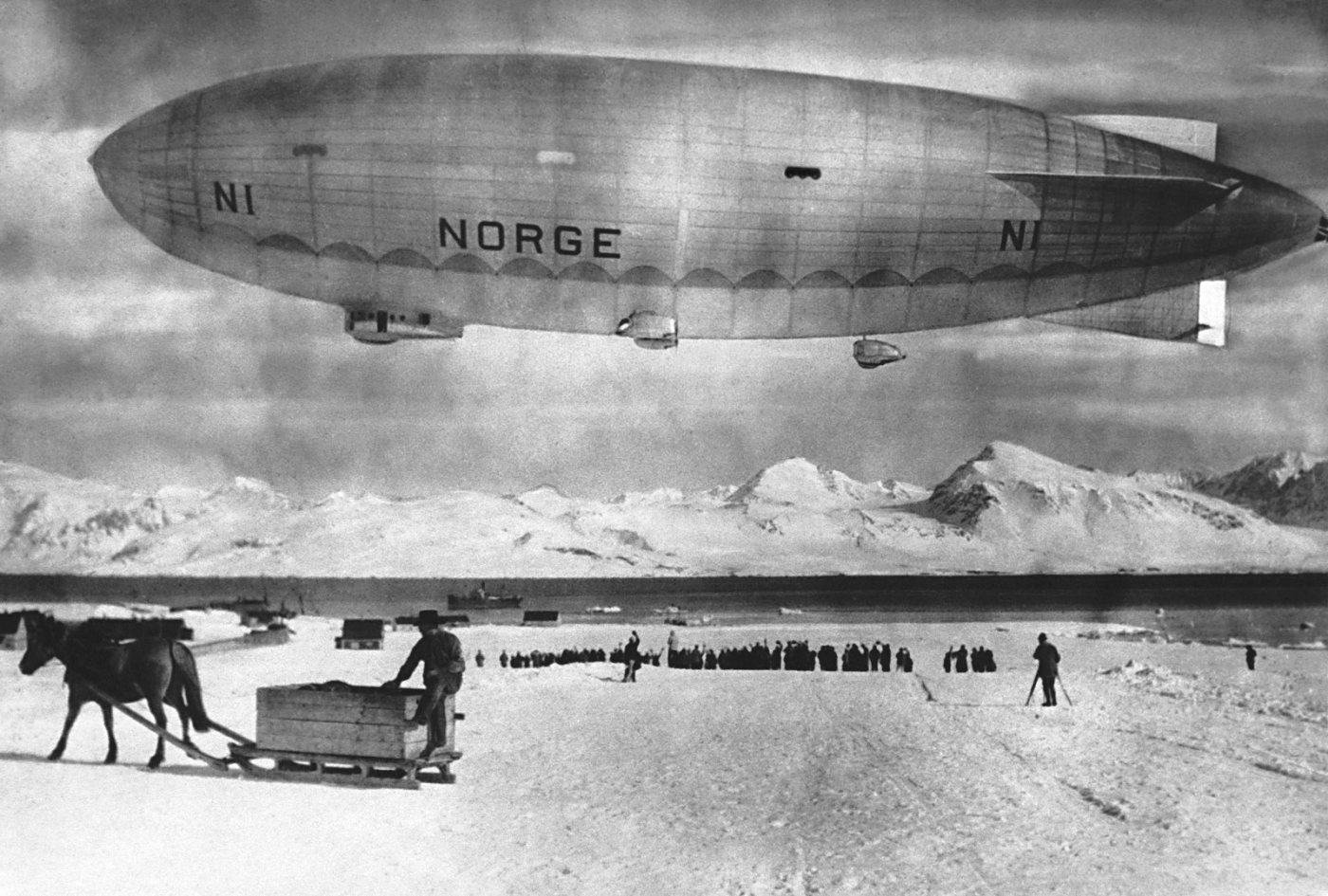
The final adventure of his life was his attempt to take an airplane to the North Pole. While he was unsuccessful upon several attempts at doing this, he did finally take an Italian dirigible there with the financial backing of an American. In 1925, he left Spitsbergen by airship on the Norge along with the American Lincoln Ellsworth and the Italian Umberto Nobile. They successfully flew over the North Pole and to Amundsen’s dismay, Nobile dropped an Italian flag down onto the North Pole! This would begin a bitter feud between Norway and Italy in which Mussolini attempted to push his fascist agenda through the expedition. Nevertheless, if Cook and Peary’s claims to reach the North Pole in 1909 were rightfully disputed, then Amundsen’s crew truly was the first to reach the North Pole as well. Despite this bitter feud, Amundsen died on a rescue mission to attempt to find the missing Nobile on his second trip to the North Pole in dirigible.
The legend of Amundsen is immense. By 1925, he had become the first person to navigate the Northwest Passage, the first to reach the South Pole, the first to circumnavigate the Arctic Circle, potentially the first to reach the North Pole (by air), and the first to reach both poles. By the end of his life, there were “no more poles to conquer”, and nothing left to explore. He had successfully filled in the rest of the map of the earth. Along the way he amassed a massive debt, had three doomed relationships with married women, had a pet polar bear, and adopted two Inuit children. He proved conclusively that there was no land on the side of the North Pole between the Pole and Nome. The world of exploration would change massively after his death, but in many ways, he can be considered the last great explorer on earth. The map was now complete. Bown sums it up nicely: “he was a man of action rather than a philosopher; angst-ridden questioning and self-doubt, circular musings on the meaning of life and the nature of God, or fretting about either the immediate future or eternity were not for him. He knew what goals he wanted to achieve in his life and he set out after them, again and again, in a intriguing cycle of reinvention and novelty”. Simply put, Amundsen was an absolute legend. He died as he lived, plunging into the fog of the Arctic skies in a French biplane on June 18, 1928, never to be seen again.
As I contemplate the legacy of Amundsen, I realize that his death truly marked the end of the age of exploration in the traditional sense. With the advent of computers and satellites, the entire world would soon be mapped out in startling detail. A mere 41 years after Amundsen’s death, humans landed on the moon. Never again would explorers face the uncertainty and proximity to death during a voyage that Amundsen did every time he set sail. Modern men still pursue his adventures with curated large game hunts and guided mountain climbs wearing the latest North Face and Patagonia apparel. Even forays into Alaska, the final frontier, seem tame in the modern age. Amundsen noted aptly after the return from the dirigible trip: “My work is fulfilled. All the big problems are solved. The work that remains in Polar exploration is a matter of detail. Let others handle it.” The Last Viking was an explorer on such a grand scale that all he left for the rest of us were the details. I highly encourage this book to anyone in search of inspiration from a figure that was truly larger than life.
Written by Cal Wilkerson

 Brains and Brawn