
Dune is heralded by many as the greatest science fiction novel of the 20th century. Considering that the genre of science fiction is relatively new in the annals of literature, that puts Dune as a front runner to the greatest work of science fiction ever written. The massive amount of work that went into this 215,000-word book (my edition was 884 pages including the afterword) reflected the culmination of 4 years of careful research followed by 4 years of meticulous writing on the part of the colossal author, Frank Herbert.
I first read Dune when I was a young teenager at the behest of my dad, who held the book in very high regard. Truth be told, I was much too young to comprehend what was going on and I hardly remembered anything about the book aside from a lot of sand, some worms, and a boy-teen hero named Paul. I had completely forgotten about Dune until I was in the movie theater about to watch Christopher Nolan’s Tenet and a preview came on for what looked like the most epic science fiction movie conceivable. The preview began with the chilling voice of a woman imploring a young man to put his hand in a box while she held a poisoned needle to the side of his neck. He was instructed not to remove his hand, no matter what he encountered in this mental trial, lest she pricked his neck and administered the poison. “The test is simple. Remove your hand from the box and you die,” she said. When the young hero asked what was in the box, she simply replied, “pain”.
This is the introduction to a fantastic world that was conceived almost entirely from scratch inside the mind of Frank Herbert. Upon realizing that I remembered virtually nothing from my first reading and knowing that I had a window of time to finish the giant book before the release of the movie (expected release date October 1, 2021), I knew that I had to go back and reintroduce myself to the world of Dune. It is important to appreciate that this book was first published in 1965, a year before the first Star Trek pilot episode (1966) and twelve years before the release of Star Wars: A New Hope (1977). If the chief complaint over science fiction is that most of the tropes are recycled and reused, any fan of the genre will find a breath of fresh air and the content source for the genre in this highly original work.
The test referred to in the trailer scene was the gom jabbar, administered by a mysterious sisterhood of women known as the Bene Gesserit who train their bodies and minds to the upper limits of human capacity. The setting is the year 10,191 in a complex society 20,000 years in the future. The Bene Gesserit have been working in the background through a selective breeding program to produce a human known as the Kwisatz Haderach. While the Bene Gesserit have been experimenting with various mind-altering substances to give them a prescience that others cannot attain, they have not yet been able to venture into a certain mental space that occupies past, present, and future simultaneously. They refer to this space as the Kwisatz Haderach, or “Shortening of the Way”, and are seeking a male born through their selective breeding program to fill this role.
A potential candidate for this role is the young Paul Atreides, son of Duke Leto Atreides of Caladan and his Bene Gesserit companion Lady Jessica. Shortly after the gom jabbar, the Atreides family are summoned by the Padishah Emperor to leave their water-filled planet of Caladan to travel to the desert planet known as Arrakis and govern it. Arrakis is at that time controlled by the Harkonnens, rival family and sworn enemies of the Atreides. This move was made to appease the Landsraad (the collection of Great Houses scattered throughout the Imperium) to stabilize this rivalry. Reluctantly, the Atreides family must go to Arrakis, colloquially known as Dune, using the transportation of the enigmatic Spacing Guild, also known as the Guild of Navigators. Guildmembers were never allowed to be seen by members of the Great Houses, as they alone held the key to faster than light space travel. They were a neutral body motivated only by money who, for reasons that are only revealed late in the book, could see the possibilities of the future that allowed them to avoid all potential calamities that could befall travelers in deep space.
Upon arrival at Arrakis, the Atreides quickly realize that they are no longer in the safety and shelter of their home planet. Dune is a planet that is without water. Thousands of miles of desert stretch out in every direction, and the planet is full of ravenous sand worms that can devour entire ships that dare to land on the surface of the deep desert. There are sandstorms that can swallow up entire cities and blot out all satellite communication to the surface in an instant. Were it not for a natural rock barrier known as the Shield Wall that protects the city of Arrakeen, the planet might be completely uninhabitable. To complicate matters further, there is a nomadic group of unknown size and origin known as the Fremen who somehow live in the deep desert and view the Great Houses as foreign intruders on their planet. Of course, the Harkonnens are not pleased with their imperial ousting from the planet and the threat of retribution remains in the minds of the House Atreides.
Duke Leto is charged with the mission of occupying the planet and turning all his resources and attention to the mining of the one resource that makes Dune of intergalactic interest – spice. Also known as mélange, this awareness spectrum narcotic is ubiquitous on the planet, and its very presence in the air has addictive properties that make those who travel to Dune reluctant to leave. Of course, it’s not an easy substance to mine, and as soon as a spice harvester begins to mine into it, giant sandworms begin to course across the desert and demolish the harvesters unless a carryall swoops down to lift the harvester up in the brink of time. Compounding all this difficulty is the perpetual problem of water, which is more precious than gold on Dune. For those who dare to venture into the desert, wearing a stillsuit is necessary to reclaim all the moisture and water from the body for re-consumption.
This is the basic premise and key players of this wild, vastly entertaining book that sets the stage for the 5 books that follow. While I have not read any of the subsequent books yet, I plan to. The wonderful thing about this book is that it can be read on so many different levels. It has depths of meaning that go far beyond the superficial, and one can quickly see the integral role that ecology plays in this book. Additional themes include philosophy, religion, politics, history, human evolution, even poetry. Each chapter opens with a beautiful excerpt from a future retelling of the events that transpire. My favorite section opens with this:
“Deep in the human unconscious is a pervasive need for a logical universe that makes sense. But the real universe is always one step beyond login.” – From “The Sayings of Muad’Dib” by the Princess Irulan
I call on all fans of science fiction to take the plunge into this monumental work and enjoy the genre at its finest, especially while there is time before the release of the movie in October. Rereading a book at such dramatically different times in brain development was a strange journey for me. It was almost as if I was experiencing a bit of the spice mélange prescience myself, having a vague impression of what was to come next without knowing with certainty until I encountered it. I can promise you that this book is worth the time and effort expended; it has certainly claimed the spot of my favorite science fiction novel.
Written by Cal Wilkerson
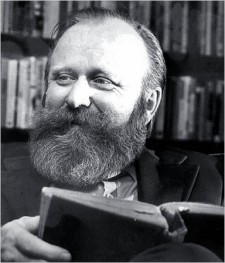
Frank Herbert
 Brains and Brawn