
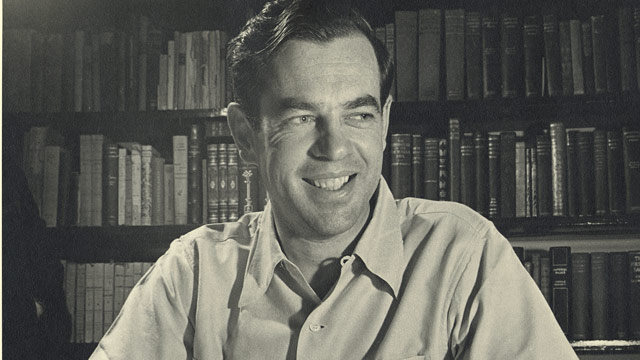
Starting this past February, I took on the daunting task of making my way through Joseph Campbell’s “Hero with a Thousand Faces.” Campbell was a monumental twentieth century professor of literature, specializing in comparative mythology and religion, and this was perhaps his seminal work. I was inspired to read this book after hearing of its vast influence on several modern hero-stories. Most notably, George Lucas has been explicit that he drew on the book for his inspiration to create the character Luke Skywalker in Star Wars.
The book focuses on the concept of the monomyth, a common story in mythology that transcends cultures and religions separated by both time and location. Campbell endorses the theory popularized by Carl Jung that the origin of the monomyth arises from the collective unconscious of humanity. Its not that this story is even conjured intentionally by mankind, we tell it because it belongs to us in a way that defies logical explanation. From the disparate corners of the world – Navajo to Inuit, Aztec to Persian, Greek to Indian – the same themes emerge and transcend coincidental plausibility. Campbell goes into painstaking detail to demonstrate this point, and many of the stories he uses will weary the casual reader (hence why it took me 5 months to finish this book). But each chapter and segment bring a wealth of reward, and the reader feels as if he is on a hero’s journey of sorts navigating his way though.
Campbell introduces us to the hero’s journey by saying, “the usual hero adventure begins with someone from whom something has been taken, or who feels there is something lacking in the normal experience available or permitted to the members of society. The person then takes off on a series of adventures beyond the ordinary, either to recover what has been lost or to discover some life-giving elixir.” This hero will have to heed the call to adventure, symbolic of the hero’s departure from the conscious comforts of their own reality into the unexplored regions of their unconscious. From there, the hero goes out seeking the “ultimate boon,” symbolizing the unrealized potentials hidden within.
Those who feel lost or disoriented in life can benefit from venturing forth into the unexplored realms of their own psyche. The call to adventure, as Campbell portrays it, is often proposed in personification by an animal or strange creature, representing one’s own suppressed instincts, which are insightful but too often ignored. Campbell describes this as the “refusal of the call,” reminding us that “often in actual life, and not infrequently in myths and popular tales, we encounter the dull case of the call unanswered; for it is always possible to turn the ear to other interests. Refusal of the summons converts the adventure into its negative. Walled in boredom, hard work, or ‘culture,’ the subject loses the power of significant affirmative action and becomes a victim to be saved.” This initial refusal is not the death of the adventure, however. Campbell advocates that “not all who hesitate are lost. The psyche has many secrets in reserve. And these are not disclosed unless required.” He calls this “supernatural aid” – forces are at work that will move the adventure along and ensure that the call does not remain unanswered forever.
This supernatural aid may come in the form of a wizard, hermit, shepherd, or woodsman. In higher mythos, this aid may be a guide, teacher, or ferryman. Regardless of the form, this aid rekindles the call to adventure and sets the hero on his way. The hero eventually answers the call and ventures off into uncharted territory. At the boundary of the familiar, the hero must encounter the “threshold guardian” and cross this first threshold. This guardian is often a menacing being in mythology, and it may represent the portion of oneself that has been repressed over time and relegated to the unconscious. This threshold guardian induces panic in the uninitiated. Having to confront the rejected aspects of one’s personality can prove an insurmountable obstacle – both difficult and distressing. If the threshold guardian can be overcome, an inner strength is realized that will bolster as he descends into the depths of his unconscious.
This descent is perilous for the hero – “either intentionally or unintentionally, into the crooked lanes of his own spiritual labyrinth.” The hero “soon finds himself in a landscape of symbolical figures (any one of which may swallow him.” Eventually, one’s previous self begins to give way to a new, more impressive self that the hero could never have imagined prior to his journey. The hero must pass through a symbolic death (be it in the form of a cave, or the belly of a whale) and emerge from it reborn. The triumphant hero seizes “the ultimate boon,” which is symbolic of the unrealized potential within. This ultimate boon is “an expansion of consciousness and therewith of being (illumination, transfiguration, freedom).”
The seizing of the ultimate boon does not mark the end of the journey – the hero must still return to the world he left behind. “The whole point of the journey is the reintroduction of this potential into the world… bringing the boon back can be even more difficult than going down into your own depths in the first place.” Many possibilities exist for this most daunting task – it is possible that no one will care, or that others will divert the hero from his newfound authenticity [that is, that the hero soon becomes the tyrant]. The one who overcomes becomes “the master of two worlds” and discovers a new “freedom to live” that was never possible before.
While this all seems quite fantastic, I found the most intriguing aspect of this proverbial hero’s journey to be that centered around the birth-rebirth cycle that patterns around human sleep. I have recently been having strange, lucid dreams that often blur the line between conscious and unconscious and Campbell has certainly helped me place some of these experiences in context. In reference to the hero’s return to reality, he says “why attempt to make plausible, or even interesting, to men and women consumed with passion, the experience of transcendental bliss? As dreams that were momentous by night may seem simply silly in the light of day, so the poet and prophet can discover themselves playing the idiot before a jury of sober eyes.”
The whole concept of sleep, particularly REM sleep, has become something that I have recently viewed as borderline absurdity. Assuming an average of 8 hours of sleep daily, the human will spend approximately 229,961 hours (9,582 days, 26 years) – close to one-third of their life in sleep. REM sleep is fascinating, the brain waves on EEG during sleep are closest to those that a human experience while awake. The eyes are moving at random; the brain is awake; the autonomic system is activated (blood pressure, respiratory rate and heart rates increases), the musculature is completely paralyzed – yet penile and clitoral tumescence occur. Memories are consolidated, and dreams that occur during REM can be vivid and remembered. On average, the adult enters REM sleep about 90 minutes after initially falling asleep, these REM stages can last up to an hour and can occur five to six cycles each night. When you awake in the morning remembering a dream, a world of absurdities meshes past, present, and future, jumbled with physical inconsistencies and worlds that could never exist. You cannot even be sure which cycle (or combination of cycles strung together) you are evening recalling.
And then, like the hero’s return from the journey, you must decide what to make of your nighttime adventure. Will you attempt to consolidate this nocturnal venture into your waking experience, or put it aside as a triviality, a thing for children and simpletons to ponder. This is likely a stretch, and beyond what Campbell ever intended, but in light of what we know now about sleep that we never knew before, it is no wonder that great sages and prophets of lore placed so much stock in the interpretation of dreams. Could this be the collective unconscious that Jung and Campbell were grasping for? It seems plausible, at least to me, that our monomyth emerges from this strange experience that humans must uniquely encounter – the lifelong, necessary journey into the depths of our subconscious and reawakening into a conscious world where no one save ourselves can draw meaning from or make sense of the personalized expedition that we embark on each night. As Campbell reminds us, “dream is the personalized myth, myth the depersonalized dream; both myth and dream are symbolic in the same general way of the dynamic of the psyche. But in the dream the forms are quirked by the peculiar troubles of the dreamer, whereas in the myth the problems and solutions sown are directly valid for all mankind.”
Speculations aside, this book was a wonderful exploration into a captivating topic. I would highly recommend a good faith attempt at reading and synthesizing this work into your own life. Everyone is called to be a hero in his own right. “The latest incarnation of Oedipus, the continued romance of Beauty and the Beast, stand this afternoon on the corner of 42nd Street and Fifth Avenue, waiting for the traffic light to change.” When the call to adventure comes, whatever form it may take, do not refuse the call. Taken this way, each day, each awakening, can transform into an adventure that will change the face of our life forever.
Written by Cal Wilkerson
 Brains and Brawn