
Thomas J. Jackson in many ways is the archetype of Southern honor, bravery, faith and leadership. Growing up in the Deep South, I’ve seen portraits and paintings of Jackson in pastor’s offices, boardrooms of lawyers, bankers, insurance agents and in various homes throughout my life. There is a certain admiration even reverence for Stonewall Jackson just as an overall consensus. Even on a larger scale, he is known and respected all over the world by many Civil War buffs. I, shamefully, had never read anything in detail about Stonewall until I finally picked up S.C. Gwynne’s masterpiece Rebel Yell: The Violence, Passion, and Redemption of Stonewall Jackson. The book has to be one of the largest biographies I have ever read but by the end, it left me wanting to know more about not only Stonewall but all the other larger than life men that fought for both sides in the Civil War. S.C. Gwynne breaks down the book into several bite sized chapters that can be consumed in manageable sittings. I had little to no background in Civil War history other than the baseline knowledge from high school and college, after completing this book I feel well versed or at least knowledgeable enough to have a good conversation on the topic.
The Civil War was a stage for men like Thomas J. Jackson to reinvent their legacies. He went from a relatively obscure and unpopular college professor in Virginia plagued with health issues to a revered national icon. Similarly, Ulysses S. Grant and William T. Sherman went from failed businessmen to heroes. Jackson opposed the war, “In the months leading up to the war Jackson had remained a confirmed Unionist. He opposed secession. Though he was a slave owner, he held no strident, pro slavery views.” Jackson like many at the time held loyalty to his state first, the State of Virginia. He also remained distant national politics but understand the debates raging over slavery. After Lincoln’s election in December 20th of 1860, South Carolina, Mississippi, Florida, Alabama, Georgia, Louisiana and Texas all seceded. Governor John Letcher’s rejection of Lincoln’s orders to send Virginians to fight against the seceded Southern States prompted the state’s convention to leave the Union and repel the Northern aggressors from their homeland on April 17th 1860 thus solidifying what side Jackson would fight for. The former professor of VMI was initially appointed to be an engineer until the intervention of Governor John Letcher, he was chosen to be a colonel over the Virginia volunteers. Gwyene notes that Jackon’s appearance wasn’t impressive at first take, “He was, in fact, the opposite of anyone’s idea of what a leader was supposed to look like, and his somber, uncourtly, and undashing manner did nothing to change that impression.” He was known for being obsessed with duty and detail along with taking his faith very seriously. The author points it out early on, “And, of course, he prayed and read his Bible and consecrated every act of his life, every thought he had, to God. He did this consciously, every day.” Jackson was a man of intense faith while being a man that could handle himself with poise, determination and lack of fear in battle. The First Battle of Manassas raged, “He moved, according to one admiring soldier, ‘in a shower of death as calmly as a farmer about his field when the seasons are good.’ He seemed to be a different man in the heat of battle; his eyes blazed, his whole being seemed to glow with ardor of the fight. One soldier in the 33rd Virginia recalled that former VMI cadets, observing the cool confidence of their commander, now saw the warrior and forgot the eccentric man.'” The victory in Manassas and Jackson’s heroics earned him his famous nickname, “Stonewall”.
In regards to a brief snapshot of Thomas Jackon’s personality. He a principled man. Jackson kept a list of how he wanted to live, “Endeavor to be at peace with all me. Never speak disrespectfully of anyone without cause. Never try to appear more wise or learned than the rest of the company…” Along with being devoutly christian, he also had a deep love of literature, architecture, history and gardening while being known to be an optimist.
Jackon’s legacy can be attributed to his Shenandoah Valley campaign, which relied on speed and deception. Fighting for Stonewall was tough, “War, in Stonewall Jackson’s army, was never going to be anything but a hard and desperate thing. There was no stasis, no easy living, no resting on laurels no rest at all, in fact. Oddly, his footsore army, amid its cursing and grumbling, was starting to embrace his idea. If Jackson was not likeable, he was certainly a man you could follow, and in spite of his delphic refusal to share information, he was at least predictable: you were going to march fast and far and then you were going to fight, and you were lucky if you got lunch.” In the battles of Front Royal and Winchester, Stonewall Jackson led his army to victories in spite of being heavily outmatched by Colonel Kenly and his Union forces. By the end of the battle, Jackson’s brilliant strategic maneuvers led to the capture of 691 Union soldiers and a large quantity of supplies. The legend of Jackson carried over in the ranks of the Union army as well, “Northern soldiers sent home their own praise, too, calling him ‘a man of decided genius,’ and ‘this great leader’ who had ‘outgeneralled all our commanders.'”
After Stonewall’s death it shook the Confederate morale to its’ core. The loss of their legendary leader was a huge blow. His funeral procession was one of the largest in American history at the time by many accounts. It was called a national tragedy, “A silence profound, mournful, stifling and oppressive as a funeral pall succeeded to the voices of cheerfulness. Jackson, whose most notable personal attribute was his silence, now inspired a wave of deep, despairing quiet throughout the army and the Southern nation.” Again from the North, a reserved mix of praise followed in the Washington Chronicle, “Stonewall Jackson was a great general, a brave soldier, a notable Christian, and a pure man. May God throw these great virtues against the sins of the secessionist, the advocate of a great national crime.”
I think a closer look at Stonewall Jackson’s life is a worthwhile endeavor. He existed in a highly controversial time in American history but is also an interesting example of leadership, discipline and poise. His legacy is a peculiar one for certain, it can be viewed as one of triumph and tragedy. He held closely the teachings of the Bible while being one of the most capable military leaders of all time. Rebel Yell is a worthwhile read, it is certainly a wise investment of time.
Written by Michael McPhail
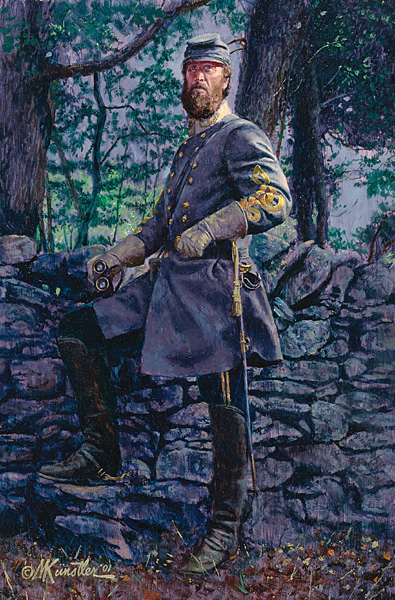
General Thomas “Stonewall” Jackson
 Brains and Brawn