
With his book The Big Picture: On the Origins of Life, Meaning and the Universe Itself, cosmologist and physicist Sean M. Carroll has certainly convinced me of one thing – it is now impossible to have a serious conversation on philosophy without a commanding knowledge of the natural sciences. A clean delineation of the humanities from the sciences that so many crave will no longer do. The central premise of Carroll’s book is an audacious claim that “the laws of physics underlying everyday life are completely known.” He derives this claim from a formulation of Nobel Laureate Frank Wilczek’s “Core Theory.”
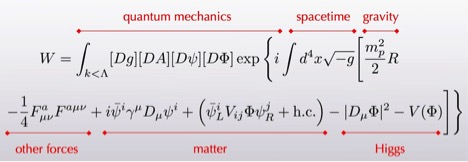
Now, if you are anything like me, when you first see this equation it does not convince of any great ontological truths. Let me attempt to elucidate. Theoretical physicists, through decades of meticulous research using particle accelerators, have postulated quantum field theory. This theory suggests that the particles and forces of which all matter is composed arise out of the vibrations of fields. Two kinds of fields, fermions and bosons, give rise to particles. Bosons make up force fields (such as the Higgs field, which gives matter to particles), and fermions make up the matter of which we are composed.
Basically, there are three kinds of particles and three kinds of forces. The three kinds of particles are protons and neutrons (which make up the nucleus of our atoms) and the electrons which orbit those atoms. The three forces are the strong and weak nuclear forces (which hold the nuclei of atoms together) and the electromagnetic force which binds the electrons to the nucleus. An additional feature of physical reality is gravity, which is more of the curvature of spacetime than a force, but we include it as a force for simplicity’s sake. The particles are made up of more fundamental particles (quarks, neutrons, and gluons), but fundamentally all physical reality is made of the particles and forces arising out of these two fields.
The seemingly presumptuous claim of Dr. Carroll is that the above equation is so wildly successful in predicting past, present, and future states of the universe, that it is completely unnecessary to introduce any further explanations. In fact, any additions to the Core Theory would be a violation of the way that things are. Drawing on the work of mathematician Pierre-Simon Laplace, Carroll postulates that a “Demon” who had the capacity to know the current momentum and position of every particle in the universe would be able to perfectly predict the state of the universe at any given moment of time future or past using the equation of the Core Theory. The future, according to Carroll, is pre-determined by “the laws of physics and the prior configuration of the universe.”
Time, as Carroll would have it, is an emergent category. We attach the labels of past, present, and future, from our human perspective, but they do not truly exist. We remember the past, but not the future. For us, causes precede their effects. We can make choices that affect the future, but not the past. All of this is a result of our human experience with entropy – the physical tendency of the universe to proceed from a state of order towards a state of disorder (low entropy to high entropy). It is this tendency that gives us the illusion of the progression of time; the states of the universe are instantaneous and irrespective of our reference frame. Carroll would argue that there truly is no meaningful reference frame, aside from the anthropological one we attach.
Theories of emergence – that the whole comes about due to the interaction of the parts – is an important feature of the book. Starting with traditional examples from science (that anyone can accept that a chair is just a collection of atoms that we ascribe the concept of a chair to), he then goes on to unravel even the most sacred Platonic objectivity. He insists that everything from gender to consciousness to meaning to morality are nothing more than emergent categories superimposed on physical reality. Everything can be explained by the Core Theory, and there is no need to introduce external variables. Carroll refers to himself as a “poetic naturalist,” which is to say that he is a naturalist who uses emergent categories to describe things that could otherwise be reduced to the Core Theory. Doing so allows him and other poetic naturalists to create meaning and order in a tumultuous and disillusioning cosmos.
Philosophically, Carroll is a moral constructivist. If he can deem a human being an emergent phenomenon, it is no surprise that he believes morality to be an emergent construction of said human beings. Humans do not derive their morality from an objective standard of virtue but rather construct it mentally and then assume universal applicability. Over thousands of years, humans have thrown off their animal instincts in an effort of self-preservation and constructed a moral system that has no basis in physical reality. There are no natural laws that demand that humans not steal from one another or kill each other – the only universal physical law, according to Carroll, is the one inserted above. Humans have constructed elaborate systems of religion to alleviate the mental agony that comes when a self-aware creature must contemplate his own inevitable end.
You may wonder why you should read this book when, statistically, the vast majority of people disagree with Carroll on matters of morality, consciousness and mortality (myself included). Using the statistical methods of 18th century Presbyterian minister Thomas Bayes, Carroll challenges his readers to weigh out their prior credence against the experimental evidence and adjust their worldviews accordingly. Most people do not believe that they are emergent constructions of the Core Theory, and most people also believe that there are supernatural explanations for the natural phenomena of our everyday lives – but do we have adequate justification for such belief? Are there natural explanations that are simpler, more succinct, and more harmonious with the body of knowledge available? How much cognitive dissonance have we humans introduced into our lives? After reading this book I realized that for the most part I am unabashedly, inconceivably unaware of the fundamental physical fabric of reality out of which I am made. I would venture that others are as well. I would not stand a chance in defending my philosophical belief system against Dr. Carroll. If you believe that you fall into this category as well, I would recommend you give his book a read.
Written by Cal Wilkerson

Sean M. Carroll
 Brains and Brawn