
Seneca has made a long overdue entrance into modern times along with his philosophy: Stoicism. Letters from a Stoic is by far his most popular collection because it can speak to all that read it on a very intimate level throughout. Seneca faced exile, alleged affairs, failing health and rising from an obscure background to wild success even tutoring the infamous Emperor Nero during his lifetime. He was an advocate of cold baths, simple meals, the pursuit of knowledge and running. Addressed to the real or fictional Lucilius nonetheless Lucilius could be every person that reads this fine collection of wise letters. It could be argued that most self help books that are peddled have their roots in stoicism. Seneca gives all who come to this collection timeless advice.
Seneca covers so much in his work that I had to make sure I paced myself to absorb all the advice. He writes about friendship, “what is my object in making a friend? To have someone to be able to die for, someone I may follow into exile, someone for whose life I may put myself up as security and pay the price as well.” That definition of friendship and the goal thereof truly puts a premium on the endeavour of getting close to someone. We water down so many definitions of words in modern times like awesome, love and great. Seneca reminds us that calling someone a “friend” means more than someone you see occasionally interact with. He also places a great deal of importance on the lost art of self reflection, “such is more or less the way of the wise man: he retires to his inner self, is his company.” I am particularly drawn in a strange way to his advice on living in view of impending death. He writes, “death ought to be right there before the eyes of a young man as much as an old one, the order in which we receive our summons is not determined by our precedence in the register and, secondly, that no one is so very old that it would be quite unnatural for him to hope for one more day…” I try to daily remind myself of his teachings on the fleeting nature of life. If I am tempted to binge watch Netflix, I ask myself what Michael the elder towards the end of his life would think? Would he prefer me to waste precious hours watching a forgettable tv show or make a phone call to our father or to pick up a volume of great literature or go run until exhaustion in pursuit of a slightly better mile time? For this reason alone, reading Seneca is valuable. I liked how he constantly reminds Lucilius to pursue wisdom, “give your whole mind to her. Sit at her side and pay her constant court, and an enormous gap will widen between yourself and other men.” I vividly remember in my various dealings with people and money that we humans can quickly become unreasonable with ourselves and with others in pursuit of selfish gains. Seeking constant improvement in understanding more through philosophy is more valuable than monetary gain because like Seneca writes, “philosophy wields an authority of her own; she doesn’t just accept time, she grants one it.” Painful reflection is perhaps one of the most challenging things we can put ourselves through. Seneca calls for it because it is necessary to improving, “what really ruins our characters is the fact that none of us looks back over his life. We think about what we are going to do, only rarely of that, and fail to think about what we have done, yet any plans for the future are dependent on the past. He writes that, “for nature does not give a man virtue: the process of becoming a good man is an art.”
Through and through Seneca’s Letter from a Stoic proves over and over that it is a timeless work that is just as applicable today as it was hundreds of years ago. Seneca like all men had his faults and fell short of his own standards and advice but he leaves us all an example on how to live life in view of our death. This book matters for young men especially because we at times think we are invincible and immortal. It is an antidote to selfish living and more importantly wasting time. I will close this post with my favorite one of my favorite quotes, “and yet time is one loan which even a grateful recipient cannot repay.”
Written by Michael McPhail
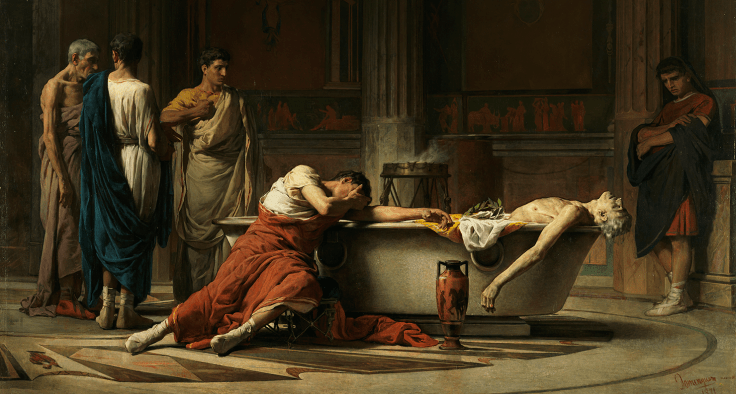
The Death of Seneca by Manuel Domínguez Sánchez
 Brains and Brawn