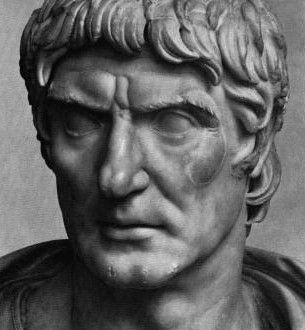
Our culture is fascinated with scandal in current times: perhaps a shady alliance with a long time geopolitical rival, rising powers in the east and the fear of immigrants altering long standing cultural norms. These words could also be written of Rome in 146 B.C. Mike Duncan’s The Storm Before the Storm: The Beginning of the End of the Roman Republic has everything and more that the hit series on HBO, Game of Thrones has that so easily captivates our hard to retain attention spans. Duncan also has an award winning podcast series, The History of Rome that is also worth a listen. It is not his point in this book to compare the Roman Empire with the United States but he does make a note that we are not in the origin phase nor in the revolutionary phase or in the global conquest phase therefore we must be between the great wars and the rise of the Caesars. There are so many fascinating players in this book like aspiring power brokers, cunning businessmen and daring military leaders. It has all the ingredients of a compelling drama. Duncan starts the book in 146 B.C. with our first characters, Publius Scipio Aemilianus as he stood victorious over their longstanding rival Carthage while to the east Lucius Mummius sacked Corinth in a sweeping display of Roman power. Their enemies to the east and west were finally defeated for now. These victories were the plateau before the decline of the republic because Rome’s compass pointed to imperialism remaining unchallenged as the dominant power in the world. A very interesting nugget of insight I gained from this book was learning that in times of crisis the consuls could pass power to a single man who would hold power in order to get Rome out of danger: the dictatorship. The dictatorship would expire after six months and for almost five hundred years the dictators held on to the power. Tiberius Sempronius Gracchus is one of our ambitious men that didn’t win his popularity on the battlefield but rather in the political arena. After the Second Punic War in 202 B.C. the roman economy was in crisis mode due to the influx of foreign wealth won during the campaigns. Essentially, a few families became very wealthy and the rest of Italy became weak with poverty, taxes and conscription. Ambitious as ever, Tiberius Sempronius Gracchus proposed Lex Agraria which was a land redistribution law. As you can imagine it was controversial like it would be in today’s time. Tiberius was able to get Lex Agraria pushed through only to his demise. Beat to death with table legs in the Temple of Jupiter by angry senators was the fate of one of Rome’s most daring politicians. Another cool insight I gained from this book was that Scipio Aemilianus introduced the habit of shaving one’s face daily, I often think when I am shaving before work that this cool habit came from Rome. Although Tiberius Gracchus met his fate in a bloody fashion, Gaius Gracchus brought the Gracchus name back in vogue. After serving in Spain with the Roman legion, he returned to the political realm of Rome to bring it back to health. Through calculated political moves winning over the rich and the poor his first term in political power was an overwhelming success. During a political war that he lost along with his Italian citizenship, he started his first colony at the site of old Carthage in North Africa. His ambitions burned out after his failures in North Africa. When 120 B.C. came around, so did the infamous Cimbri from near modern Denmark. They were in search of a new homeland which alerted and unnerved the Roman inhabitants to the south. The Cimbri made quick work of the Roman legion sent to challenge them in the battle of Noreia. They would be a thorn in the side of the Roman Empire for a long time and be a constant external threat. Enter, Lucius Cornelius Sulla to the scene. After strategic moves he was teamed up with Gaius Marius. This relationship would be pitoval as several military victories earned Sulla a spot on an embassy that acquired the long time rival of Rome the Numidian King Jurtha that hid from Rome with the neighboring Mauritanians. Jurtha had been a constant threat to Rome and Sulla negotiated with King Bocchus to surrender Jurtha over to him. This success only further catapulted the undefeated military leader. Sulla would claim victory in a preceding civil war and become dictator for life in Rome. There is a lot more to say of this incredible book but I hope this a nice taste for the compelling history of Rome. This book is important because history has patterns and much can be learned from a great civilization that was filled with incredibly ambitious men that regardless of being right or wrong laid the foundation of the modern world. History has always been one of my favorite subjects to read about and this book gives the average reader great information to further peak the interest in learning more about the Roman Empire.
Written by Michael McPhail


 Brains and Brawn