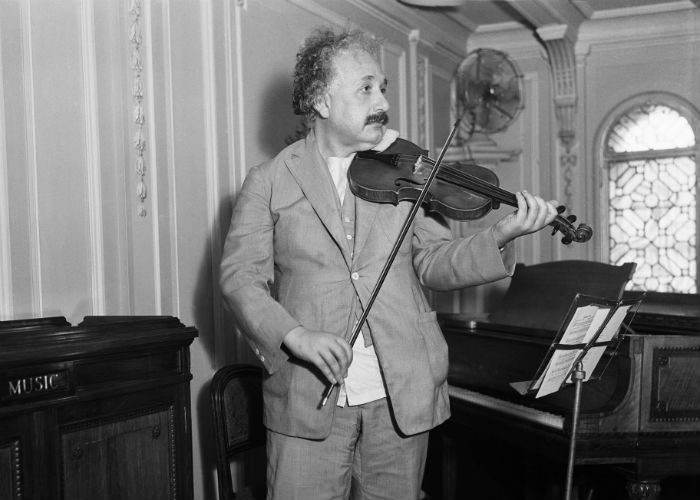
During a recent perusal of books that influenced Elon Musk, I stumbled upon “Einstein: His Life and Universe” by Walter Isaacson. Being a man of science, I have always had a fascination with Albert, and I knew that he was a household name for a reason. However, I only knew of his life and work vaguely. Through the pages of Isaacson, the man and the myth came alive to me, and I am now able to fully appreciate this giant of the 20th century.
Einstein was born into a Jewish family in Germany during the late 1800s. Throughout his lifetime, he would renounce his German citizenship, reclaim it and renounce it again, become a Swiss citizen and finally an American. He was also instrumental in the foundation of Hebrew University in Jerusalem. Such internationalism won Einstein the nickname: “Citizen of the World”. Einstein was a theoretical-physicist, pacifist, Zionist and humanist. His life was characterized principally by a love of freedom and a rebellion against strict authority – both academic and political. He claimed that all great thinkers required freedom as a prerequisite for greatness, calling it the “foundation for creativity” without which there would have been “no Shakespeare, Goethe, Newton, Faraday, Pasteur, or Lister”. Most think of Einstein as the professorial type, clicking away on a chalkboard in a university hall confined to academia. However, his most unrestrained work was done while working at a Swiss patent office.
The patent office environment allowed him the freedom to conceive complex thought experiments about the way that light and time operated in the universe. It was from these thought experiments that he was able to have his 1905 “Miracle Year” in which he published 5 papers that would shake humanity’s conceptions of the physical universe. From these papers came his famous theory of special relativity, which (without getting bogged down) asserts that because the speed of light is constant, time must not be constant at or near the speed of light. Consequently, time slows down the faster one travels, and therefore two individuals could age differently depending on their speeds relative to each other. He also came up with the photoelectric effect in these papers, the idea that light behaves as both a particle and a wave. It was this finding that won him his only Nobel Prize in Physics in 1921. From these foundational concepts, he later came up with his general theory of relativity, where he proposed that mass curves space-time, resulting in his famed equation .
Einstein spent the better part of the 1920s helping to invent, and later discredit, quantum mechanics – the idea that on the subatomic level, the positions and momentum of particles exist only as probabilities until they are observed. Einstein was uncomfortable with the implications of this theory, famously stating “God doesn’t play dice with the universe”. His 1905 papers did so much to advance this field, but afterwards he could not accept a universe in which all outcomes are completely random and dependent on the observer. The latter part of his life would be consumed with the quest to disprove quantum mechanics, and to find a unified theory that linked gravity with the electromagnetic force. He died without ever seeing these accomplished.
Aside from his science, Einstein was also an influential man in the world of politics. Though he did not follow the Jewish faith as such, Einstein was seen by many as the premier Zionist of the Western world, advocating for his fellow Jewish brethren in every way possible. In fact, Einstein was offered (but declined) the second presidency of Israel. The first president referred to Einstein as “the greatest Jew alive”. Einstein was also an outspoken pacifist who called for multilateral disarmament and the creation of a one-world governing body. Both his pacifism and Zionism were put on hold, however, whenever the Nazi Party took control over Germany. As a newly sworn-in American citizen, Einstein did his part to contribute to the war effort by writing President Roosevelt a letter which would launch the Manhattan Project. His famous equation served as the basis for the first successful detonation of the atom bomb.
After the war, Einstein’s aversion to totalitarian regimes persisted, and got him into trouble with the American Red Scare. At the height of McCarthyism, a 1400-page FBI dossier was kept on Einstein as a suspected Communist. These suspicions were highly unwarranted, and though he was verbal that the true threat to freedom were Communist witch-hunts, he largely lived out his remaining days in America in relative quiet. At this point in his life, he was an international celebrity and one of the most famous men alive, but his obliviousness to the fame and eccentric personality contained this genius to his New Jersey home at 112 Mercer Street.
Much more could be said about Einstein, and Isaacson has said it all elegantly. I highly recommend this book for anyone wanting to know about the man, or anyone desiring to glance inside the mind of a savant. By his own admission, Einstein claimed, “I have no special talents, I am only passionately curious”. His “curiosity” unraveled the very fabric of the universe as we know it, illuminating our perceptions of space and time in the process. Einstein had that sense of wonder which leads towards all great discoveries – the special eye that looks at everyday occurrences as miraculous and strives to discover the deeper meanings behind them. “A spirit is manifest in the laws of the universe – a spirit vastly superior to that of man, and one in the face of which we with our modest powers must feel humble. In this way, the pursuit of science leads to a religious feeling of a special sort.”
Written by Cal Wilkerson
Albert Einstein
 Brains and Brawn