
What is meaning to humans? Truly, it is hard to even pose the question without utilizing the word itself – i/e What does meaning mean? The most infuriation tautology to elucidate, meaning seems to be absolutely pivotal to humanity. Looking at the conundrum from a philosophy of language perspective, meaning becomes one of the most essential staples to the noölogical sphere, as we derive essence to the ontic realm seemingly just as much from linking verbs – what something is, was, be, etc… – as we do from the meaning or purpose of something. In discerning this ontic essence of a given thing, almost all logical progressions follow the linking verb to the meaning. In other words, “what is it” is usually followed by “what does it mean?” This process most likely occurs just as often in the reverse, but one curiosity remains – meaning and existence are inherently tied to our reality, and, furthermore, our lives as humans. Now, if my vague philosophical ramblings may be excused, I would like to convey what this means pragmatically by observing the work of a great man – Viktor Frankl.
Frankl’s most famous work Man’s Search for Meaning has already been wonderfully discussed on this blog. I highly recommend reading both the post of that book on this site by Michael McPhail and the book itself, and if you are not to take my recommendation on it, Man’s Search for Meaning consistently comes up on 100 Books to Read in Your Lifetime listings. It is a classic and beautiful work. However, I would like to shed light on one of Frankl’s lesser-known works. This work goes by the title of Man’s Search for Ultimate Meaning, but serves as an expansion of another work of Frankl’s – The Unconscious God – with additional material further being added from a lecture Frankl gave in 1985. Needless to say, this much later work of Frankl’s is an amalgamation of many of his theories. As such, even though rich with complexities and clinical terminology, this work feels inherently personal. It feels as if a much older Frankl is trying to convey his lifetime of experience as a psychiatrist and human to paper in the hopes of motivating and inspiring posterity.
In contrast to his earlier works, Frankl is now years away from his concentration camp experience – doubtless to say such unimaginable malice and horrors are not for someone like me who has not gone through them to speculate as to their implication to someone who has gone through them -, but this work does not draw on much proof from his accounts from his imprisonment during World War II. Instead, one can tell that this is Frankl truly reaching for the zenith – the crux – of his paradigm of logotheraphy. Having outlined strategies, examples, and tenants of logotheraphy in earlier works such as “meaning-making” and “existential analysis,” Frankl now delves deep into what makes logotheraphy “tick.” What is the protoplast to which he was able to build this paradigm off of.
Searching backwards, Frankl begins to postulate factors of consciousness. One of the most unique aspects of human consciousness is its transcendent capabilities. For example, we are able to view ourselves in the 3rd person and think of the narrative of our lives from both a subjective and objective perspective. From this oddity, we can look at ourselves as if looking at another person, surely then enabling us to develop fields such as ethics. The speculations in the philosophy of the mind area in this book are remarkable, but another area far supersedes them – Frankl’s delve into the religious.
As a religious studies major, Frankl absolutely fascinated me in this work. Integrating the psychological with the religious, Frankl speculates as to where the ultimate meaning in one’s life can be found. In a logical span of ideas and postulates, Frankl arrives at the conclusion that Unconscious Religiousness is the wellspring for humanity’s individualized meaning and – from the perspective of logotherapy – the source where healing and purpose may be ultimately derived from.
Now, one of the most unique things Frankl does which enables this theory to hold for just about every person is to expand the notion of a religious person and an irreligious person. By Frankl’s account – or by the definition he proposed for strictly the sake of this work –religiousness is the foundation which meaning is built off of in each person’s life. While I am paraphrasing – and no doubt paraphrasing poorly at that -, this expands the notion of religion far past the Abrahamic or contemplative practices we are familiar with to a sphere where it would be hard to actually find an irreligious person. Truly, by this outlook, any underlying philosophical, sentimental, or intuitive worldview one has that slakes the ensuing chaos we as humans face when contemplating or own mortality may be consider religious. In other words, as long as a person has a belief in something within the world of ideas and ideals – be it Kantian logic, Buddhism, Logotherapy, or even a household family maxim– they may be considered religious.
How would an irreligious person even be perceived by this standard? Poor souls who have nothing to believe in, literally nothing, facing the maelstrom of disarray that comes with meaninglessness. This void of meaninglessness is what Frankl calls the existential vacuum. It is the source of the tragic triad – guilt, suffering, and death. Prophetically, Frankl embarks as a crusader to provide meaning through understanding via logotheraphy to combat this existential vacuum which will only grow hungrier in the coming decades.
This work is incredibly deep but worth every second of the read. Being the last work of unbelievably inspiring man, this book is a must for any fan of literature, religious studies, philosophy, psychology, theology, or human nature in general. Having passed away so recently (in 1997), it is interesting to think that the work Frankl was doing in his lifetime is sitting there ready for some pilgrim to pick up to reigns, to follow in the logotherapeutic footsteps as a crusader trying to combat the existential vacuum with meaning making.
Written by Michael Salvatore Politz
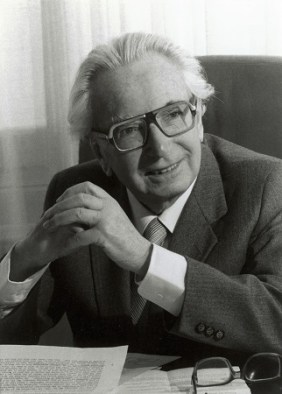
Dr. Viktor Frankl
 Brains and Brawn