
Alfred Lansing’s “Endurance: Shackleton’s Incredible Voyage”, is a fascinating true story of adventure, failure, friendship, determination and triumph against the odds. Antarctica the cold remote continent was a forge that refined the 28 man Trans-Antarctic Expedition in the early 1900s that faced almost no chance of survival as they watched their ship crushed by sheet ice, “….the nearest known outpost of humanity, some 1,200 miles away.” The leader of the expedition, Sir Ernest Shackleton is a constant source of inspiration to emulate in my own life. Lansing writes of Shackleton after the Endurance was finally crushed and lost forever into the sea, “He was the Boss. There was always a barrier, an aloofness, which kept him apart. It was not a calculated thing; he was simply emotionally incapable of forgetting— even for an instant— his position and the responsibility it entailed. The others might rest, or find escape by the device of living for the moment. But for Shackleton there was little rest and no escape. The responsibility was entirely his, and a man could not be in his presence without feeling this.” After drifting in the pack ice, the team set out for the remote Elephant Island off the coast of Antarctica in nothing more than homemade lifeboats. After days without sleep, freezing temperatures and open sea navigation they all made it to the island, “They were on land. It was the merest handhold, 100 feet wide and 50 feet deep. A meager grip on a savage coast, exposed to the full fury of the sub-Antarctic Ocean. But no matter— they were on land. For the first time in 497 days they were on land. Solid, unsinkable, immovable, blessed land.” In today’s world it is hard to get a group of bankers in the same room much less to cooperate with each other but we see with this group despite their different backgrounds, they banded together to accomplish a remarkable feat. Shackleton knew that the task was not finished after reaching Elephant Island. Lansing paints a moving image after they landed on the island, “Shackleton stood in the center of the group. He had removed his helmet and his long, uncut hair hung down over his forehead. His shoulders were bent with care, and his voice was so hoarse from shouting that he was unable to speak above a whisper. Yet he felt a profound sense of satisfaction and accomplishment to be standing at last on land, surrounded by his men.” Shackleton knew that the mission was not finished with Elephant Island. He selected his five men to be a part of another ambitious effort to sail to South Georgia Island in hopes of alerting Scandinavian whalers of their plight. The five chosen were, “To guide an open boat that distance, under conditions that were frightening even to contemplate, and then to strike a pinpoint on the chart was a task that would sorely tax even Worsley’s skill as a navigator. After him, Shackleton chose Crean, McNeish, Vincent, and McCarthy.” Impossible odds were surmounted only to be followed by more. After the perilous open sea excursion of nearly 800 miles they landed on South Georgia only to realize a mountain range lay between them and the small whaling station, “A few of the peaks on South Georgia rise to somewhat less than 10,000 feet, which certainly is not high by mountain-climbing standards. But the interior of the island has been described by one expert as ‘a saw-tooth thrust through the tortured upheaval of mountain and glacier that falls in chaos to the northern sea.’ In short, it was impassable.” They made the decision to trek 29 miles instead of risking 130 more miles in the ocean. When the group reached the whaling village, Shackleton was taken to Sørlle who he knew to identify him, “‘Who the hell are you?’ he said at last. The man in the center stepped forward. ‘My name is Shackleton,’ he replied in a quiet voice. Again there was silence. Some said that Sørlle turned away and wept.” Through teamwork, leadership and belief in the impossible the entire crew was rescued. Shackleton has developed a cult following when it comes to his leadership style for good reason. The mission was not a success but survival of the crew has been immortalized and the story itself is perhaps far more harrowing than if they would have accomplished their task. Every young man should read this book regardless of his endeavours because throughout life we will all be put up against seemingly impossible tasks. I want to end this post with one of my favorite quotes by Sir Ernest Shackleton, “Never for me the lowered banner, never the last endeavor.”
Written by Michael McPhail
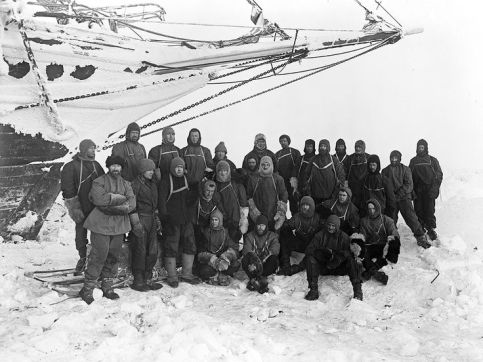
The crew
 Brains and Brawn