
Just the other day, I was called upon to help out an acquaintance with her katsaridaphobia (fear of cockroaches) by demolishing the pesky intruder with a book binder. While I thought the matter completely trivial, she was traumatized by the experience – completely paralyzed with fear at this tiny pest. The encounter sparked a conversation about phobias, and I was forced to admit that I have one of my own – thanatophobia, the fear of death. Being a man of faith with a supposed eternal security policy, it might seem odd that I fear the very gateway to the divine. Nevertheless, the inexplicable nature of this solitary confrontation has kept me up many a nights. What becomes of perception at death, are our senses heightened or diminished, can we perceive things extra-sensory, or does the very fabric of time and reality unravel in a way incomprehensible for our minds to fathom? These harrowing questions were the subject of inquiry for Dr. Paul Kalanithi. The doctor approached this problem from several different angles throughout his academic traverse. He earned a master’s in English literature at Stanford, followed by a masters in History and Philosophy of Science at Cambridge. Unsatisfied with the results, he decided on a direct encounter with death by applying to and being accepted into Yale Medical School. Dr. Kalanithi relates, “I was pursuing medicine to bear witness to the twinned mysteries of death, its experiential and biological manifestations: at once deeply personal and utterly impersonal.”Continuing his journey, Dr. Kalanithi took a highly competitive medical residency in neurosurgery at Stanford, his alma mater. Still seeking to comprehend death in an endless sea of life-altering neurological trauma, he recounts, “I began to suspect that being so close to the fiery light of such moments only blinded me to their nature, like trying to learn astronomy by staring directly at the sun.” Dr. Kalanithi needed to access the core of the sun to arrive at an understanding, and tragically, at the age of 36 he would get his wish. A chief resident with a world of possibilities ahead of him, Dr. Kalanithi was diagnosed with inoperable lung cancer, only a 0.0012% chance at his age. “Death, so familiar to me in my work, was now paying a personal visit.” I will save the details of the latter half of the book for the perusal of the reader, save this bit of information – Dr. Kalanithi had has book published posthumously a year after his 37th birthday. Curiosity kills the cat took on an eerily true meaning, and Dr. Kalanithi explored the intersection of “biology, morality, literature, and philosophy” from the patient bed rather than the physician’s bedside. In his work, the doctor proved his worth as a philosopher, poet, and tenacious human being. He referred to the cancer wrecking his body as “the privilege of direct experience,” and boldly asserted that “even if I’m dying, until I actually die, I am still living.” He exposited the works of Nietzsche and Darwin – that the characteristic of the organism is striving. He held on to hope for the sake of his wife and newborn daughter, asserting that hope was some combination of confidence and desire. Paradoxically, as a medical doctor his confidence was that he would die, while his hope that he would live. Therein lies the heart wrenching drama of human death. And so it is with us all. Death is as inevitable as the rising and setting of the sun that sustains life. As Michel de Montaigne penned, “to study philosophy is to learn to die.” As more or less healthy young men, we assume that the bridge of death is so far off that we never needs cross it, for we will never arrive there. This is not so, and the bridge could be directly over the horizon. In a world of statistical probability, the philosophical young man will opine “why not me” rather than “why me?” Upon reading this book, my advice to young men is a rather stoical bit. On occasion, it is prudent to envision yourself as already dead. Take the view from the casket and imagine what legacy of life will be told at your funeral oration. Have you dreams, plans, or aspirations? Do not delay their realization. Not to wax morbid, but to examine for a life worth living and to live a life worth examining. Time is a nonrenewable resource, and death sets the limit. Prepare now for your death and the hereafter by living an intentional and purposeful life. Remember that until you actually die, you are still living. Breathe in each breath fully; there will come a day for us all when breath becomes air.
Written by Cal Wilkerson
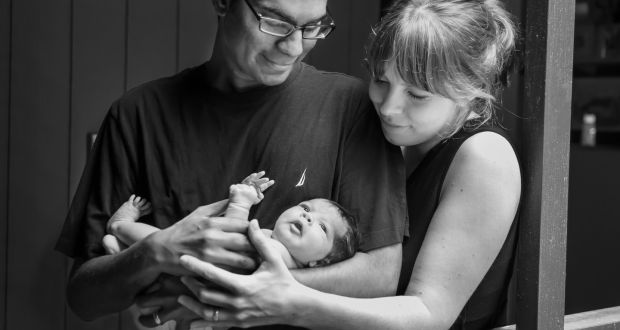
Dr. Paul Kalanithi with his family
 Brains and Brawn